Toubou people in the context of "Oases"

Play Trivia Questions online!

or

Skip to study material about Toubou people in the context of "Oases"

Ad spacer

⭐ Core Definition: Toubou people

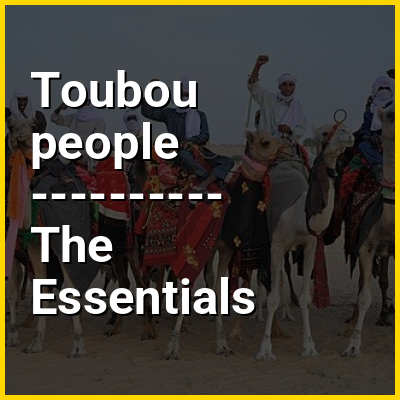
The Toubou or Tubu (from Old Tebu, meaning "rock people") are an ethnic group native to the Tibesti Mountains that inhabit the central Sahara in northern Chad, southern Libya, northeastern Niger, and northwestern Sudan. They live either as herders and nomads or as farmers near oases. Their society is clan-based, with each clan having certain oases, pastures and wells.

The Toubou are generally divided into two closely related groups: the Teda (or Tuda, Téda, Toda, Tira) and the Daza (or Dazzaga, Dazagara, Dazagada). They are believed to share a common origin and speak the Tebu languages, which are from the Saharan branch of the Nilo-Saharan language family. Tebu is divided further into two closely related languages, called Tedaga (Téda Toubou) and Dazaga (Daza Toubou). Of the two groups, the Daza, found to the south of the Teda, are more numerous.

↓ Menu

>>>PUT SHARE BUTTONS HERE<<<
In this Dossier

Toubou people in the context of Nomadic pastoralism

Nomadic pastoralism, also known as nomadic herding, is a form of pastoralism in which livestock are herded in order to seek for fresh pastures on which to graze. True nomads follow an irregular pattern of movement, in contrast with transhumance, where seasonal pastures are fixed. However, this distinction is often not observed and the term 'nomad' used for both—and in historical cases the regularity of movements is often unknown in any case. The herded livestock include cattle, water buffalo, yaks, llamas, sheep, goats, reindeer, horses, donkeys or camels, or mixtures of species. Nomadic pastoralism is commonly practiced in regions with little arable land, typically in the developing world, especially in the steppe lands north of the agricultural zone of Eurasia. Pastoralists often trade with sedentary agrarians, exchanging meat for grains; however, they have been known to raid.

Of the estimated 30–40 million nomadic pastoralists worldwide, most are found in central Asia and the Sahel region of North and West Africa, such as Fulani, Tuaregs, and Toubou, with some also in the Middle East, such as traditionally Bedouins, and in other parts of Africa, such as Nigeria and Somalia. Increasing numbers of stock may lead to overgrazing of the area and desertification if lands are not allowed to fully recover between one grazing period and the next. Increased enclosure and fencing of land has reduced the amount of land for this practice.

↑ Return to Menu

Toubou people in the context of Kanuri people

The Kanuri people (kanuri, Kanuri, also Barnawi, Yerwa, Barebari and several subgroup names) are an African ethnic group living largely in the lands of the former Kanem and Bornu Empires in Niger, Nigeria, Chad, and Cameroon, as well as a diaspora community residing in Sudan. Those generally termed Kanuri include several subgroups and dialect groups, some of whom identify as distinct from the Kanuri. Most trace their origins to ruling lineages of the medieval Kanem–Bornu Empire, and its client states or provinces. In contrast to the neighboring Toubou or Zaghawa pastoralists, Kanuri groups have traditionally been sedentary, engaging in farming, fishing the Chad Basin, trade, and salt processing.

↑ Return to Menu

Toubou people in the context of Tibesti Mountains

The Tibesti Mountains are a mountain range in the central Sahara, primarily located in the extreme north of Chad, with a small portion located in southern Libya. The highest peak in the range, Emi Koussi, lies to the south at a height of 3,415 meters (11,204 ft) and is the highest point in both Chad and the Sahara. Bikku Bitti, the highest peak in Libya, is located in the north of the range. The central third of the Tibesti is of volcanic origin and consists of five volcanoes topped by large depressions: Emi Koussi, Tarso Toon, Tarso Voon, Tarso Yega and Toussidé. Major lava flows have formed vast plateaus that overlie Paleozoic sandstone. The volcanic activity was the result of a continental hotspot that arose during the Oligocene and continued in some places until the Holocene, creating fumaroles, hot springs, mud pools and deposits of natron and sulfur. Erosion has shaped volcanic spires and carved an extensive network of canyons through which run rivers subject to highly irregular flows that are rapidly lost to the desert sands.

Tibesti, which means "place where the mountain people live", is the domain of the Toubou people. The Toubou live mainly along the wadis, on rare oases where palm trees and limited grains grow. They harness the water that collects in gueltas, the supply of which is highly variable from year-to-year and decade-to-decade. The plateaus are used to graze livestock in the winter and harvest grain in the summer. Temperatures are high, although the altitude ensures that the range is cooler than the surrounding desert. The Toubou, who were settled in the range by the 5th century BC, adapted to these conditions and turned the range into a large natural fortress. They arrived in several waves, taking refuge in times of conflict and dispersing in times of prosperity, although not without intense internal hostility at times.
↑ Return to Menu

Toubou people in the context of Daza language

Daza (also known as Dazaga) is a Nilo-Saharan language spoken by the Daza people (a sub-group of the Toubou people inhabiting northern Chad and eastern Niger). The Daza are also known as the Gouran (Gorane) in Chad. Dazaga is spoken by around 700,000 people, primarily in the Djurab Desert region and the Borkou region, locally called Haya or Faya-Largeau northern-central Chad, in Kanem there is a lot of Daza around 300,000, the capital of the Dazaga people. Dazaga is spoken in the Tibesti Mountains of Chad (606,000 speakers), in eastern Niger near N'guigmi and to the north (93,200 speakers). It is also spoken to a smaller extent in Libya and in Sudan, where there is a community of 3,000 speakers in the city of Omdurman. There's also a small diaspora community working in Jeddah, Saudi Arabia.

The two primary dialects of the Dazaga language are Daza and Kara, but there are several other mutually intelligible dialects, including Kaga, Kanobo, Taruge and Azza. It is closely related to the Tedaga language, spoken by the Teda, the other out of the two Toubou people groups, who reside primarily in the Tibesti Mountains of northern Chad and in southern Libya near the city of Sabha.

↑ Return to Menu

Toubou people in the context of Teda language

The Teda language, also known as Tedaga, Todaga, Todga, or Tudaga is a Nilo-Saharan language spoken by the Teda, a northern subgroup of the Toubou people who inhabit southern Libya, northern Chad and eastern Niger. A small number also inhabit northeastern Nigeria.

Along with the more populous southern dialect of Daza, the northern Teda dialect constitutes one of the two varieties of Tebu. However, Teda is also sometimes used for Tebu in general.

↑ Return to Menu

Toubou people in the context of Tebu languages

Tebu is a small family of two Saharan languages, consisting of Daza and Teda. It is spoken by the two groups of Toubou people, the Daza and Teda.

Tebu is predominantly spoken in Chad and in southern Libya by around 580,000 people. Daza and Teda have an estimated 537,000 and 42,500 speakers, respectively.

↑ Return to Menu