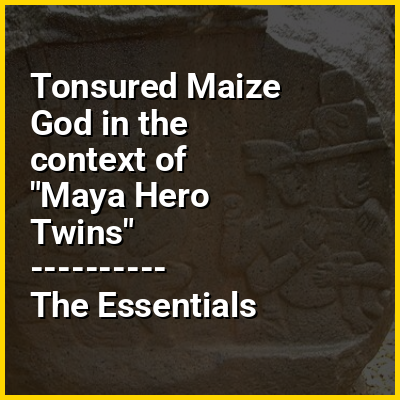
Like other Mesoamerican peoples, the Maya peoples recognize in their staple crop, maize, a vital force with which they strongly identify. This is clearly shown by their mythological traditions. In the Mesoamerican Classic period (200–900), the Maize God shows aspects of a culture hero. According to the 16th-century Popol Vuh, the Hero Twins have maize plants as alter egos and humanity was created from maize. The discovery and opening of Maize Mountain, the place where the corn seeds were hidden, remains one of the most popular tales.
HINT:
In this Dossier
- ⭐ Core Definition: Tonsured Maize God
- Tonsured Maize God in the context of Maya codices
- Tonsured Maize God in the context of Howler Monkey Gods
Tonsured Maize God in the context of Maya codices
Maya codices (sg.: codex) are folding books written by the pre-Columbian Maya civilization in Maya hieroglyphic script on Mesoamerican bark paper. The folding books are the products of professional scribes working under the patronage of deities such as the Tonsured Maize God and the Howler Monkey Gods. The codices have been named for the cities where they eventually settled. The Dresden Codex is generally considered the most important of the few that survive.
The Maya made paper from the inner bark of a certain wild fig tree, Ficus cotinifolia. This sort of paper was generally known by the word huun in Mayan languages (the Aztec people far to the north used the word āmatl [ˈaːmat͡ɬ] for paper). The Maya developed their huun-paper around the 5th century. Maya paper was more durable and a better writing surface than papyrus.
View the full Wikipedia page for Maya codicesTonsured Maize God in the context of Howler Monkey Gods
Among the Classic Mayas, the howler monkey god was a major deity of the arts—including music—and a patron of the artisans, especially of the scribes and sculptors. As such, his sphere of influence overlapped with that of the Tonsured Maize God. The monkey patrons—there are often two of them—have been depicted on classical vases in the act of writing books (while stereotypically holding an ink nap) and carving human heads. Together, these two activities may have constituted a metaphor for the creation of mankind, with the book containing the birth signs and the head the life principle or 'soul', an interpretation reinforced by the craftsman titles of the creator gods in the Popol Vuh.
Based on its facial features, the stone sculpture of a seated writer found within the House of the Scribes in Copan is often described as a howler monkey. However, it is the two large statues of simian figures shaking rattles (see fig.), found on both sides of the 'Reviewing Stand' of Copan's temple 11, that approach much more closely the standard representation of this animal in Maya art and in Long Count inscriptions (including the snakes in the corners of the mouth). Variously described as wind gods and as 'were-monkeys' and ritual clowns, these statues may actually represent howler monkeys in their quality of musicians. A ceramic incense burner modeled like a howler monkey scribe has been found at post-classic Mayapan.
View the full Wikipedia page for Howler Monkey Gods