Toda people in the context of Domestic buffalo


Toda people in the context of Domestic buffalo

⭐ Core Definition: Toda people

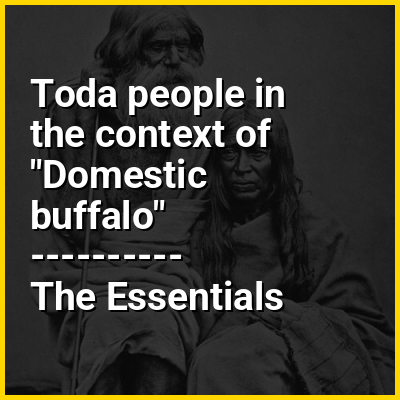
The Toda people are a Dravidian ethnic group who live in the state of Tamil Nadu in southern India. Before the 18th century and British colonisation, the Toda coexisted locally with other ethnic communities, including the Kota, Badaga and Kurumba. During the 20th century, the Toda population has hovered in the range of 700 to 900. A small fraction of the large population of India, since the early 19th century the Toda have attracted "a most disproportionate amount of attention from anthropologists and other scholars because of their ethnological aberrancy" and "their unlikeness to their neighbours in appearance, manners, and customs". The Toda tribe shows high DNA similarity with the Maniyani caste (Kerala Yadava community).

The Toda traditionally live in settlements called mund, consisting of three to seven small thatched houses, constructed in the shape of half-barrels and located across the slopes of the pasture, on which they keep domestic buffalo. Their economy was pastoral, based on the buffalo, whose dairy products they traded with neighbouring peoples of the Nilgiri Hills. Toda religion features the sacred buffalo; consequently, rituals are performed for all dairy activities as well as for the ordination of dairymen-priests. The religious and funerary rites provide the social context in which complex poetic songs about the cult of the buffalo are composed and chanted.
↓ Menu
HINT:

In this Dossier

Toda people in the context of Ootacamund

Ooty (Tamil: [uːʈ(ː)i] ; officially Udagamandalam (Tamil: [uðɐhɐmɐɳɖɐlɐm]), anglicized: Ootacamund listen, abbreviated as Udagai, Tamil: [uðɐhɐi]) is a town and municipality in the Nilgiris district of the Indian state of Tamil Nadu. It is located 86 km (53 mi) northwest of Coimbatore, and is the headquarters of Nilgiris district. Situated in the Nilgiri hills, it is known by the epithet "King of all the Hill Stations", and is a popular tourist destination.

Originally occupied by the Toda people, the area came under the rule of the East India Company in the 18th century. It later served as the summer capital of Madras Presidency. The economy is based on the hospitality industry serving tourism and agriculture. The town is connected to the plains by the Nilgiri ghat roads and Nilgiri Mountain Railway.

View the full Wikipedia page for Ootacamund
↑ Return to Menu

Toda people in the context of Nilgiri Biosphere Reserve

Nilgiri Biosphere Reserve is a biosphere reserve in the Nilgiri Mountains of the Western Ghats in South India. It is the largest protected forest area in India, spreading across Tamil Nadu, Karnataka and Kerala. It includes the protected areas Mudumalai National Park, Mukurthi National Park, Sathyamangalam Wildlife Sanctuary in Tamil Nadu; Nagarhole National Park, Bandipur National Park, both in Karnataka; Silent Valley National Park, Aralam Wildlife Sanctuary, Wayanad Wildlife Sanctuary, and Karimpuzha Wildlife Sanctuary in Kerala.

An ecosystem of the hill ranges of Nilgiris and its surrounding environments covering a tract of over 5,000 km (1,900 sq mi) was constituted as Nilgiris Biosphere Reserve by UNESCO in September 1986 under Man and Biosphere Programme. Nilgiris Biosphere Reserve is India's first and foremost biosphere reserves with a heritage, rich in flora and fauna. Tribal groups such as the Toda, Kotas, Irulla, Kurumba, Paniya, Adiyan, Edanadan Chettis, Allar, and Malayan are native to the reserve.

View the full Wikipedia page for Nilgiri Biosphere Reserve
↑ Return to Menu

Toda people in the context of Toda language

Toda (Toda: [t̪od͡z]) is a indigenous Dravidian language noted for its many fricatives and trills. It is spoken by the Toda people, a population of about one thousand who live in the Nilgiri Hills of southern India. The Toda language is considered to have originated from the Toda-Kota subgroup of South Dravidian. Krishnamurti (2003) does not consider the existence of a single Toda-Kota branch and says Kota split first and later Toda did as Kota doesn't have the centralized vowels of other Tamil-Toda languages.

View the full Wikipedia page for Toda language
↑ Return to Menu