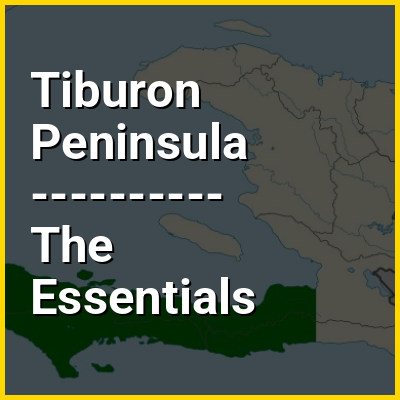
The Tiburon Peninsula (French: Péninsule de Tiburon [penɛ̃syl də tibyʁɔ̃]; Haitian Creole: Penensil Tibiwon), or simply the Tiburon (French: Tiburon; Haitian Creole: Tibiwon), is a region encompassing most of Haiti's southern coast. It starts roughly at the southernmost point of the Haiti-Dominican Republic border and extends westward near Cuba, forming a large headland. Three of Haiti's ten departments are located entirely within the region. They are the departments of Grand'Anse, Nippes and Sud. A large part of Ouest department is also located in the region, with the capital, Port-au-Prince serving as the line of demarcation between central Haiti and the south. Half of Sud-Est is also located within the Tiburon Peninsula. The mountains on the peninsula are known as the Massif de la Hotte.
- ⭐ Core Definition: Tiburon Peninsula
- Tiburon Peninsula in the context of Navassa Island
- Tiburon Peninsula in the context of Ciboney
- Tiburon Peninsula in the context of Ouest (department)
Tiburon Peninsula in the context of Navassa Island
Navassa Island (/nəˈvæsə/; Haitian Creole: Lanavaz; French: Île de la Navasse, sometimes la Navase) is an uninhabited island in the Windward Passage of the Caribbean Sea. Located east of Jamaica, south of Cuba, and 40 nautical miles (74 km; 46 mi) west of Jérémie on the Tiburon Peninsula of Haiti, it is subject to an ongoing territorial dispute between Haiti and the United States, the latter of which administers the island through the U.S. Fish and Wildlife Service.
The U.S. has claimed the island as an appurtenance since 1857, based on the Guano Islands Act of 1856. Haiti's claim over Navassa goes back to the Treaty of Ryswick in 1697 that recognized French, rather than Spanish, control of the western portion of the island of Hispaniola and other specifically named nearby islands. However, there was no mention of Navassa in the treaty detailing terms. Haiti's 1801 constitution claimed several nearby islands by name, among which Navassa was not listed, but also laid claim to "other adjacent islands", which Haiti maintains included Navassa. The U.S. claim to the island, first made in 1857, asserts that Navassa was not included among the unnamed "other adjacent islands" in the 1801 Haitian Constitution. Since the Haitian Constitution of 1874, Haiti has explicitly named "la Navase" as one of the territories it claims. It maintains that it has continuously been claimed as part of Haiti since 1801.
View the full Wikipedia page for Navassa IslandTiburon Peninsula in the context of Ciboney
The Ciboney, or Siboney, were a Taíno people of Cuba, Jamaica, and the Tiburon Peninsula of Haiti. A Western Taíno group living in Cuba during the 15th and 16th centuries, they had a dialect and culture distinct from the Classic Taíno in the eastern part of the island, though much of the Ciboney territory was under the control of the eastern chiefs. Confusion in the historical sources led 20th-century scholars to apply the name "Ciboney" to the non-Taíno Guanahatabey of western Cuba and various archaic cultures around the Caribbean, but this is deprecated.
View the full Wikipedia page for CiboneyTiburon Peninsula in the context of Ouest (department)
Ouest (French, pronounced [wɛst] ) or Lwès (Haitian Creole; both meaning "West") is one of the ten departments of Haiti. It is located in south-central Haiti, linking the Great-North and the Tiburon Peninsula.
It is the jurisdictional seat of the national capital, the city of Port-au-Prince.
View the full Wikipedia page for Ouest (department)