Théâtre des Champs-Élysées in the context of Avenue des Champs-Élysées


Théâtre des Champs-Élysées in the context of Avenue des Champs-Élysées

⭐ Core Definition: Théâtre des Champs-Élysées

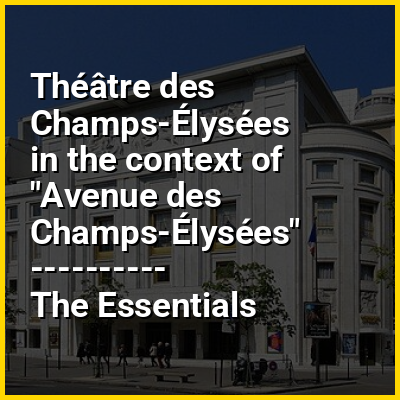
The Théâtre des Champs-Élysées (French pronunciation: [teɑtʁə de ʃɑ̃z‿elize]) is an entertainment venue standing at 15 avenue Montaigne in Paris. It is situated near Avenue des Champs-Élysées, from which it takes its name. Its eponymous main hall may seat up to 1,905 people, while the smaller Comédie and Studio des Champs-Élysées above the latter may seat 601 and 230 people respectively.

Commissioned by impresario Gabriel Astruc, the theatre was built from 1911 to 1913 upon the designs of brothers Auguste Perret and Gustave Perret following a scheme by Henry van de Velde, and became the first example of Art Deco architecture in the city. Less than two months after its inauguration, the Théâtre hosted the world premiere of the Ballets Russes' Rite of Spring, which provoked one of the most famous classical music riots.

↓ Menu
HINT:

In this Dossier

Théâtre des Champs-Élysées in the context of Art Deco in Paris

The Art Deco movement of architecture and design appeared in Paris in about 1910–12, and continued until the beginning of World War II in 1939. It took its name from the International Exposition of Modern Decorative and Industrial Arts held in Paris in 1925. It was characterized by bold geometric forms, bright colors, and highly stylized decoration, and it symbolized modernity and luxury. Art Deco architecture, sculpture, and decoration reached its peak at 1939 Exposition Internationale des Arts et Techniques dans la Vie Moderne, and in movie theaters, department stores, other public buildings. It also featured in the work of Paris jewelers, graphic artists, furniture craftsmen, and jewelers, and glass and metal design. Many Art Deco landmarks, including the Théâtre des Champs-Élysées and the Palais de Chaillot, can be seen today in Paris.

View the full Wikipedia page for Art Deco in Paris
↑ Return to Menu

Théâtre des Champs-Élysées in the context of Auguste Perret

Auguste Perret (French pronunciation: [ɔɡyst(ə) pɛʁɛ]; 12 February 1874 – 25 February 1954) was a French architect and a pioneer of the architectural use of reinforced concrete. His major works include the Théâtre des Champs-Élysées, the first Art Deco building in Paris; the Church of Notre-Dame du Raincy (1922–23); the Mobilier National in Paris (1937); and the French Economic, Social and Environmental Council building in Paris (1937–39). After World War II he designed a group of buildings in the centre of the port city of Le Havre, including St. Joseph's Church, Le Havre, to replace buildings destroyed by bombing during World War II. His reconstruction of the city is now a World Heritage Site for its exceptional urban planning and architecture.

View the full Wikipedia page for Auguste Perret
↑ Return to Menu

Théâtre des Champs-Élysées in the context of Entr'acte (film)

Entr'acte is a silent French Dada short film directed by René Clair. It premiered on 4 December 1924 at the Théâtre des Champs-Élysées in Paris as a prologue and entr'acte for the Ballets Suédois production of Relâche, based on a book by Francis Picabia, which had settings by Picabia, was produced by Rolf de Maré, and was choreographed by Jean Börlin. The music for both the ballet and the film was composed by Erik Satie.

View the full Wikipedia page for Entr'acte (film)
↑ Return to Menu

Théâtre des Champs-Élysées in the context of The Rite of Spring

The Rite of Spring (French: Le Sacre du printemps) is a ballet and orchestral concert work by the Russian composer Igor Stravinsky. It was written for the 1913 Paris season of Sergei Diaghilev's Ballets Russes company; the original choreography was by Vaslav Nijinsky with stage designs and costumes by Nicholas Roerich. When first performed at the Théâtre des Champs-Élysées on 29 May 1913, the avant-garde nature of the music and choreography caused a sensation. Many have called the first-night reaction a "riot" or "near-riot", though this wording did not come about until reviews of later performances in 1924, over a decade later. Although designed as a work for the stage, with specific passages accompanying characters and action, the music achieved equal if not greater recognition as a concert piece and is widely considered to be one of the most influential musical works of the 20th century.

Stravinsky was a young, virtually unknown composer when Diaghilev recruited him to create works for the Ballets Russes. Le Sacre du printemps was the third such major project, after the acclaimed Firebird (1910) and Petrushka (1911). The concept behind The Rite of Spring, developed by Roerich from Stravinsky's outline idea, is suggested by its subtitle, "Pictures of Pagan Russia in Two Parts"; the scenario depicts various primitive rituals celebrating the advent of spring, after which a young girl is chosen as a sacrificial victim and dances herself to death. After a mixed critical reception for its original run and a short London tour, the ballet was not performed again until the 1920s, when a version choreographed by Léonide Massine replaced Nijinsky's original, which saw only eight performances. Massine's was the forerunner of many innovative productions directed by the world's leading choreographers, gaining the work worldwide acceptance. In the 1980s, Nijinsky's original choreography, long believed lost, was reconstructed by the Joffrey Ballet in Los Angeles.

View the full Wikipedia page for The Rite of Spring
↑ Return to Menu