Three Crowned Kings in the context of "Tirunelveli"

Play Trivia Questions online!

or

Skip to study material about Three Crowned Kings in the context of "Tirunelveli"


⭐ Core Definition: Three Crowned Kings

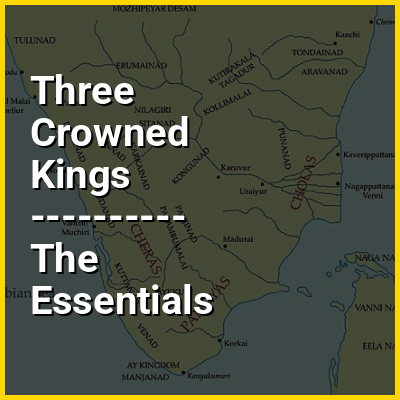
The Three Crowned Kings, were the triumvirate of Chera, Chola and Pandya who dominated the politics of the ancient Tamil country, Tamilakam, from their three Nadu (countries) of Chola Nadu, Pandya Nadu (present day Madurai and Tirunelveli) and Chera Nadu (present day Kerala and some parts of Tamil Nadu) in southern India. They signalled a time of integration and political identity for the Tamil people. They frequently waged war against one another under a period of instability and between each other, held control over Greater Tamilakam from 6th century BCE to the 13th century. After being defeated by the Pandyas, the Cholas fled to Devicottah and are later mentioned in various texts that participated in wars in the 16th century.

↓ Menu

In this Dossier

Three Crowned Kings in the context of Chera dynasty

The Chera dynasty (or Cēra, IPA: [t͡ʃeːɾɐ]), also known as Keralaputra, from the early historic or the Sangam period in southern India, ruled over parts of present-day states Kerala and Tamil Nadu. The Cheras, known as one of the mu-ventar (the Three Crowned Kings) of Tamilakam (the Tamil country) alongside the Cholas and Pandyas, have been documented as early as the third century BCE. The Chera country was geographically well placed at the tip of the Indian peninsula to profit from maritime trade via the extensive Indian Ocean networks. Exchange of spices, especially black pepper, with Middle Eastern or Graeco-Roman merchants is attested to in several sources. Chera influence extended over central Kerala and western Tamil Nadu until the end of the early historic period in southern India.

The Cheras of the early historical period (c. second century BCE – c. third/fifth century CE) had their capital in interior Tamil country (Vanchi-Karuvur or Karur, the Kongu country), and ports/capitals at Muchiri-Vanchi (Muziris) and Thondi (Tyndis) on the Indian Ocean coast of Kerala. They also controlled Palakkad Gap and the Noyyal River valley, the principal trade route between the Malabar Coast and eastern Tamil Nadu. The bow and arrow, or just the bow, was the traditional dynastic emblem of the Chera family.

↑ Return to Menu

Three Crowned Kings in the context of Pandya

The Pandya dynasty (Tamil: [paːɳɖijɐr]), also referred to as the Pandyas of Madurai, was an ancient Tamil dynasty of South India, and among the four great kingdoms of Tamilakam, the other three being the Pallavas, the Cholas and the Cheras. Existing since at least the 4th to 3rd centuries BCE, the dynasty passed through two periods of imperial dominance, the 6th to 10th centuries CE, and under the 'Later Pandyas' (13th to 14th centuries CE). In the second half of the 13th century under Jatavarman Sundara Pandyan I and Maravarman Kulasekara Pandyan I, the Pandyas ruled extensive territories including regions of present-day South India and northern Sri Lanka through vassal states subject to Madurai. The Pandya dynasty is the longest ruling dynasty in the world.

The rulers of the three Tamil dynasties were referred to as the "three crowned rulers (the mu-ventar) of the Tamil Region" in the southern part of India. The origin and the timeline of the Pandya dynasty are difficult to establish. The early Pandya chieftains ruled their country (Pandya Nadu) from the ancient period, which included the inland city of Madurai and the southern port of Korkai. The Pandyas are celebrated in the earliest available Tamil poetry (Sangam literature). Graeco-Roman accounts (as early as the 4th century BCE), the edicts of Maurya emperor Ashoka, coins with legends in Tamil-Brahmi script, and Tamil-Brahmi inscriptions suggest the continuity of the Pandya dynasty from the 3rd century BCE to the early centuries CE. The early historic Pandyas faded into obscurity upon the rise of the Kalabhra dynasty in south India.

↑ Return to Menu

Three Crowned Kings in the context of Tamil people

The Tamils (/ˈtæmɪlz, ˈtɑː-/ TAM-ilz, TAHM-), also known by their demonym Tamilar, are a Dravidian ethnic group who natively speak the Tamil language and trace their ancestry mainly to the southern part of the Indian subcontinent. Tamil is one of the longest-surviving languages, with over two thousand years of written history, dating back to the Sangam period (between 300 BCE and 300 CE). Tamils constitute about 5.7% of the Indian population and form the majority in the South Indian state of Tamil Nadu and the union territory of Puducherry. They also form significant proportions of the populations in Sri Lanka (15.3%), Malaysia (7%) and Singapore (5%). Tamils have migrated world-wide since the 19th century CE and a significant population exists in South Africa, Mauritius, Fiji, as well as other regions such as the Southeast Asia, Middle East, Caribbean and parts of the Western World.

Archaeological evidence from Tamil Nadu indicates a continuous history of human occupation for more than 3,800 years. In the Sangam period, Tamilakam was ruled by the Three Crowned Kings of the Cheras, Cholas and Pandyas. Smaller Velir kings and chieftains ruled certain territories and maintained relationship with the larger kingdoms. Urbanisation and mercantile activity developed along the coasts during the later Sangam period with the Tamils influencing the regional trade in the Indian Ocean region. Artifacts obtained from excavations indicate the presence of early trade relations with the Romans. The major kingdoms to rule the region later were the Pallavas (3rd–9th century CE), and the Vijayanagara Empire (14th–17th century CE).

↑ Return to Menu

Three Crowned Kings in the context of Chola dynasty

The Chola dynasty (Tamil: [t͡ʃoːɻɐr]) was a Tamil dynasty originating from Southern India. At its height, it ruled over the Chola Empire, an expansive maritime empire. The earliest datable references to the Chola are from inscriptions dated to the 3rd century BCE during the reign of Ashoka of the Maurya Empire. The Chola empire was at its peak and achieved imperialism under the Medieval Cholas in the mid-9th century CE. As one of the Three Crowned Kings of Tamilakam, along with the Chera and Pandya, the dynasty continued to govern over varying territories until the 13th century CE.

The heartland of the Cholas was the fertile valley of the Kaveri River. They ruled a significantly larger area at the height of their power from the latter half of the 9th century till the beginning of the 13th century. They unified peninsular India south of the Tungabhadra River and held the territory as one state for three centuries between 907 and 1215 CE. Under Rajaraja I and his successors Rajendra I, Rajadhiraja I, Rajendra II, Virarajendra, and Kulothunga Chola I, the empire became a military, economic and cultural powerhouse in South Asia and Southeast Asia.

↑ Return to Menu

Three Crowned Kings in the context of Tamil culture

Tamil culture refers to the culture of the Tamil people. The Tamils speak the Tamil language, one of the oldest languages in India with more than two thousand years of written history.

Archaeological evidence from the Tamilakam region indicates a continuous history of human occupation for more than 3,800 years. Historically, the region was inhabited by Tamil-speaking Dravidian people. It was ruled by various kingdoms such as the Sangam period (3rd century BCE to 3rd century CE) triumvirate of the Cheras, Cholas and Pandyas, the Pallavas (3rd–9th century CE), and the later Vijayanagara Empire (14th–17th century CE). European colonization began in the 17th century CE, and continued for two centuries until the Indian Independence in 1947. Due to its long history, the culture has seen multiple influences over the years and have developed diversely.

↑ Return to Menu