The Feast in the House of Levi in the context of Venetian Holy Inquisition


The Feast in the House of Levi in the context of Venetian Holy Inquisition

⭐ Core Definition: The Feast in the House of Levi

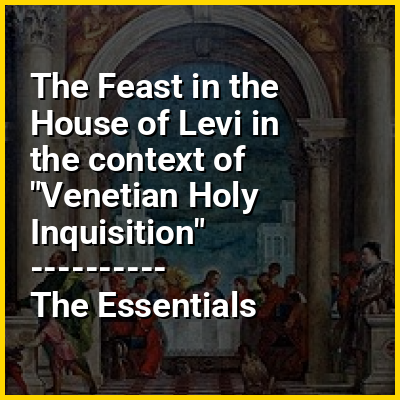
The Feast in the House of Levi or Christ in the House of Levi is a 1573 oil painting by Italian painter Paolo Veronese and one of the largest canvases of the 16th century, measuring 555 cm × 1,309 cm (18.21 ft × 42.95 ft). It is now in the Gallerie dell'Accademia, in Venice. It was painted by Veronese for a wall of a Dominican friary called the refectory of the Basilica di Santi Giovanni e Paolo.

This painting was intended to be a Last Supper, to replace an earlier work by Titian of this subject destroyed by fire in 1571. The painting is directly tied to Luke, chapter 5, of the Bible which is clear from the inscription the artist added. The painting shows a banquet taking place in which Christ is the focal point at the center of the image. However, the painting led to an investigation by the Tribunal of the Venetian Holy Inquisition. Veronese was called to answer for irreverence and indecorum, and the serious offense of heresy was mentioned.
↓ Menu
HINT:

In this Dossier

The Feast in the House of Levi in the context of Paolo Veronese

Paolo Caliari (1528 – 19 April 1588), known as Paolo Veronese (/ˌvɛrəˈnz, -zi/ VERR-ə-NAY-zay, -⁠zee, US also /-si/ -⁠see; Italian: [ˈpaːolo veroˈneːze, -eːse]), was an Italian Renaissance painter based in Venice, known for extremely large history paintings of religion and mythology, such as The Wedding at Cana (1563) and The Feast in the House of Levi (1573). Included with Titian, a generation older, and Tintoretto, a decade senior, Veronese is one of the "great trio that dominated Venetian painting of the cinquecento" and the Late Renaissance in the 16th century. Known as a supreme colorist, and after an early period with Mannerism, Paolo Veronese developed a naturalist style of painting, influenced by Titian.

His most famous works are elaborate narrative cycles, executed in a dramatic and colorful style, full of majestic architectural settings and glittering pageantry. His large paintings of biblical feasts, crowded with figures, painted for the refectories of monasteries in Venice and Verona are especially famous, and he was also the leading Venetian painter of ceilings. Most of these works remain in situ, or at least in Venice, and his representation in most museums is mainly composed of smaller works such as portraits that do not always show him at his best or most typical.

View the full Wikipedia page for Paolo Veronese
↑ Return to Menu