Tepidarium in the context of "Lawrence Alma-Tadema"

Play Trivia Questions online!

or

Skip to study material about Tepidarium in the context of "Lawrence Alma-Tadema"

Ad spacer

⭐ Core Definition: Tepidarium

The tepidarium was the warm (tepidus) bathroom of the Roman baths heated by a hypocaust or underfloor heating system. The speciality of a tepidarium is the pleasant feeling of constant radiant heat, which directly affects the human body from the walls and floor.

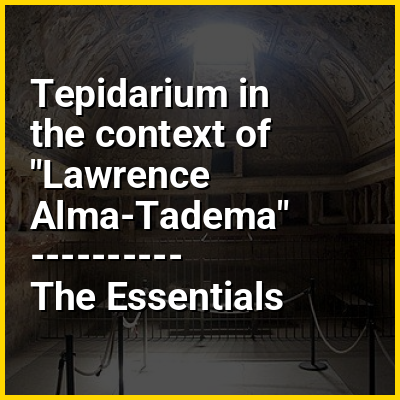
A notable example at Pompeii is covered with a semicircular barrel vault, decorated with reliefs in stucco, and round the room a series of square recesses or niches divided from one another by telamones. The tepidarium was the great central hall, around which all the other halls were grouped, and which gave the key to the plans of the thermae. It was probably the hall where the bathers first assembled prior to passing through the various hot baths (caldarium) or taking the cold bath (frigidarium). The tepidarium was decorated with the richest marbles and mosaics; it received its light through clerestory windows on the sides, the front, and the rear, and would seem to have been the hall in which the finest treasures of art were placed.
↓ Menu

>>>PUT SHARE BUTTONS HERE<<<
In this Dossier

Tepidarium in the context of Turkish bath

A hammam (Arabic: حمّام, romanizedḥammām), also often called a Turkish bath by Westerners, is a type of steam bath or a place of public bathing associated with the Islamic world. It is a prominent feature in the culture of the Muslim world and was inherited from the model of the Roman thermae. Muslim bathhouses or hammams were historically found across the Middle East, North Africa, al-Andalus (Islamic Iberia, i.e. Spain and Portugal), Central Asia, the Indian subcontinent, and in Southeastern Europe (notably Balkans and Hungary) under Ottoman rule.

In Islamic cultures the significance of the hammam was both religious and civic: it provided for the needs of ritual ablutions but also provided for general hygiene in an era before private plumbing and served other social functions such as offering a gendered meeting place for men and for women. Archeological remains attest to the existence of bathhouses in the Islamic world as early as the Umayyad period (7th–8th centuries) and their importance has persisted up to modern times. Their architecture evolved from the layout of Roman and Greek bathhouses and featured a regular sequence of rooms: an undressing room, a cold room, a warm room, and a hot room. Heat was produced by furnaces which provided hot water and steam, while smoke and hot air was channeled through conduits under the floor.

↑ Return to Menu

Tepidarium in the context of Caldarium

A caldarium (also called a calidarium, cella caldaria or cella coctilium) was a room with a hot plunge bath, used in a Roman bath complex.The boiler supplying hot water to a baths complex was also called caldarium.

This was a very hot and steamy room heated by a hypocaust, an underfloor heating system using tunnels with hot air, heated by a furnace tended by slaves. It was also the hottest room in the regular sequence of bathing rooms; after the caldarium, bathers would progress back through the tepidarium to the frigidarium.

↑ Return to Menu

Tepidarium in the context of Thermes de Cluny

The Thermes de Cluny (French pronunciation: [tɛʁm klyni]) are the ruins of Gallo-Roman thermal baths lying in the heart of Paris' 5th arrondissement, and which are partly subsumed into the Musée National du Moyen Âge - Thermes et Hôtel de Cluny.

↑ Return to Menu