Tarsier in the context of Afrotarsiidae


Tarsier in the context of Afrotarsiidae

Tarsier Study page number 1 of 1

Play TriviaQuestions Online!

or

Skip to study material about Tarsier in the context of "Afrotarsiidae"


⭐ Core Definition: Tarsier

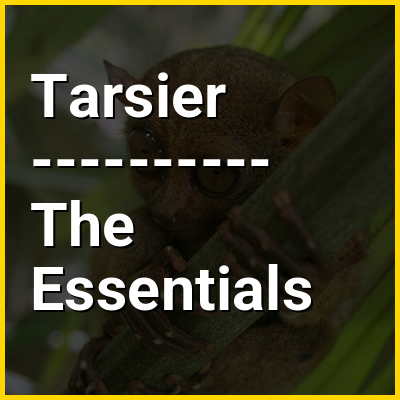
Tarsiers (/ˈtɑːrsiərz/ TAR-see-ərz) are haplorhine primates of the family Tarsiidae, which is the lone extant family within the infraorder Tarsiiformes. Although the group was prehistorically more globally widespread, all of the existing species are restricted to Maritime Southeast Asia, predominantly in Brunei, Indonesia, Malaysia and the Philippines.

They are found primarily in forested habitats, especially forests that have liana, since the vine gives tarsiers vertical support when climbing trees.

↓ Menu
HINT:

In this Dossier

Tarsier in the context of Haplorhini

Haplorhini (/hæpləˈrn/), the haplorhines (Greek for "simple-nosed") or the "dry-nosed" primates is a suborder of primates containing the tarsiers and the simians (Simiiformes or anthropoids), as sister of the Strepsirrhini ("moist-nosed"). The name is sometimes spelled Haplorrhini. The simians include catarrhines (Old World monkeys and apes, including humans), and the platyrrhines (New World monkeys).

Haplorhini was proposed by Pocock in 1918 when he realized the tarsiers were actually sister to the monkeys rather than the lemurs, also following findings of Hugh Cuming 80 years earlier and Linnaeus 160 years earlier. For Linnaeus, this ensemble of primates constituted a genus "Simia". For religious reasons, Homo constituted its own genus (which has remained).

View the full Wikipedia page for Haplorhini
↑ Return to Menu

Tarsier in the context of Tarsiiformes

Tarsiiformes /ˈtɑːrsi.ɪfɔːrmz/ are a group of primates that once ranged across Europe, northern Africa, Asia, and North America, but whose extant species are all found in the islands of Southeast Asia. Tarsiers (family Tarsiidae) are the only living members of the infraorder; other members of Tarsiidae include the extinct Tarsius eocaenus from the Eocene, and Tarsius thailandicus from the Miocene. Two extinct genera, Xanthorhysis and Afrotarsius, are considered to be close relatives of the living tarsiers, and are generally classified within Tarsiiformes, with the former grouped within family Tarsiidae, and the latter listed as incertae sedis (undefined). Omomyids are generally considered to be extinct relatives, or even ancestors, of the living tarsiers, and are often classified within Tarsiiformes.

Other fossil primates, including Microchoeridae, Carpolestidae, and Eosimiidae, have been included in this classification, although the fossil evidence is debated. Eosimiidae has also been classified under the infraorder Simiiformes (with monkeys and apes), and most experts now consider Eosimiidae to be stem simians. Likewise, Carpolestidae is often classified within the order Plesiadapiformes, a very close, extinct relative of primates.

View the full Wikipedia page for Tarsiiformes
↑ Return to Menu

Tarsier in the context of Polyphyly

A polyphyletic group is an assemblage that includes organisms with mixed evolutionary origin but does not include their most recent common ancestor. The term is often applied to groups that share similar features known as homoplasies, which are explained as a result of convergent evolution. The arrangement of the members of a polyphyletic group is called a polyphyly /ˈpɒlɪˌfli/. It is contrasted with monophyly and paraphyly.

For example, the biological characteristic of warm-bloodedness evolved separately in the ancestors of mammals and the ancestors of birds; "warm-blooded animals" is therefore a polyphyletic grouping. Other examples of polyphyletic groups are algae, C4 photosynthetic plants, and edentates.

View the full Wikipedia page for Polyphyly
↑ Return to Menu

Tarsier in the context of Monophyletic

In biological cladistics for the classification of organisms, monophyly is the condition of a taxonomic grouping being a clade – that is, a grouping of organisms which meets these criteria:

  1. the grouping contains its own most recent common ancestor (or more precisely an ancestral population), i.e. excludes non-descendants of that common ancestor
  2. the grouping contains all the descendants of that common ancestor, without exception

Monophyly is contrasted with paraphyly and polyphyly as shown in the second diagram. A paraphyletic grouping meets 1. but not 2., thus consisting of the descendants of a common ancestor, excepting one or more monophyletic subgroups. A polyphyletic grouping meets neither criterion, and instead serves to characterize convergent relationships of biological features rather than genetic relationships – for example, night-active primates, fruit trees, or aquatic insects. As such, these characteristic features of a polyphyletic grouping are not inherited from a common ancestor, but evolved independently.

View the full Wikipedia page for Monophyletic
↑ Return to Menu

Tarsier in the context of Nocturnal

Nocturnality is a behavior in some non-human animals characterized by being active during the night and sleeping during the day. The common adjective is nocturnal, with diurnal meaning the opposite.

Nocturnal creatures generally have highly developed senses of hearing, smell, and specially adapted eyesight. Some animals, such as ferrets, have eyes that can adapt to both low-level and bright day levels of illumination (see metaturnal). Others, such as bushbabies and (some) bats, can function only at night. Many nocturnal creatures including tarsiers and some owls have large eyes in comparison with their body size to compensate for the lower light levels at night. More specifically, they have been found to have a larger cornea relative to their eye size than diurnal creatures to increase their visual sensitivity: in the low-light conditions. Nocturnality helps wasps, such as Apoica flavissima, avoid hunting in intense sunlight.

View the full Wikipedia page for Nocturnal
↑ Return to Menu

Tarsier in the context of Catarrhini

The parvorder Catarrhini /kætəˈrn/ (known commonly as catarrhine monkeys, Old World anthropoids, or Old World monkeys) consists of the Cercopithecoidea (Old World monkeys) and Hominoidea (apes). In 1812, Geoffroy grouped those two groups together and established the name Catarrhini, "Old World monkeys", ("singes de l'Ancien Monde" in French). Its sister in the infraorder Simiiformes (simians) is the parvorder Platyrrhini (New World monkeys). There has been some resistance to directly designate apes (and thus humans) as monkeys despite the scientific evidence, so "Old World monkey" may be taken to mean the Cercopithecoidea or the Catarrhini. That apes are monkeys was already realized by Georges-Louis Leclerc, Comte de Buffon in the 18th century. Linnaeus placed this group in 1758 together with what we now recognise as the tarsiers and the New World monkeys, in a single genus "Simia" (sans Homo). The Catarrhini are all native to Africa and Asia. Members of this parvorder are called catarrhines.

The Catarrhini are the sister group to the New World monkeys, the Platyrrhini. Some six million years before the ape - Cercopithecoidea bifurcation, the Platyrrhini emerged within "monkeys" by migration to South America from Afro-Arabia (the Old World), likely by ocean.

View the full Wikipedia page for Catarrhini
↑ Return to Menu

Tarsier in the context of Afrotarsius

Afrotarsius is a primate found in the Paleogene of Africa.

The first species to be named, Afrotarsius chatrathi, was named in 1985 on the basis of a single lower jaw from the Oligocene of Fayum, Egypt, and tentatively referred to the tarsier family (Tarsiidae). However, this relationship immediately proved controversial, and in 1987 the animal was placed in a separate family Afrotarsiidae related to simians. A tarsier-like tibiofibula was allocated to Afrotarsius in 1998, but the identity of this bone is controversial. In 2010, a second species of the genus, Afrotarsius libycus, was named from the Eocene of Dur At-Talah, Libya, on the basis of isolated upper and lower teeth. Features of these teeth were interpreted as additional evidence for a relationship between Afrotarsius and anthropoids. A second afrotarsiid genus, Afrasia, was named in 2012 from the Eocene Pondaung Formation of Myanmar. In the same paper, Afrotarsiidae was placed together with the Asian Eosimiidae in an infraorder Eosimiiformes, in the simians. However, some studies indicate that it should be placed in Tarsiiformes.

View the full Wikipedia page for Afrotarsius
↑ Return to Menu

Tarsier in the context of Omomyid

Omomyidae is a group of early primates that radiated during the Eocene epoch between about 55 to 34 million years ago (mya). Fossil omomyids are found in North America, Europe & Asia, making it one of two groups of Eocene primates with a geographic distribution spanning holarctic continents, the other being the adapids (family Adapidae). Early representatives of the Omomyidae and Adapidae appear suddenly at the beginning of the Eocene (56 mya) in North America, Europe, and Asia, and are the earliest known crown primates.

Omomyids are generally as regarded as closely related to or within the Tarsiiformes, and thus most closely related to tarsiers among living primates.

View the full Wikipedia page for Omomyid
↑ Return to Menu

Tarsier in the context of Prosimian

Prosimians are a group of primates that includes all living and extinct strepsirrhines (lemurs, lorisoids, and adapiforms), as well as the haplorhine tarsiers and their extinct relatives, the omomyiforms, i.e. all primates excluding the simians. They are considered to have characteristics that are more "primitive" (ancestral or plesiomorphic) than those of simians (monkeys, apes, and humans).

Simians emerged within the Prosimians as sister group of the haplorhine tarsiers, and therefore cladistically belong to this group. Simians are thus distinctly closer related to tarsiers than lemurs are. Strepsirrhines bifurcated some 20 million years earlier than the tarsier–simian bifurcation. However, simians are traditionally excluded, rendering prosimians paraphyletic. Consequently, the term "prosimian" is no longer widely used in a taxonomic sense, but is still used to illustrate the behavioral ecology of tarsiers relative to the other primates.

View the full Wikipedia page for Prosimian
↑ Return to Menu

Tarsier in the context of Menstruation (mammal)

Menstruation is the shedding of the uterine lining (endometrium) in some mammals. It occurs on a regular basis in uninseminated sexually reproductive-age females of certain mammal species.

Although there is some disagreement in definitions between sources, menstruation is generally considered to be limited to primates. It is common in simians (Old World monkeys, New World monkeys, and apes), but completely lacking in strepsirrhine primates and possibly weakly present in tarsiers. Beyond primates, it is known only in bats, the elephant shrew, and the spiny mouse species Acomys cahirinus. Overt menstruation (where there is bleeding from the uterus through the vagina) is found primarily in humans and close relatives such as chimpanzees.

View the full Wikipedia page for Menstruation (mammal)
↑ Return to Menu

Tarsier in the context of Altiatlasius koulchii

Altiatlasius is an extinct genus of mammal, which may have been the oldest known primate, dating to the Late Paleocene (c.57 ma) from Morocco. The only species, Altiatlasius koulchii, was described in 1990.

Its true taxonomic position remains controversial. It has also been suggested that it should be classified as a plesiadapiform (an extinct group of arboreal mammal thought to be ancestral to primates) or that it should be recognized as a euprimate, either as an omomyid (a branch of fossil primates thought to be closely related to tarsiers), an early tarsiiform, or the oldest stem simian (monkeys and apes).

View the full Wikipedia page for Altiatlasius koulchii
↑ Return to Menu

Tarsier in the context of Archicebus

Archicebus is a genus of fossil primates that lived in the early Eocene forests (~55.8–54.8 million years ago) of what is now Jingzhou in the Hubei Province in central China, discovered in 2013. The only known species, A. achilles, was a small primate, estimated to weigh about 20–30 grams (0.7–1.1 oz), and is the only known member of the family Archicebidae. When discovered, it was the oldest fossil haplorhine primate skeleton found, appearing to be most closely related to tarsiers and the fossil omomyids, although A. achilles is suggested to have been diurnal, whereas tarsiers are nocturnal. Resembling tarsiers and simians (monkeys and apes), it was a haplorhine primate, and it also may have resembled the last common ancestor of all haplorhines.

View the full Wikipedia page for Archicebus
↑ Return to Menu