Tacuarembó (Spanish pronunciation: [takwaɾemˈbo]) is the largest department of Uruguay and it is part of its northern region. Its capital is Tacuarembó. It borders Rivera Department to its north and east, the departments of Salto, Paysandú and Río Negro to its west and has the river Río Negro flowing along its south border, separating it from the departments of Durazno and Cerro Largo.
HINT:
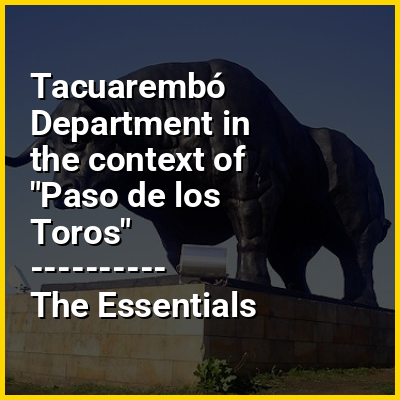
👉 Tacuarembó Department in the context of Paso de los Toros
Paso de los Toros (Bulls' Crossing) is a city of the Tacuarembó Department in Uruguay.
In this Dossier
- ⭐ Core Definition: Tacuarembó Department
- 👉 Tacuarembó Department in the context of Paso de los Toros
- Tacuarembó Department in the context of Salto Department
- Tacuarembó Department in the context of Paysandú Department
- Tacuarembó Department in the context of Río Negro Department
- Tacuarembó Department in the context of Cerro Largo Department
- Tacuarembó Department in the context of Rivera Department
- Tacuarembó Department in the context of Durazno Department
Tacuarembó Department in the context of Salto Department
Salto Department (Spanish pronunciation: [ˈsalto]) is a department of the northwestern region of Uruguay. It has an area of about 14,163 km (5,468 sq mi) and a population of about 136,197. Its capital is the city of Salto. It borders Artigas Department to its north, Paysandú Department to its south, the departments of Rivera and Tacuarembó to its east and has the Río Uruguay flowing at its west, separating it from Argentina.
View the full Wikipedia page for Salto DepartmentTacuarembó Department in the context of Paysandú Department
Paysandú Department (Spanish pronunciation: [pajsanˈdu]) is a department of the northwestern region of Uruguay. It has an area of 13,922 km (5,375 sq mi) and a population of 121,843. Its capital is the city of Paysandú. It borders Salto Department to its north, Tacuarembó Department to its east, Río Negro Department to its south and has the Río Uruguay flowing at its west, separating it from Argentina.
The origin of its name is debated but is likely to be of Charrúa origin.
View the full Wikipedia page for Paysandú DepartmentTacuarembó Department in the context of Río Negro Department
Río Negro Department (Spanish: Departamento de Río Negro, Spanish pronunciation: [ˈri.o ˈneɣɾo]) is a department of the northwestern region of Uruguay. It has an area of 9,282 km (3,584 sq mi) and a population of 57,334. Its capital is Fray Bentos. It borders Paysandú Department to the north, Tacuarembó Department to the east, Durazno Department to the southeast, Soriano Department to the south and has the Río Uruguay flowing at its west, separating it from Argentina.
View the full Wikipedia page for Río Negro DepartmentTacuarembó Department in the context of Cerro Largo Department
Cerro Largo Department (Spanish pronunciation: [ˈsero ˈlaɾɣo]) is a department of Uruguay. Its capital is Melo. It is located in the east of the country, bordering Brazil to its northeast with Yaguaron River as the natural border, Treinta y Tres Department to its south, Durazno Department to its west and the departments of Tacuarembó and Rivera to its northwest with Negro River as its natural border with them.
View the full Wikipedia page for Cerro Largo DepartmentTacuarembó Department in the context of Rivera Department
Rivera Department (Spanish pronunciation: [riˈβeɾa]) is a department of the northern region of Uruguay. It has an area of 9,370 km (3,620 sq mi) and a population of 109,300. Its capital is the city of Rivera. It borders Brazil to the north and east, Cerro Largo Department to the southeast, Tacuarembó Department to the south and west and Salto Department to the northwest.
View the full Wikipedia page for Rivera DepartmentTacuarembó Department in the context of Durazno Department
Durazno (Spanish pronunciation: [duˈɾasno]; Uruguayan Spanish: [duˈɾahno]) is a department of Uruguay. Its capital is Durazno. Its name means "peach" in Spanish, referring to the department's peaches and its status as an agricultural breadbasket. It is located in the centre of the country, and is bounded to the north by the Río Negro and the Río Yi to the South. To its north are the departments of Río Negro and Tacuarembó, to it southeast the departments of Treinta y Tres, to its south the departments of Flores and Florida, while on its east is the department of Cerro Largo.
View the full Wikipedia page for Durazno Department