Tabulating machine in the context of "Unit record equipment"

Play Trivia Questions online!

or

Skip to study material about Tabulating machine in the context of "Unit record equipment"


⭐ Core Definition: Tabulating machine

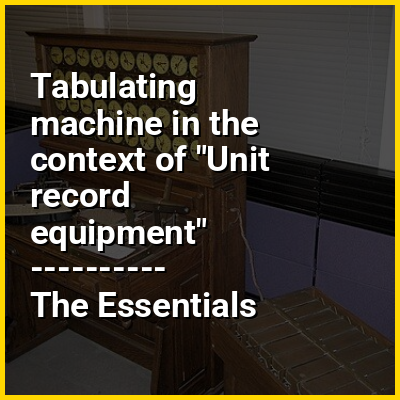
The tabulating machine was an electromechanical machine designed to assist in summarizing information stored on punched cards. Invented by Herman Hollerith, the machine was developed to help process data for the 1890 U.S. Census. Later models were widely used for business applications such as accounting and inventory control. It spawned a class of machines, known as unit record equipment, and the data processing industry.

The term "Super Computing" was used by the New York World newspaper in 1931 to refer to a large custom-built tabulator that IBM made for Columbia University.
↓ Menu

In this Dossier

Tabulating machine in the context of IBM

International Business Machines Corporation (using the trademark IBM), nicknamed Big Blue, is an American multinational technology company headquartered in Armonk, New York, and present in over 175 countries. It is a publicly traded company and one of the 30 companies in the Dow Jones Industrial Average. IBM is the largest industrial research organization in the world, with 19 research facilities across a dozen countries; for 29 consecutive years, from 1993 to 2021, it held the record for most annual U.S. patents generated by a business.

IBM was founded in 1911 as the Computing-Tabulating-Recording Company (CTR), a holding company of manufacturers of record-keeping and measuring systems. It was renamed "International Business Machines" in 1924 and soon became the leading manufacturer of punch-card tabulating systems. During the 1960s and 1970s, the IBM mainframe, exemplified by the System/360 and its successors, was the world's dominant computing platform, with the company producing 80 percent of computers in the U.S. and 70 percent of computers worldwide. Embracing both business and scientific computing, System/360 was the first family of computers designed to cover a complete range of applications from small to large.

↑ Return to Menu

Tabulating machine in the context of Computing-Tabulating-Recording Company

The Computing-Tabulating-Recording Company (CTR) was a holding company of manufacturers of record-keeping and measuring systems. The company would ultimately become known as IBM.

In 1911, the financier and noted trust organizer Charles R. Flint, called the "Father of Trusts", amalgamated (via stock acquisition) four companies: Bundy Manufacturing Company, International Time Recording Company, the Tabulating Machine Company, and the Computing Scale Company of America; creating a fifth company – the Computing-Tabulating-Recording Company.

↑ Return to Menu

Tabulating machine in the context of International Business Machines

International Business Machines Corporation, doing business as IBM (nicknamed Big Blue), is an American multinational technology company headquartered in Armonk, New York, and present in over 175 countries. It is a publicly traded company and one of the 30 companies in the Dow Jones Industrial Average. IBM is the largest industrial research organization in the world, with 19 research facilities across a dozen countries; for 29 consecutive years, from 1993 to 2021, it held the record for most annual U.S. patents generated by a business.

IBM was founded in 1911 as the Computing-Tabulating-Recording Company (CTR), a holding company of manufacturers of record-keeping and measuring systems. It was renamed "International Business Machines" in 1924 and soon became the leading manufacturer of punch-card tabulating systems. During the 1960s and 1970s, the IBM mainframe, exemplified by the System/360 and its successors, was the world's dominant computing platform, with the company producing 80 percent of computers in the U.S. and 70 percent of computers worldwide. Embracing both business and scientific computing, System/360 was the first family of computers designed to cover a complete range of applications from small to large.

↑ Return to Menu

Tabulating machine in the context of Voting machine

A voting machine is a machine used to record votes in an election without paper. The first voting machines were mechanical but it is increasingly more common to use electronic voting machines. Traditionally, a voting machine has been defined by its mechanism, and whether the system tallies votes at each voting location, or centrally. Voting machines should not be confused with tabulating machines, which count votes done by paper ballot.

Voting machines differ in usability, security, cost, speed, accuracy, and ability of the public to oversee elections. Machines may be more or less accessible to voters with different disabilities.

↑ Return to Menu