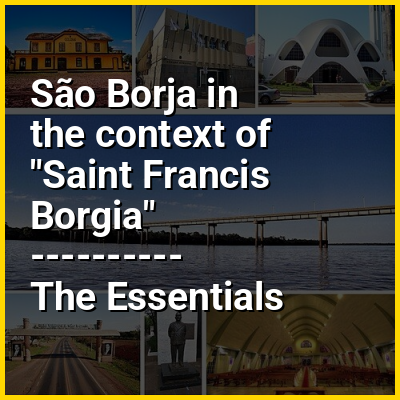
São Borja is a city in the Brazilian state of Rio Grande do Sul. São Borja is the oldest municipality in the Brazilian state of Rio Grande do Sul and was founded in 1682 by the Jesuits as the first of the Seven Places of the Missions, and named São Francisco de Borja, in honor of Saint Francis Borgia.
HINT:
In this Dossier
- ⭐ Core Definition: São Borja
- São Borja in the context of Riograndense Republic
- São Borja in the context of Getúlio Vargas
São Borja in the context of Riograndense Republic
The Riograndense Republic, often called the Piratini Republic (Portuguese: República Rio-Grandense or República do Piratini), was a de facto state that seceded from the Empire of Brazil and roughly coincided with the present state of Rio Grande do Sul. It was proclaimed on 11 September 1836 by general Antônio de Sousa Neto as a direct consequence of the victory obtained by gaúcho oligarchic forces at the Battle of Seival (1836) during the Ragamuffin War (1835–1845). It had a constitution adopted in 1843 and was recognised only by the United Kingdom, France, and Uruguay.
In 1839, the Riograndense Republic formed a confederation with the short-lived Juliana Republic (Portuguese: República Juliana) which proclaimed its independence in the same year. November 1839, however, saw the war result in the defeat and disappearance of the Juliana Republic. The Riograndense Republic had five capitals during its nearly nine years of existence: the cities of Piratini (for which it is often called Piratini Republic), Alegrete, Caçapava do Sul (official capitals), Bagé (for only two weeks), and São Borja. The war between the Gaúchos and the Brazilian Empire was ended by the Ponche Verde Treaty.
View the full Wikipedia page for Riograndense RepublicSão Borja in the context of Getúlio Vargas
Getúlio Dornelles Vargas (19 April 1882 – 24 August 1954) was a Brazilian lawyer and politician who served as the 14th and 17th president of Brazil, from 1930 to 1945 and from 1951 until his suicide in 1954. Due to his long and controversial tenure as Brazil's provisional, constitutional, dictatorial and democratic leader, he is considered by historians as the most influential Brazilian politician of the 20th century.
Born on 19 April 1882 in São Borja, Rio Grande do Sul, to a powerful local family, Vargas had a short stint in the Brazilian Army before entering law school. He began his political career as district attorney, soon becoming a state deputy prior to a brief departure from politics. After returning to the state Legislative Assembly, Vargas led troops during Rio Grande do Sul's 1923 civil war. He entered national politics as a member of the Chamber of Deputies. Afterward, Vargas served as Minister of Finance under president Washington Luís before resigning to head Rio Grande do Sul as state president, during which he had an active tenure and introduced many policies.
View the full Wikipedia page for Getúlio Vargas