Sydney Harbour Bridge in the context of "Sydney Opera House"

Play Trivia Questions online!

or

Skip to study material about Sydney Harbour Bridge in the context of "Sydney Opera House"

Ad spacer

⭐ Core Definition: Sydney Harbour Bridge

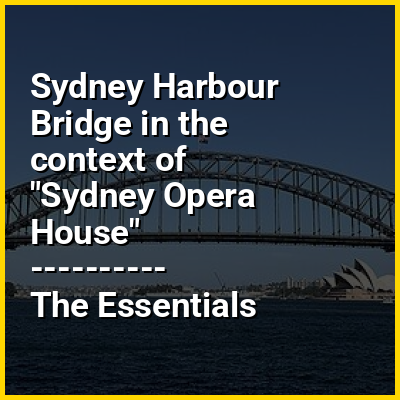
The Sydney Harbour Bridge is a steel through arch bridge in Sydney, New South Wales, Australia, spanning Sydney Harbour from the central business district (CBD) to the North Shore. The view of the bridge, the Harbour, and the nearby Sydney Opera House is widely regarded as an iconic image of Sydney, and of Australia itself. Nicknamed "the Coathanger" because of its arch-based design, the bridge carries rail, vehicular, bicycle and pedestrian traffic.

Under the direction of John Bradfield of the New South Wales Department of Public Works, the bridge was designed and built by British firm Dorman Long of Middlesbrough, and opened in 1932. The bridge's general design, which Bradfield tasked the NSW Department of Public Works with producing, was a rough copy of the Hell Gate Bridge in New York City. The design chosen from the tender responses was original work created by Dorman Long, who leveraged some of the design from its own Tyne Bridge.
↓ Menu

>>>PUT SHARE BUTTONS HERE<<<
In this Dossier

Sydney Harbour Bridge in the context of Circular Quay

Circular Quay is a harbour, former working port and now international passenger shipping terminal, public piazza and tourism precinct, heritage area, and transport node located in Sydney, New South Wales, Australia, on the northern edge of the Sydney central business district on Sydney Cove, between Bennelong Point and The Rocks. It is part of the local government area of the City of Sydney.

The Circular Quay area is a popular neighbourhood for tourism and consists of walkways, pedestrian malls, parks and restaurants. It hosts a number of ferry wharves, bus stops, and a railway station. Often referred to as the "gateway to Sydney", the precinct has views of the Sydney Harbour Bridge and the Sydney Opera House and is a common location for viewing Sydney New Year's Eve fireworks.

↑ Return to Menu

Sydney Harbour Bridge in the context of Sydney Harbour

Port Jackson, commonly known as Sydney Harbour, is a natural harbour on the east coast of Australia, around which Sydney was built. It consists of the waters of Sydney Harbour, Middle Harbour, North Harbour and the Lane Cove and Parramatta Rivers. The harbour is an inlet of the Tasman Sea (part of the South Pacific Ocean). It is the location of significant landmarks such as the Sydney Opera House and Sydney Harbour Bridge. The location of the first European settlement and colony on the Australian mainland, Port Jackson has continued to play a key role in the history and development of Sydney.

Port Jackson, in the early days of the colony, was also used as a shorthand for Sydney and its environs. Thus, many botanists, see, e.g., Robert Brown's Prodromus Florae Novae Hollandiae et Insulae Van Diemen, described their specimens as having been collected at Port Jackson.

↑ Return to Menu

Sydney Harbour Bridge in the context of Philippe Petit

Philippe Petit (French pronunciation: [filip pəti]; born 13 August 1949) is a French highwire artist who gained fame for his unauthorized highwire walks between the towers of Notre-Dame Cathedral in Paris in 1971 and of Sydney Harbour Bridge in 1973, as well as between the Twin Towers of the World Trade Center in New York City on August 7, 1974.

Since then, Petit has lived in New York, where he has been artist-in-residence at the Cathedral of St. John the Divine, another site of his aerial performances. He has done wire walking as part of official celebrations in New York, across the United States, and in France and other countries, as well as teaching workshops on the art. In 2008, Man on Wire, a documentary directed by James Marsh about Petit's walk between the towers, won numerous awards including the 2009 Academy Award for Best Documentary Feature. The Walk, a film based on Petit's walk, was released in September 2015, starring Joseph Gordon-Levitt as Petit and directed by Robert Zemeckis. Petit was also the subject of a children's book and an animated adaptation of it, released in 2005.

↑ Return to Menu

Sydney Harbour Bridge in the context of Sydney Cove

Sydney Cove (Eora: Warrane) is a bay on the southern shore of Sydney Harbour, one of several harbours in Port Jackson, on the coast of Sydney, New South Wales. Sydney Cove is a focal point for community celebrations, due to its central Sydney location between the Sydney Opera House and the Sydney Harbour Bridge.

Sydney Cove was the site of the First Fleet's landing on 26 January 1788 and the subsequent raising of the Union Jack, a seminal date in Australian history now marked as Australia Day.

↑ Return to Menu

Sydney Harbour Bridge in the context of Tourism in Sydney

Tourism in Sydney forms an important part of the city's economy. The city received 12 million domestic visitors and 4.1 million international visitors in year ending June 2019. The most famous attractions include the Sydney Opera House, and the Sydney Harbour Bridge. Other attractions include the Sydney Mardi Gras, Royal Botanical Gardens, Luna Park, the beaches and Sydney Tower.

↑ Return to Menu

Sydney Harbour Bridge in the context of Sydney New Year's Eve

Sydney New Year's Eve is an annual New Year's Eve fireworks event in Sydney, New South Wales, Australia. The event currently consists of two fireworks shows, with an evening display known as the Calling Country Fireworks (formerly, the Family Fireworks) held at 9:00 p.m. AEDT, and the main Midnight Fireworks, held at 12:00 a.m. Fireworks are launched from barges in Port Jackson, as well as nearby landmarks such as the Sydney Opera House, and the Sydney Harbour Bridge, which serves as the main focal point of the show via lighting and pyrotechnic effects.

As one of the first major cities to celebrate the New Year, the event is widely-viewed in Australia and worldwide. Organizers have estimated the annual in-person attendance of the event to be around 1.5 to 1.6 million, with tourists accounting for a large portion of its attendees. Some locations, such as the Royal Botanic Garden, host ticketed seating areas.

↑ Return to Menu

Sydney Harbour Bridge in the context of List of road–rail bridges

Road–rail bridges are bridges shared by road transport and rail transport. They are sometimes called combined bridges.

The road and rail on these bridges may be segregated, so that railway vehicles may operate at the same time as road vehicles (e.g., the Sydney Harbour Bridge). The rail tracks can be above the roadway, or vice versa (e.g., a truss bridge).

↑ Return to Menu