Swarm in the context of "Swarm robotics"

Play Trivia Questions online!

or

Skip to study material about Swarm in the context of "Swarm robotics"


⭐ Core Definition: Swarm

Swarm behaviour, or swarming, is a collective behaviour exhibited by entities, particularly animals, of similar size which aggregate together, perhaps milling about the same spot or perhaps moving en masse or migrating in some direction. It is a highly interdisciplinary topic.

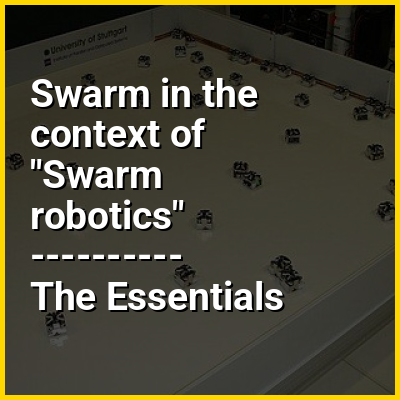
As a term, swarming is applied particularly to insects, but can also be applied to any other entity or animal that exhibits swarm behaviour. The term flocking or murmuration can refer specifically to swarm behaviour in birds, herding to refer to swarm behaviour in tetrapods, and shoaling or schooling to refer to swarm behaviour in fish. Phytoplankton also gather in huge swarms called blooms, although these organisms are algae and are not self-propelled the way most animals are. By extension, the term "swarm" is applied also to inanimate entities which exhibit parallel behaviours, as in a robot swarm, an earthquake swarm or a star swarm.
↓ Menu

In this Dossier

Swarm in the context of Antarctic krill

Antarctic krill (Euphausia superba) is a species of krill found in the Antarctic waters of the Southern Ocean. It is a small, swimming crustacean that lives in large schools, called swarms, sometimes reaching densities of 10,000–30,000 animals per cubic metre. It feeds directly on minute phytoplankton, thereby using the primary production energy that phytoplankton originally derive from the sun in order to sustain its pelagic life cycle. It grows to a length of 6 centimetres (2.4 in), weighs up to 2 grams (0.071 oz), and can live for up to six years. A key species in the Antarctic ecosystem and in terms of biomass, E. superba is one of the most abundant animal species on the planet, with a cumulative biomass of approximately 500 million metric tons (550 million short tons; 490 million long tons).

↑ Return to Menu

Swarm in the context of Locust

Locusts (derived from the Latin locusta, locust or lobster) are various species of short-horned grasshoppers in the family Acrididae that have a swarming phase. These insects are usually solitary, but under certain circumstances they become more abundant and change their behaviour and habits, becoming gregarious. No taxonomic distinction is made between locust and grasshopper species; the basis for the definition is whether a species forms swarms under intermittently suitable conditions; this has evolved independently in multiple lineages, comprising at least 18 genera in 5 different subfamilies.

Normally, these grasshoppers are innocuous, their numbers are low, and they do not pose a major economic threat to agriculture. However, under suitable conditions of drought followed by rapid vegetation growth, serotonin in their brains triggers dramatic changes: they start to breed abundantly, becoming gregarious and nomadic (loosely described as migratory) when their populations become dense enough. They form bands of wingless nymphs that later become swarms of winged adults. Both the bands and the swarms move around, rapidly strip fields, and damage crops. The adults are powerful fliers; they can travel great distances, consuming most of the green vegetation wherever the swarm settles.

↑ Return to Menu