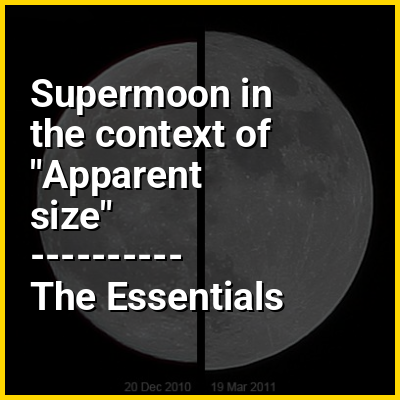
Supermoon in the context of "Apparent size"

Play Trivia Questions online!

or

Skip to study material about Supermoon in the context of "Apparent size"

Ad spacer

⭐ Core Definition: Supermoon

A supermoon is a full moon or a new moon that nearly coincides with perigee—the closest that the Moon comes to the Earth in its orbit—resulting in a slightly larger-than-usual apparent size of the lunar disk as viewed from Earth.‍ The technical name is a perigee syzygy (of the Earth–Moon–Sun system) or a full (or new) Moon around perigee.‍ Because the term supermoon is astrological in origin, it has no precise astronomical definition.‍

The association of the Moon with both oceanic and crustal tides has led to claims that the supermoon phenomenon may be associated with increased risk of events like earthquakes and volcanic eruptions, but no such link has been found.‍

↓ Menu

>>>PUT SHARE BUTTONS HERE<<<
In this Dossier

Supermoon in the context of Full moon

The full moon is the lunar phase when the Moon appears fully illuminated from Earth's perspective. This occurs when Earth is located between the Sun and the Moon (when the ecliptic longitudes of the Sun and Moon differ by 180°). This means that the lunar hemisphere facing Earth—the near side—is completely sunlit and appears as an approximately circular disk. The full moon occurs roughly once a month.

The time interval between a full moon and the next repetition of the same phase, a synodic month, averages about 29.53 days. Because of irregularities in the moon's orbit, the new and full moons may fall up to thirteen hours either side of their mean. If the calendar date is not locally determined through observation of the new moon at the beginning of the month there is the potential for a further twelve hours difference depending on the time zone. Potential discrepancies also arise from whether the calendar day is considered to begin in the evening or at midnight. It is normal for the full moon to fall on the fourteenth or the fifteenth of the month according to whether the start of the month is reckoned from the appearance of the new moon or from the conjunction.

↑ Return to Menu