Staveless runes in the context of Hälsingland


Staveless runes in the context of Hälsingland

⭐ Core Definition: Staveless runes

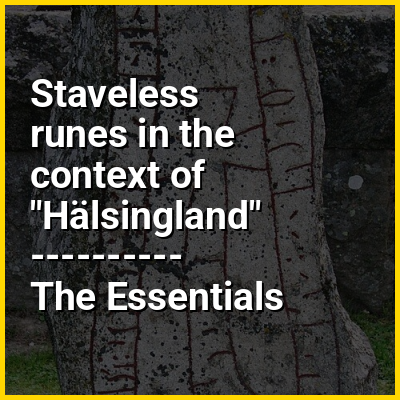
Staveless runes were the climax of the simplification process in the evolution of runic alphabets that had started when the Elder Futhark was superseded by the Younger Futhark. To create the staveless runes, vertical marks (or staves) were dropped from individual letters (or runes). The name "staveless" is not entirely accurate, since the i rune consists of a whole stave and the f, þ, k and the s runes consist of shortened main staves.

Since their discovery on runestones at Hälsingland in the 17th century, staveless runes have also been known as the Hälsinge runes. This label is, however, misleading since staveless runes also appear in Medelpad, Södermanland, and the Norwegian town of Bergen.
↓ Menu
HINT:

In this Dossier

Staveless runes in the context of Younger Futhark

The Younger Futhark (/ˈfðɑːrk/), also called Scandinavian runes, is a runic alphabet and a reduced form of the Elder Futhark, with only 16 characters, in use from about the 9th century, after a "transitional period" during the 7th and 8th centuries.The reduction happened at the same time as phonetic changes that led to a greater number of different phonemes in the spoken language, when Proto-Norse evolved into Old Norse. Also, the writing custom avoided carving the same rune consecutively for the same sound, so the spoken distinction between long and short vowels was lost in writing. Thus, the language included distinct sounds and minimal pairs that were written the same.

The Younger Futhark is divided into long-branch (Danish) and short-twig (Swedish and Norwegian) runes; in the 10th century, it was further expanded by the "Hälsinge Runes" or staveless runes.

View the full Wikipedia page for Younger Futhark
↑ Return to Menu