A statistical model is a mathematical model that embodies a set of statistical assumptions concerning the generation of sample data (and similar data from a larger population). A statistical model represents, often in considerably idealized form, the data-generating process. When referring specifically to probabilities, the corresponding term is probabilistic model. All statistical hypothesis tests and all statistical estimators are derived via statistical models. More generally, statistical models are part of the foundation of statistical inference. A statistical model is usually specified as a mathematical relationship between one or more random variables and other non-random variables. As such, a statistical model is "a formal representation of a theory" (Herman Adèr quoting Kenneth Bollen).

- ⭐ Core Definition: Statistical model
- Statistical model in the context of Statistics
- Statistical model in the context of Likelihood
- Statistical model in the context of Equilibrium distribution
- Statistical model in the context of Regression analysis
- Statistical model in the context of Maximum likelihood estimation
- Statistical model in the context of Exploratory data analysis
- Statistical model in the context of Regression coefficient
- Statistical model in the context of Relative likelihood
- Statistical model in the context of Data mining
- Statistical model in the context of Generative model
- Statistical model in the context of Bayesian statistics
- Statistical model in the context of Plant disease epidemiology
- Statistical model in the context of Econometric model
Statistical model in the context of Statistics
Statistics (from German: Statistik, orig. "description of a state, a country") is the discipline that concerns the collection, organization, analysis, interpretation, and presentation of data. In applying statistics to a scientific, industrial, or social problem, it is conventional to begin with a statistical population or a statistical model to be studied. Populations can be diverse groups of people or objects such as "all people living in a country" or "every atom composing a crystal". Statistics deals with every aspect of data, including the planning of data collection in terms of the design of surveys and experiments.
When census data (comprising every member of the target population) cannot be collected, statisticians collect data by developing specific experiment designs and survey samples. Representative sampling assures that inferences and conclusions can reasonably extend from the sample to the population as a whole. An experimental study involves taking measurements of the system under study, manipulating the system, and then taking additional measurements using the same procedure to determine if the manipulation has modified the values of the measurements. In contrast, an observational study does not involve experimental manipulation.
View the full Wikipedia page for StatisticsStatistical model in the context of Likelihood
A likelihood function (often simply called the likelihood) measures how well a statistical model explains observed data by calculating the probability of seeing that data under different parameter values of the model. It is constructed from the joint probability distribution of the random variable that (presumably) generated the observations. When evaluated on the actual data points, it becomes a function solely of the model parameters.
In maximum likelihood estimation, the model parameter(s) or argument that maximizes the likelihood function serves as a point estimate for the unknown parameter, while the Fisher information (often approximated by the likelihood's Hessian matrix at the maximum) gives an indication of the estimate's precision.
View the full Wikipedia page for LikelihoodStatistical model in the context of Equilibrium distribution
In probability theory and statistics, a Markov chain or Markov process is a stochastic process describing a sequence of possible events in which the probability of each event depends only on the state attained in the previous event. Informally, this may be thought of as, "What happens next depends only on the state of affairs now." A countably infinite sequence, in which the chain moves state at discrete time steps, gives a discrete-time Markov chain (DTMC). A continuous-time process is called a continuous-time Markov chain (CTMC). Markov processes are named in honor of the Russian mathematician Andrey Markov.
Markov chains have many applications as statistical models of real-world processes. They provide the basis for general stochastic simulation methods known as Markov chain Monte Carlo, which are used for simulating sampling from complex probability distributions, and have found application in areas including Bayesian statistics, biology, chemistry, economics, finance, information theory, physics, signal processing, and speech processing.
View the full Wikipedia page for Equilibrium distributionStatistical model in the context of Regression analysis
In statistical modeling, regression analysis is a statistical method for estimating the relationship between a dependent variable (often called the outcome or response variable, or a label in machine learning parlance) and one or more independent variables (often called regressors, predictors, covariates, explanatory variables or features).
The most common form of regression analysis is linear regression, in which one finds the line (or a more complex linear combination) that most closely fits the data according to a specific mathematical criterion. For example, the method of ordinary least squares computes the unique line (or hyperplane) that minimizes the sum of squared differences between the true data and that line (or hyperplane). For specific mathematical reasons (see linear regression), this allows the researcher to estimate the conditional expectation (or population average value) of the dependent variable when the independent variables take on a given set of values. Less common forms of regression use slightly different procedures to estimate alternative location parameters (e.g., quantile regression or Necessary Condition Analysis) or estimate the conditional expectation across a broader collection of non-linear models (e.g., nonparametric regression).
View the full Wikipedia page for Regression analysisStatistical model in the context of Maximum likelihood estimation
In statistics, maximum likelihood estimation (MLE) is a method of estimating the parameters of an assumed probability distribution, given some observed data. This is achieved by maximizing a likelihood function so that, under the assumed statistical model, the observed data is most probable. The point in the parameter space that maximizes the likelihood function is called the maximum likelihood estimate. The logic of maximum likelihood is both intuitive and flexible, and as such the method has become a dominant means of statistical inference.
If the likelihood function is differentiable, the derivative test for finding maxima can be applied. In some cases, the first-order conditions of the likelihood function can be solved analytically; for instance, the ordinary least squares estimator for a linear regression model maximizes the likelihood when the random errors are assumed to have normal distributions with the same variance.
View the full Wikipedia page for Maximum likelihood estimationStatistical model in the context of Exploratory data analysis
In statistics, exploratory data analysis (EDA) or exploratory analytics is an approach of analyzing data sets to summarize their main characteristics, often using statistical graphics and other data visualization methods. A statistical model can be used or not, but primarily EDA is for seeing what the data can tell beyond the formal modeling and thereby contrasts with traditional hypothesis testing, in which a model is supposed to be selected before the data is seen. Exploratory data analysis has been promoted by John Tukey since 1970 to encourage statisticians to explore the data, and possibly formulate hypotheses that could lead to new data collection and experiments. EDA is different from initial data analysis (IDA), which focuses more narrowly on checking assumptions required for model fitting and hypothesis testing, and handling missing values and making transformations of variables as needed. EDA encompasses IDA.
View the full Wikipedia page for Exploratory data analysisStatistical model in the context of Regression coefficient
In statistics, linear regression is a model that estimates the relationship between a scalar response (dependent variable) and one or more explanatory variables (regressor or independent variable). A model with exactly one explanatory variable is a simple linear regression; a model with two or more explanatory variables is a multiple linear regression. This term is distinct from multivariate linear regression, which predicts multiple correlated dependent variables rather than a single dependent variable.
In linear regression, the relationships are modeled using linear predictor functions whose unknown model parameters are estimated from the data. Most commonly, the conditional mean of the response given the values of the explanatory variables (or predictors) is assumed to be an affine function of those values; less commonly, the conditional median or some other quantile is used. Like all forms of regression analysis, linear regression focuses on the conditional probability distribution of the response given the values of the predictors, rather than on the joint probability distribution of all of these variables, which is the domain of multivariate analysis.
View the full Wikipedia page for Regression coefficientStatistical model in the context of Relative likelihood
In statistics, when selecting a statistical model for given data, the relative likelihood compares the relative plausibilities of different candidate models or of different values of a parameter of a single model.
View the full Wikipedia page for Relative likelihoodStatistical model in the context of Data mining
Data mining is the process of extracting and finding patterns in massive data sets involving methods at the intersection of machine learning, statistics, and database systems. Data mining is an interdisciplinary subfield of computer science and statistics with an overall goal of extracting information (with intelligent methods) from a data set and transforming the information into a comprehensible structure for further use. Data mining is the analysis step of the "knowledge discovery in databases" process, or KDD. Aside from the raw analysis step, it also involves database and data management aspects, data pre-processing, model and inference considerations, interestingness metrics, complexity considerations, post-processing of discovered structures, visualization, and online updating.
The term "data mining" is a misnomer because the goal is the extraction of patterns and knowledge from large amounts of data, not the extraction (mining) of data itself. It also is a buzzword and is frequently applied to any form of large-scale data or information processing (collection, extraction, warehousing, analysis, and statistics) as well as any application of computer decision support systems, including artificial intelligence (e.g., machine learning) and business intelligence. Often the more general terms (large scale) data analysis and analytics—or, when referring to actual methods, artificial intelligence and machine learning—are more appropriate.
View the full Wikipedia page for Data miningStatistical model in the context of Generative model
In statistical classification, two main approaches are called the generative approach and the discriminative approach. These compute classifiers by different approaches, differing in the degree of statistical modelling. Terminology is inconsistent, but three major types can be distinguished:
- A generative model is a statistical model of the joint probability distribution on a given observable variable X and target variable Y; A generative model can be used to "generate" random instances (outcomes) of an observation x.
- A discriminative model is a model of the conditional probability of the target Y, given an observation x. It can be used to "discriminate" the value of the target variable Y, given an observation x.
- Classifiers computed without using a probability model are also referred to loosely as "discriminative".

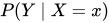
The distinction between these last two classes is not consistently made; Jebara (2004) refers to these three classes as generative learning, conditional learning, and discriminative learning, but Ng & Jordan (2002) only distinguish two classes, calling them generative classifiers (joint distribution) and discriminative classifiers (conditional distribution or no distribution), not distinguishing between the latter two classes. Analogously, a classifier based on a generative model is a generative classifier, while a classifier based on a discriminative model is a discriminative classifier, though this term also refers to classifiers that are not based on a model.
View the full Wikipedia page for Generative modelStatistical model in the context of Bayesian statistics
Bayesian statistics (/ˈbeɪziən/ BAY-zee-ən or /ˈbeɪʒən/ BAY-zhən) is a theory in the field of statistics based on the Bayesian interpretation of probability, where probability expresses a degree of belief in an event. The degree of belief may be based on prior knowledge about the event, such as the results of previous experiments, or on personal beliefs about the event. This differs from a number of other interpretations of probability, such as the frequentist interpretation, which views probability as the limit of the relative frequency of an event after many trials. More concretely, analysis in Bayesian methods codifies prior knowledge in the form of a prior distribution.
Bayesian statistical methods use Bayes' theorem to compute and update probabilities after obtaining new data. Bayes' theorem describes the conditional probability of an event based on data as well as prior information or beliefs about the event or conditions related to the event. For example, in Bayesian inference, Bayes' theorem can be used to estimate the parameters of a probability distribution or statistical model. Since Bayesian statistics treats probability as a degree of belief, Bayes' theorem can directly assign a probability distribution that quantifies the belief to the parameter or set of parameters.
View the full Wikipedia page for Bayesian statisticsStatistical model in the context of Plant disease epidemiology
Plant disease epidemiology is the study of disease in plant populations. Much like diseases of humans and other animals, plant diseases occur due to pathogens such as bacteria, viruses, fungi, oomycetes, nematodes, phytoplasmas, protozoa, and parasitic plants. Plant disease epidemiologists strive for an understanding of the cause and effects of disease and develop strategies to intervene in situations where crop losses may occur. Destructive and non-destructive methods are used to detect diseases in plants. Additionally, understanding the responses of the immune system in plants will further benefit and limit the loss of crops. Typically successful intervention will lead to a low enough level of disease to be acceptable, depending upon the value of the crop.
Plant disease epidemiology is often looked at from a multi-disciplinary approach, requiring biological, statistical, agronomic and ecological perspectives. Biology is necessary for understanding the pathogen and its life cycle. It is also necessary for understanding the physiology of the crop and how the pathogen is adversely affecting it. Agronomic practices often influence disease incidence for better or for worse. Ecological influences are numerous. Native species of plants may serve as reservoirs for pathogens that cause disease in crops. Statistical models are often applied in order to summarize and describe the complexity of plant disease epidemiology, so that disease processes can be more readily understood. For example, comparisons between patterns of disease progress for different diseases, cultivars, management strategies, or environmental settings can help in determining how plant diseases may best be managed. Policy can be influential in the occurrence of diseases, through actions such as restrictions on imports from sources where a disease occurs.
View the full Wikipedia page for Plant disease epidemiologyStatistical model in the context of Econometric model
Econometric models are statistical models used in econometrics. An econometric model specifies the statistical relationship that is believed to hold between the various economic quantities pertaining to a particular economic phenomenon. An econometric model can be derived from a deterministic economic model by allowing for uncertainty, or from an economic model which itself is stochastic. However, it is also possible to use econometric models that are not tied to any specific economic theory.
A simple example of an econometric model is one that assumes that monthly spending by consumers is linearly dependent on consumers' income in the previous month. Then the model will consist of the equation
View the full Wikipedia page for Econometric model