Staraya Ladoga in the context of "Volkhovsky District"

Play Trivia Questions online!

or

Skip to study material about Staraya Ladoga in the context of "Volkhovsky District"


⭐ Core Definition: Staraya Ladoga

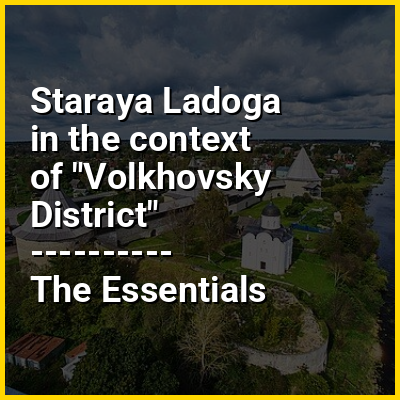
Staraya Ladoga (Russian: Ста́рая Ла́дога, romanized: Stáraya Ládoga, IPA: [ˈstarəjə ˈladəɡə], lit. 'Old Ladoga'), known as Ladoga until 1704, is a rural locality (a selo) in Volkhovsky District of Leningrad Oblast, Russia, located on the Volkhov River near Lake Ladoga, 8 kilometers (5.0 mi) north of the town of Volkhov, the administrative center of the district.

It used to be a prosperous trading outpost in the 8th and 9th centuries. During this period, it was known to the Norse as Aldeigjuborg. It was dominated by Varangians who became known as the Rus'. For that reason, Staraya Ladoga is sometimes called the first capital of Russia; it is also regarded as one of the original centers from which the name Rus' spread to other territories inhabited by the East Slavs.

↓ Menu

In this Dossier

Staraya Ladoga in the context of Trade route from the Varangians to the Greeks

The trade route from the Varangians to the Greeks was a medieval trade route that connected Scandinavia, Kievan Rus' and the Eastern Roman Empire. The route allowed merchants along its length to establish a direct prosperous trade with the Empire, and prompted some of them to settle in the territories of present-day Belarus, Russia and Ukraine. The majority of the route comprised a long-distance waterway, including the Baltic Sea, several rivers flowing into the Baltic Sea, and rivers of the Dnieper river system, with portages on the drainage divides. An alternative route was along the Dniester river with stops on the western shore of Black Sea. These more specific sub-routes are sometimes referred to as the Dnieper trade route and Dniester trade route, respectively.

The route began in Scandinavian trading centers such as Birka, Hedeby, and Gotland, the eastern route crossed the Baltic Sea, entered the Gulf of Finland, and followed the Neva River into Lake Ladoga. Then it followed the Volkhov River upstream past the towns of Staraya Ladoga and Novgorod (where it met the Volga trade route and which became a major trade centre), crossed Lake Ilmen, and continued up the Lovat River, the Kunya River and possibly the Serezha River [ru]. From there, a portage led to the Toropa River [ru] and downstream to the Western Dvina River. From the Western Dvina, the ships went upstream along the Kasplya River and were portaged again to the Katynka River (near Katyn), a tributary of the Dnieper. It seems probable that once the route was established, the goods were unloaded onto land transport to cross the portage and reloaded onto other waiting ships on the Dnieper. Along the Dnieper, the route crossed several major rapids and passed through Kiev. After entering the Black Sea, it followed its west coast to Constantinople.

↑ Return to Menu

Staraya Ladoga in the context of Rus' people

The Rus', also known as Russes, were a people in early medieval Eastern Europe. The scholarly consensus holds that they were originally Norsemen, mainly originating from present-day Sweden, who settled and ruled along the river-routes between the Baltic and the Black Seas from around the 8th to 11th centuries AD.

The two original centres of the Rus' were Ladoga (Aldeigja), founded in the mid-8th century, and Rurikovo Gorodische (Holmr), founded in the mid-9th century. The two settlements were situated at opposite ends of the Volkhov River, between Lake Ilmen and Lake Ladoga, and the Norsemen likely called this territory Gardar. From there, the name of the Rus' was transferred to the Middle Dnieper, and the Rus' then moved eastward to where the Finnic tribes lived and southward to where the Slavs lived.

↑ Return to Menu

Staraya Ladoga in the context of Garðaríki

Garðaríki (anglicized Gardariki or Gardarike) or Garðaveldi was the Old Norse term used in the Middle Ages for the lands of Rus'. According to Göngu-Hrólfs saga, the name Hólmgarðaríki (also used as a name for Novgorodian Rus') was synonymous with Garðaríki, and these names were used interchangeably in several other Old Norse stories.

As the Varangians dealt mainly with the northern lands of Rus', their sagas regard the city of Hólmgarðr/Hólmgarðaborg (usually identified with Novgorod) as the capital of Garðaríki. Other important places of Garðaríki mentioned in the sagas that have generally been identified with well known historical towns are Aldeigja/Aldeigjuborg (Ladoga), Kœnugarðr/Kænugarðr (Kiev), Pallteskja/Pallteskia (Polotsk), Smaleskja/Smaleskia (Smolensk), Súrdalar (Suzdal), Móramar (Murom), and Rostofa (Rostov).

↑ Return to Menu

Staraya Ladoga in the context of Volkhov River

The Volkhov (/ˈvɔːlxɒv/ VAWL-khov; Russian: Волхов [ˈvoɫxəf]; Veps: Olhav) is a river in Novgorodsky and Chudovsky Districts of Novgorod Oblast and Kirishsky and Volkhovsky Districts of Leningrad Oblast in northwestern Russia. The Volkhov, which forms part of the basin of the Neva, is the only outflow of Lake Ilmen, and connects it with Lake Ladoga. The length of the Volkhov is 224 kilometres (139 mi), and the area of its drainage basin is 80,200 square kilometres (31,000 sq mi). The city of Veliky Novgorod, the towns of Kirishi, Volkhov and Novaya Ladoga, and the historically important village of Staraya Ladoga are located along the Volkhov.

↑ Return to Menu