St Magnus Cathedral in the context of Bishop's Palace, Kirkwall


St Magnus Cathedral in the context of Bishop's Palace, Kirkwall

⭐ Core Definition: St Magnus Cathedral

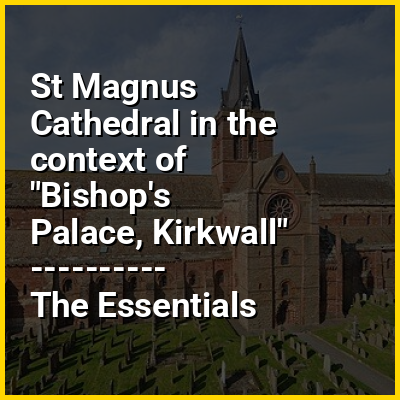
St Magnus Cathedral is a Church of Scotland parish church in Kirkwall, the main town of Orkney, a group of islands off the north coast of mainland Scotland. Originally a Roman Catholic cathedral, it is the oldest cathedral in Scotland and the most northerly cathedral in the United Kingdom. A large edifice that dominates the skyline of Kirkwall, it is a fine example of Romanesque architecture with later Gothic additions, built when the islands were ruled by the Norse Earls of Orkney as a semi-autonomous part of the Kingdom of Norway. The building is today owned by Orkney Islands Council as successor of the burgh of Kirkwall as a result of an act of King James III of Scotland following Orkney's annexation by the Scottish Crown in 1468.

Construction began in 1137 and it was added to over the next 300 years. The first bishop of Orkney was William the Old and it was for Bishop William that the nearby Bishop's Palace was built. Before the Scottish Reformation, the cathedral was presided over by the Bishop of Orkney. Today, it is a parish church of the Church of Scotland (with a presbyterian system of Church governance). As of 2024, the congregation of St Magnus Cathedral is part of Orkney Islands Church of Scotland – a single Church of Scotland ecclesiastical parish. The cathedral is listed at Category A, the highest grade of listed building in Scotland.
↓ Menu
HINT:

In this Dossier

St Magnus Cathedral in the context of St. Mungo's Cathedral, Glasgow

Glasgow Cathedral (Scottish Gaelic: Cathair-eaglais Ghlaschu) is a parish church of the Church of Scotland in Glasgow, Scotland. It was the cathedral church of the Archbishop of Glasgow, and the mother church of the Archdiocese of Glasgow and the province of Glasgow, from the 12th century until the Scottish Reformation in the 16th century. It is the oldest cathedral in mainland Scotland and the oldest building in Glasgow. With St Magnus Cathedral in Orkney, they are the only medieval cathedrals in Scotland to have survived the Reformation virtually intact. The medieval Bishop's Castle stood to the west of the cathedral until 1789. Although notionally it lies within the Townhead area of the city, the Cathedral grounds and the neighbouring Necropolis are considered to be their own district within the city.

The cathedral is dedicated to Saint Mungo (also known as Kentigern), the patron saint of Glasgow, whose tomb lies at the centre of the building's Lower Church. The first stone cathedral was dedicated in 1136, in the presence of David I. Fragments of this building have been found beneath the structure of the present cathedral, which was dedicated in 1197, although much of the present cathedral dates from a major rebuilding in the 13th century. Following its foundation in 1451, the University of Glasgow held its first classes within the cathedral's chapter house. After the Reformation, Glasgow Cathedral was internally partitioned to serve three separate congregations (Inner High, Outer High and Barony). The early 19th century saw a growing appreciation of the cathedral's medieval architecture, and by 1835 both the Outer High and Barony congregations had moved elsewhere in the city, allowing the restoration of the cathedral to something approaching its former glory.

View the full Wikipedia page for St. Mungo's Cathedral, Glasgow
↑ Return to Menu

St Magnus Cathedral in the context of Kirkwall

Kirkwall (Scots: Kirkwa, Kirkwaa, or Kirkwal; Norn: Kirkavå) is the largest town in Orkney, an archipelago to the north of mainland Scotland. First mentioned in the Orkneyinga saga, it is today the location of the headquarters of the Orkney Islands Council and a transport hub with ferries to many locations. It is the centre of the St Magnus International Festival and is also a popular stopping off point for cruise ships. St Magnus Cathedral stands at the heart of the town.

View the full Wikipedia page for Kirkwall
↑ Return to Menu

St Magnus Cathedral in the context of Samuel Laing (travel writer)

Samuel Laing (1780–1868) from Papdale in Orkney was a Scottish travel writer. He travelled in Scandinavia and northern Germany and published descriptions of these countries. Laing was the first translator of Heimskringla by Snorri Sturluson.

He unsuccessfully contested the Orkney and Shetland parliamentary constituency in 1832 against incumbent MP George Traill. Held after the passage of the Great Reform Act, this was the first election in which Shetlanders had the right to vote. Laing had won an early majority of votes counted in Orkney and was initially celebrated as the victor, however the delayed arrival of votes from Shetland produced a majority of 11 for Traill. The loss of Laing's majority provoked a riot in Kirkwall, leading to one fatality. Laing's subsequent attempt to lodge a legal challenge to his defeat was also unsuccessful.

View the full Wikipedia page for Samuel Laing (travel writer)
↑ Return to Menu