St Andrew Undershaft in the context of "St Helen's Bishopsgate"

Play Trivia Questions online!

or

Skip to study material about St Andrew Undershaft in the context of "St Helen's Bishopsgate"

Ad spacer

⭐ Core Definition: St Andrew Undershaft

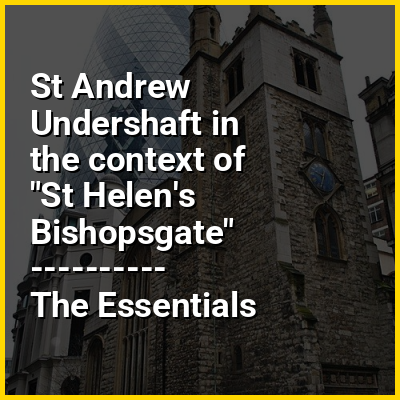
St Andrew Undershaft is a Church of England church in the City of London, the historic nucleus and modern financial centre of London. It is located on St Mary Axe, within the Aldgate ward, and is a rare example of a City church that survived both the Great Fire of London and the Blitz.

The present building was constructed in 1532 but a church has existed on the site since the 12th century. Today, St Andrew Undershaft is administered from the nearby St Helen's Bishopsgate church.

↓ Menu

>>>PUT SHARE BUTTONS HERE<<<
In this Dossier

St Andrew Undershaft in the context of Architecture of the United Kingdom

The architecture of the United Kingdom, or British architecture, consists of a combination of architectural styles, dating as far back to Roman architecture, to the present day 21st century contemporary. England has seen the most influential developments, though Ireland, Scotland, and Wales have each fostered unique styles and played leading roles in the international history of architecture. Although there are prehistoric and classical structures in the United Kingdom, British architectural history effectively begins with the first Anglo-Saxon Christian churches, built soon after Augustine of Canterbury arrived in Great Britain in 597. Norman architecture was built on a vast scale throughout Great Britain and Ireland from the 11th century onwards in the form of castles and churches to help impose Norman authority upon their dominions. English Gothic architecture, which flourished between 1180 until around 1520, was initially imported from France, but quickly developed its own unique qualities.

Throughout the United Kingdom, secular medieval architecture has left a legacy of large stone castles, with a concentration being found lining both sides of the Anglo-Scottish border, dating from the Wars of Scottish Independence of the 14th century. The invention of gunpowder and cannons made castles redundant, and the English Renaissance that followed facilitated development of new artistic styles for domestic architecture: Tudor style, English Baroque, Queen Anne Style, and Palladian. Georgian, Scots Baronial and Neoclassical architecture advanced after the Scottish Enlightenment, and since the 1930s various modernist forms appeared, though traditionalist resistance movements continue with support from Charles, Prince of Wales.
↑ Return to Menu

St Andrew Undershaft in the context of Architecture of England

The architecture of England is the architecture of the historic Kingdom of England up to 1707, and of England since then, but is deemed to include buildings created under English influence or by English architects in other parts of the world, particularly in the English overseas possessions and the later British Empire, which developed into the present-day Commonwealth of Nations.

Apart from Anglo-Saxon architecture, the major non-vernacular forms employed in England before 1900 originated elsewhere in western Europe, chiefly in France and Italy, while 20th-century Modernist architecture derived from both European and American influences. Each of these foreign modes became assimilated within English architectural culture and gave rise to local variation and innovation, producing distinctive national forms. Among the most characteristic styles originating in England are the Perpendicular Gothic of the late Middle Ages, High Victorian Gothic and the Queen Anne style.

↑ Return to Menu

St Andrew Undershaft in the context of John Stow

John Stow (also Stowe; 1524/25 – 5 April 1605) was an English historian and antiquarian. He wrote a series of chronicles of English history, published from 1565 onwards under such titles as The Summarie of Englyshe Chronicles, The Chronicles of England, and The Annales of England; and also A Survey of London (1598; second edition 1603). A. L. Rowse has described him as "one of the best historians of that age; indefatigable in the trouble he took, thorough and conscientious, accurate – above all things devoted to truth".

↑ Return to Menu