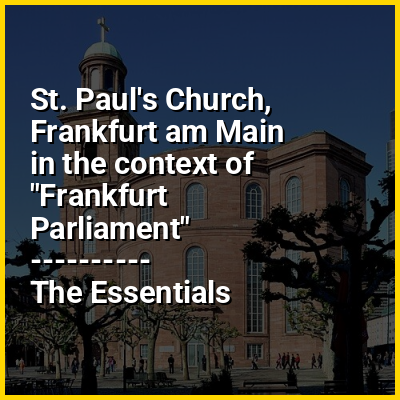
St. Paul's Church, Frankfurt am Main in the context of "Frankfurt Parliament"

Play Trivia Questions online!

or

Skip to study material about St. Paul's Church, Frankfurt am Main in the context of "Frankfurt Parliament"


In this Dossier

St. Paul's Church, Frankfurt am Main in the context of Germania (St. Paul's Church, Frankfurt am Main)

Germania is the name of a painting that was probably created in March 1848. It hung in the St. Paul's Church (Paulskirche) in Frankfurt, Germany. At that time, first the so-called Pre-Parliament and then the Frankfurt National Assembly, the first all-German parliament, met there. The National Assembly was a popular motif of the time, so the Germania painting also became very well-known. After the National Assembly was violently terminated in May 1849, the painting was taken down. In 1867 it was moved to the German National Museum in Nuremberg.

The painting is one of the best-known representations of Germania, a woman who stands for Germany. Such a national allegory also exists in other countries. The motif was often taken up during the time of the emerging German Empire 1848/1849 and later.

↑ Return to Menu

St. Paul's Church, Frankfurt am Main in the context of Frankfurt parliament

The Frankfurt National Assembly (German: Frankfurter Nationalversammlung) was the first freely elected parliament for all German states, including the German-populated areas of the Austrian Empire, elected on 1 May 1848 (see German federal election, 1848).

The session was held from 18 May 1848 to 30 May 1849 in the Paulskirche at Frankfurt am Main. Its existence was part of the result of the "March Revolution" within the states of the German Confederation.

↑ Return to Menu