St. Kilda, Scotland in the context of Hirta


St. Kilda, Scotland in the context of Hirta

⭐ Core Definition: St. Kilda, Scotland

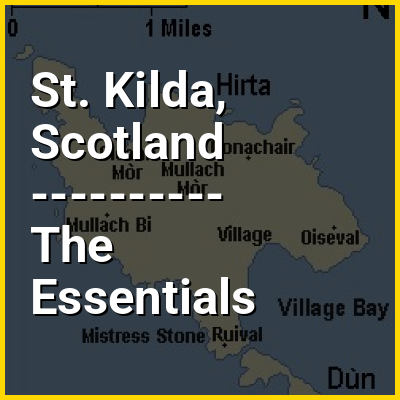
St Kilda (Scottish Gaelic: Hiort) is a remote archipelago situated 35 nautical miles (65 kilometres) west-northwest of North Uist in the North Atlantic Ocean. It contains the westernmost islands of the Outer Hebrides of Scotland. The largest island is Hirta, whose sea cliffs are the highest in the United Kingdom; three other islands (Dùn, Soay and Boreray) were also used for grazing and seabird hunting. The islands are administratively a part of the Comhairle nan Eilean Siar local authority area.

The origin of the name St Kilda is a matter of conjecture. The islands' human heritage includes unique architectural features from the historic and prehistoric periods, although the earliest written records of island life date from the Late Middle Ages. The medieval village on Hirta was rebuilt in the 19th century, but illnesses brought by increased external contacts through tourism, and the upheaval of the First World War, contributed to the island's evacuation. Permanent habitation on the islands possibly extends back two millennia, the population probably never exceeding 180; its peak was in the late 17th century. The population waxed and waned, eventually dropping to 36 in 1930, when the remaining population was evacuated. Currently, the only year-round residents are military personnel; a variety of conservation workers, volunteers and scientists spend time there in the summer months. The entire archipelago is owned by the National Trust for Scotland.
↓ Menu
HINT:

In this Dossier

St. Kilda, Scotland in the context of Northern gannet

The northern gannet (Morus bassanus) is a seabird, the largest species of the gannet family, Sulidae. It is native to the coasts of the Atlantic Ocean, breeding in Western Europe and Northeastern North America. It is the largest seabird in the northern Atlantic. The sexes are similar in appearance. The adult northern gannet has a mainly white streamlined body with a long neck, and long and slender wings. It is 87–100 cm (34+1239+12 in) long with a 170–180 cm (67–71 in) wingspan. The head and nape have a buff tinge that is more prominent in breeding season, and the wings are edged with dark brown-black feathers. The long, pointed bill is blue-grey, contrasting with black, bare skin around the mouth and eyes. Juveniles are mostly grey-brown, becoming increasingly white in the five years it takes them to reach maturity.

Nesting takes place in colonies on both sides of the North Atlantic, the largest of which are at Bass Rock (75,000 pairs as of 2014), St. Kilda (60,000 pairs as of 2013) and Ailsa Craig (33,000 pairs as of 2014) in Scotland, in Ireland (Sceilg Bheag; little Skellig, 35,000 pairs in 2011), Grassholm in Wales, and Bonaventure Island (60,000 pairs in 2009) off the coast of Quebec. Its breeding range has extended northward and eastward, with colonies being established on Russia's Kola Peninsula in 1995 and Bear Island (the southernmost island of Svalbard), in 2011. Colonies are mostly located on offshore islands with cliffs, from which the birds can more easily launch into the air. The northern gannet undertakes seasonal migrations and catches fish (which are the mainstay of its diet) by making high-speed dives into the sea.

View the full Wikipedia page for Northern gannet
↑ Return to Menu

St. Kilda, Scotland in the context of Feral animal

A feral (/ˈfɛrəl/; from Latin fera 'a wild beast') animal or plant is one that lives in the wild but is descended from domesticated individuals. As with an introduced species, the introduction of feral animals or plants to non-native regions may disrupt ecosystems and has, in some cases, contributed to extinction of indigenous species. The removal of feral species is a major focus of island restoration.

View the full Wikipedia page for Feral animal
↑ Return to Menu