Spectral irradiance in the context of Radiometry


Spectral irradiance in the context of Radiometry

Spectral irradiance Study page number 1 of 1

Play TriviaQuestions Online!

or

Skip to study material about Spectral irradiance in the context of "Radiometry"


⭐ Core Definition: Spectral irradiance

In radiometry, irradiance is the radiant flux received by a surface per unit area. The SI unit of irradiance is the watt per square metre (symbol W⋅m or W/m). The CGS unit erg per square centimetre per second (erg⋅cm⋅s) is often used in astronomy. Irradiance is often called intensity, but this term is avoided in radiometry where such usage leads to confusion with radiant intensity. In astrophysics, irradiance is called radiant flux.

Spectral irradiance is the irradiance of a surface per unit frequency or wavelength, depending on whether the spectrum is taken as a function of frequency or of wavelength. The two forms have different dimensions and units: spectral irradiance of a frequency spectrum is measured in watts per square metre per hertz (W⋅m⋅Hz), while spectral irradiance of a wavelength spectrum is measured in watts per square metre per metre (W⋅m), or more commonly watts per square metre per nanometre (W⋅m⋅nm).

↓ Menu
HINT:

In this Dossier

Spectral irradiance in the context of Black body

A black body or blackbody is an idealized physical body that absorbs all incident electromagnetic radiation, regardless of frequency or angle of incidence. The radiation emitted by a black body in thermal equilibrium with its environment is called black-body radiation. The name "black body" is given because it absorbs all colors of light. In contrast, a white body is one with a "rough surface that reflects all incident rays completely and uniformly in all directions."

A black body in thermal equilibrium (that is, at a constant temperature) emits electromagnetic black-body radiation. The radiation is emitted according to Planck's law, meaning that it has a spectrum that is determined by the temperature alone (see figure at right), not by the body's shape or composition.

View the full Wikipedia page for Black body
↑ Return to Menu

Spectral irradiance in the context of Jansky

The jansky (symbol Jy, plural janskys) is a non-SI unit of spectral flux density, or spectral irradiance, used especially in radio astronomy. It is equivalent to 10 watts per square metre per hertz.

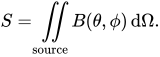
The spectral flux density or monochromatic flux, S, of a source is the integral of the spectral radiance, B, over the source solid angle:

View the full Wikipedia page for Jansky
↑ Return to Menu