Soviet occupation of Latvia in 1940 in the context of "BT-7"

Play Trivia Questions online!

or

Skip to study material about Soviet occupation of Latvia in 1940 in the context of "BT-7"


⭐ Core Definition: Soviet occupation of Latvia in 1940

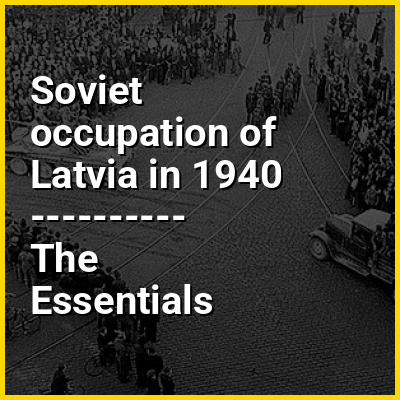
The Soviet occupation of Latvia in 1940 refers to the military occupation of the Republic of Latvia by the Soviet Union under the provisions of the 1939 Molotov–Ribbentrop Pact with Nazi Germany and its Secret Additional Protocol signed in August 1939.

In 1989, the USSR condemned the 1939 secret protocol between Nazi Germany and itself that had led to the invasion and occupation of the three Baltic countries, including Latvia. In July 1989, the people of Latvia began the process of restoring their independence. In 1991, after the dissolution of the Soviet Union, Latvia's sovereignty was fully restored. On 22 August 1996, the Latvian parliament adopted a declaration that stated that the Soviet occupation of Latvia in 1940 was a military occupation and an illegal incorporation.
↓ Menu

In this Dossier

Soviet occupation of Latvia in 1940 in the context of Latvia

Latvia, officially the Republic of Latvia, is a country in the Baltic region of northern Europe. It is one of the three Baltic states, along with Estonia to the north and Lithuania to the south. It borders Russia to the east and Belarus to the southeast and shares a maritime border with Sweden to the west. Latvia covers an area of 64,589 km (24,938 sq mi), with a population of 1.8 million. The country has a temperate seasonal climate. Its capital and largest city is Riga. Latvians, who are the titular nation and comprise 65.5% of the country's population, belong to the ethnolinguistic group of the Balts and speak Latvian. Russians are the most prominent minority in the country, at almost a quarter of the population; 37.7% of the population speak Russian as their native tongue.

After centuries of Teutonic, Swedish, Polish-Lithuanian, and Russian rule, the independent Republic of Latvia was established on 18 November 1918 after breaking away from the Russian Empire in the aftermath of World War I. The country became increasingly autocratic after the coup in 1934 established the dictatorship of Kārlis Ulmanis. Latvia's de facto independence was interrupted at the outset of World War II, beginning with forcible incorporation into the Soviet Union, followed by the invasion and occupation by Nazi Germany in 1941 and the re-occupation by the Soviets in 1944, which formed the Latvian SSR for the next 45 years. As a result of extensive immigration during the Soviet occupation, ethnic Russians became the most prominent minority in the country. The peaceful Singing Revolution started in 1987 among the Baltic Soviet republics and ended with the restoration of both de facto and official independence on 21 August 1991. Latvia has since been a democratic unitary parliamentary republic.

↑ Return to Menu

Soviet occupation of Latvia in 1940 in the context of 1934 Latvian coup d'état

The 1934 Latvian coup d'état (Latvian: 1934. gada 15. maija apvērsums) known in Latvia also as the 15 May Coup (15. maija apvērsums) or Ulmanis' Coup (Ulmaņa apvērsums), was a self-coup by the veteran Prime Minister Kārlis Ulmanis against the parliamentary system in Latvia. His regime lasted until the Soviet occupation of Latvia in 1940.

On the night of 15–16 May, Ulmanis, with the support of Minister of War Jānis Balodis and the paramilitary Aizsargi organization, took control of the main state and party offices, proclaimed a nationwide state of emergency (also referred to martial law), suspended the Constitution, dissolved all political parties and the Saeima (parliament).

↑ Return to Menu

Soviet occupation of Latvia in 1940 in the context of Soviet re-occupation of Latvia in 1944

The Soviet re-occupation of Latvia in 1944 refers to the military occupation of Latvia by the Soviet Union in 1944. During World War II Latvia was first occupied by the Soviet Union in June 1940, then was occupied by Nazi Germany in 1941–1944, and after which it was re-occupied by the Soviet Union.

↑ Return to Menu

Soviet occupation of Latvia in 1940 in the context of SMS M68

SMS M68 was a M1916 type minesweeper built for the Imperial German Navy during the First World War. She entered service on 6 October 1917, but was mined and sunk off Latvia on 29 October 1917. The ship was salvaged by Latvia and entered service with the Latvian Navy on 10 November 1921 under the name Virsaitis as its first vessel. She was taken over by the Soviet Navy in August 1940 when the Soviet Union occupied Latvia in August 1940, serving as T-297 and was sunk by a mine on 2 December 1941.
Cite error: There are <ref group=lower-alpha> tags or {{efn}} templates on this page, but the references will not show without a {{reflist|group=lower-alpha}} template or {{notelist}} template (see the help page).

↑ Return to Menu

Soviet occupation of Latvia in 1940 in the context of Sovietization

Sovietization (Russian: советизация, romanizedsovyetizatsiya [səvʲɪtʲɪˈzat͡sɨjə]) is the adoption of a political system based on the model of soviets (workers' councils) or the adoption of a way of life, mentality, and culture modeled after the Soviet Union.

A notable wave of Sovietization (in the second meaning) occurred during the Russian Civil War in the territories captured by the Red Army. Later, the territories occupied by the Russian SFSR and the USSR were Sovietized. Mongolia was conquered by the Soviet Union and Sovietized in the 1920s, and after the end of the Second World War, Sovietization took place in the countries of the Soviet Bloc (Eastern and Central Europe: Czechoslovakia, East Germany, Hungary, Poland, the Baltic states, etc.). In a broad sense, it included the creation of Soviet-style authorities, new elections held by Bolshevik party members with opposition parties being restricted, the nationalization of private land and property, and the repression against representatives of "class enemies" (kulaks, or osadniks, for instance). Mass executions and imprisoning in Gulag labor camps and exile settlements often accompany that process. This was usually promoted and sped up by propaganda aimed at creating a common way of life in all states within the Soviet sphere of influence. In modern history, Sovietization refers to the copying of models of Soviet life (the cult of the leader's personality, collectivist ideology, mandatory participation in propaganda activities, etc.).

↑ Return to Menu

Soviet occupation of Latvia in 1940 in the context of Latvian diplomatic service

The Latvian diplomatic service in exile (Latvian: Latvijas diplomātiskais un konsulārais dienests trimdā) was the only governmental body of the Republic of Latvia which continued its activities during the Nazi and Soviet occupation of Latvia during 1940–1991. Latvian diplomats who were stationed in embassies and consulates at the moment of the occupation in 1940, refused to recognize the occupation and return to Soviet Latvia. They continued to formally represent the interests of Latvia in countries that did not recognize the Soviet annexation. After the restoration of Latvian independence in 1991, the diplomats started reporting to the restored Latvian Ministry of Foreign Affairs.

↑ Return to Menu

Soviet occupation of Latvia in 1940 in the context of On the Restoration of Independence of the Republic of Latvia

The Declaration "On the Restoration of Independence of the Republic of Latvia" (Latvian: Deklarācija par Latvijas Republikas neatkarības atjaunošanu) was adopted on 4 May 1990 by the Supreme Soviet of the Latvian SSR in which Latvia declared independence from the Soviet Union. The Declaration stated that, although Latvia had de facto lost its independence in 1940, when it was annexed by the Soviet Union, the country had de jure remained a sovereign country as the annexation had been unconstitutional and against the will of the Latvian people.

It asserted the priority of the basics of the international law over the national laws and therefore it resolved that the Molotov–Ribbentrop Pact and the Soviet occupation of Latvia in 1940 were illegal. It also asserted that the heavily rigged 1940 elections were illegal and unconstitutional, and that all acts of the People's Saeima (lv; ru) chosen at that election–including the request to join the Soviet Union on 21 July 1940–were ipso facto void.

↑ Return to Menu