Sonoma Valley AVA in the context of "Sonoma County, California"

Play Trivia Questions online!

or

Skip to study material about Sonoma Valley AVA in the context of "Sonoma County, California"

Ad spacer

⭐ Core Definition: Sonoma Valley AVA

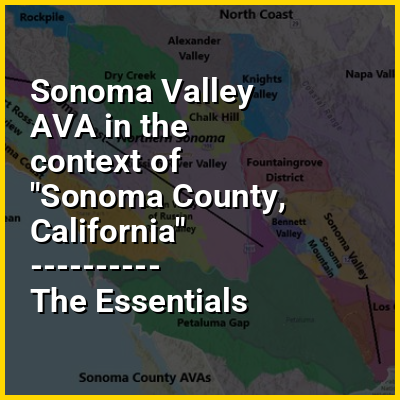
Sonoma Valley is an American Viticultural Area (AVA) located within the Sonoma Valley landform occupying the southeastern portion of Sonoma County, California. The name "Sonoma" means 'Valley of the Moon' in the indigenous Chocuyen dialect. The wine appellation was established on December 4, 1981, as the nation's ninth, the state's seventh and the county's initial AVA by the Bureau of Alcohol, Tobacco and Firearms (ATF), Treasury after reviewing the petition submitted by the Sonoma Valley Vintners Association of Santa Rosa, on behalf of Sonoma Valley wineries and grape growers proposing the new viticultural area named "Sonoma Valley."

The 72,402-acre (113 sq mi) viticultural area cultivates 13,000 acres (5,300 ha) under vine and is flanked by two mountain ranges: the Mayacamas Mountains to the east and the Sonoma Mountains to the west. The plant hardiness zone ranges from 9a to 10a.
↓ Menu

>>>PUT SHARE BUTTONS HERE<<<
In this Dossier

Sonoma Valley AVA in the context of Sonoma, California

Sonoma (/səˈnmə/) is a city in Sonoma County, California, United States, located in the North Bay region of the San Francisco Bay Area. Sonoma is one of the principal cities of California's Wine Country and the center of the Sonoma Valley AVA. Sonoma's population was 10,739 as of the 2020 census, while the Sonoma urban area had a population of 31,479. Sonoma is a popular tourist destination, owing to its Californian wineries, noted events like the Sonoma International Film Festival, and its historic center.

Sonoma's origins date to 1823, when Padre José Altimira established Mission San Francisco Solano, under the direction of Governor Luis Antonio Argüello. Following the Mexican secularization of the missions, Californio statesman Mariano G. Vallejo founded Sonoma on the former mission's lands in 1835. Sonoma served as the base of General Vallejo's operations until the Bear Flag Revolt in 1846, when American filibusters overthrew the local Mexican government and declared the California Republic, ushering in the American Conquest of California.

↑ Return to Menu

Sonoma Valley AVA in the context of Wine Country

Wine Country is a region of California, in the northern San Francisco Bay Area, known worldwide as a premier wine-growing region. The region is famed for its wineries, its cuisine, Michelin star restaurants, boutique hotels, luxury resorts, historic architecture, and culture. Viticulture and wine-making have been practiced in the region since the Spanish missionaries from Mission San Francisco Solano established the first vineyards in 1812.

There are over 1,700 wineries in the North Bay, mostly located in the area's valleys, including Napa Valley in Napa County, and the Sonoma Valley, Alexander Valley, Dry Creek Valley, Bennett Valley, and Russian River Valley in Sonoma County. Wine grapes are also grown at higher elevations, such as Atlas Peak and Mount Veeder AVAs. Cities and towns associated with the Wine Country include Santa Rosa, Healdsburg, Sonoma, Kenwood, Petaluma, Sebastopol, Guerneville, Windsor, Geyserville, and Cloverdale in Sonoma County; Napa, Yountville, Rutherford, St. Helena and Calistoga in Napa County; and Hopland and Ukiah in Mendocino County. Wine is also an important part of the economy in nearby Lake, Solano, and Yolo counties.

↑ Return to Menu