Solvation shell in the context of "Solute"

Play Trivia Questions online!

or

Skip to study material about Solvation shell in the context of "Solute"


⭐ Core Definition: Solvation shell

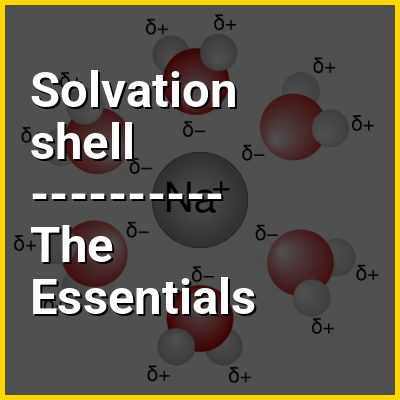
A solvation shell or solvation sheath is the solvent interface of any chemical compound or biomolecule that constitutes the solute in a solution. When the solvent is water it is called a hydration shell or hydration sphere. The number of solvent molecules surrounding each unit of solute is called the hydration number of the solute.

A classic example is when water molecules arrange around a metal ion. If the metal ion is a cation, the electronegative oxygen atom of the water molecule would be attracted electrostatically to the positive charge on the metal ion. The result is a solvation shell of water molecules that surround the ion. This shell can be several molecules thick, dependent upon the charge of the ion, its distribution and spatial dimensions.

↓ Menu

In this Dossier

Solvation shell in the context of Dissolution (chemistry)

Solvations describes the interaction of a solvent with dissolved molecules. Both ionized and uncharged molecules interact strongly with a solvent, and the strength and nature of this interaction influence many properties of the solute, including solubility, reactivity, and color, as well as influencing the properties of the solvent such as its viscosity and density. If the attractive forces between the solvent and solute particles are greater than the attractive forces holding the solute particles together, the solvent particles pull the solute particles apart and surround them. The surrounded solute particles then move away from the solid solute and out into the solution. Ions are surrounded by a concentric shell of solvent. Solvation is the process of reorganizing solvent and solute molecules into solvation complexes and involves bond formation, hydrogen bonding, and van der Waals forces. Solvation of a solute by water is called hydration.

Solubility of solid compounds depends on a competition between lattice energy and solvation, including entropy effects related to changes in the solvent structure.

↑ Return to Menu

Solvation shell in the context of Aqueous solution

An aqueous solution is a solution in which the solvent is water. It is mostly shown in chemical equations by appending (aq) to the relevant chemical formula. For example, a solution of table salt, also known as sodium chloride (NaCl), in water would be represented as Na(aq) + Cl(aq). The word aqueous (which comes from aqua) means pertaining to, related to, similar to, or dissolved in, water. As water is an excellent solvent and is also naturally abundant, it is a ubiquitous solvent in chemistry. Since water is frequently used as the solvent in experiments, the word solution refers to an aqueous solution, unless the solvent is specified.

A non-aqueous solution is a solution in which the solvent is a liquid, but is not water.

↑ Return to Menu

Solvation shell in the context of Ionic radius

Ionic radius, rion, is the radius of a monatomic ion in an ionic crystal structure. Although neither atoms nor ions have sharp boundaries, they are treated as if they were hard spheres with radii such that the sum of ionic radii of the cation and anion gives the distance between the ions in a crystal lattice. Ionic radii are typically given in units of either picometers (pm) or angstroms (Å), with 1 Å = 100 pm. Typical values range from 31 pm (0.3 Å) to over 200 pm (2 Å).

The concept can be extended to solvated ions in liquid solutions taking into consideration the solvation shell.

↑ Return to Menu

Solvation shell in the context of Hydration number

The hydration number of a compound is defined as the number of molecules of water bonded to a central ion, often a metal cation. The hydration number is related to the broader concept of solvation number, the number of solvent molecules bonded to a central atom. The hydration number varies with the atom or ion of interest.

In aqueous solution, solutes interact with water molecules to varying degrees. Metal cations form aquo complexes, wherein the oxygen of water bind to the cation. This first coordination sphere is encased in further solvation shells, whereby water bonds to the coordinated water via hydrogen bonding. For charged species, the orientation of water molecules around the solute dependent on its radius and charge, with cations attracting water's electronegative oxygen and anions attracting the hydrogens. Uncharged compounds such as methane can also be solvated by water and also have a hydration number. Although solvation shells can contain inner and outer shell solvent-solute interactions, the hydration number generally focuses on the inner shell solvent molecules that directly interact with the solute. Sodium ions are typically surrounded by 4 to 6 water molecules in their primary hydration shell. This arrangement reflects the ion's charge density and size, leading to strong ion-dipole interactions with water molecules. In contrast, chloride ions generally have a hydration number closer to 6 due to their larger ionic radius and more distributed charge, which allows them to stabilize a larger number of water molecules in their hydration shell.

↑ Return to Menu

Solvation shell in the context of Metal ions in aqueous solution

A metal ion in aqueous solution or aqua ion is a cation, dissolved in water, of chemical formula [M(H2O)n]. The solvation number, n, determined by a variety of experimental methods is 4 for Li and Be and 6 for most elements in periods 3 and 4 of the periodic table. Lanthanide and actinide aqua ions have higher solvation numbers (often 8 to 9), with the highest known being 11 for Ac. The strength of the bonds between the metal ion and water molecules in the primary solvation shell increases with the electrical charge, z, on the metal ion and decreases as its ionic radius, r, increases. Aqua ions are subject to hydrolysis. The logarithm of the first hydrolysis constant is proportional to z/r for most aqua ions.

The aqua ion is associated, through hydrogen bonding with other water molecules in a secondary solvation shell. Water molecules in the first hydration shell exchange with molecules in the second solvation shell and molecules in the bulk liquid. The residence time of a molecule in the first shell varies among the chemical elements from about 100 picoseconds to more than 200 years. Aqua ions are prominent in electrochemistry.

↑ Return to Menu