Soho Square in the context of "Soho, London"

Play Trivia Questions online!

or

Skip to study material about Soho Square in the context of "Soho, London"

Ad spacer

⭐ Core Definition: Soho Square

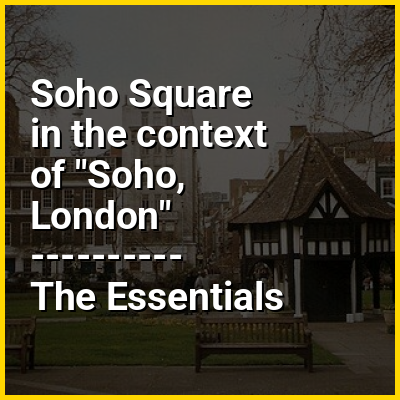
Soho Square is a garden square in Soho, London, hosting since 1954 a de facto public park let by the Soho Square Garden Committee to Westminster City Council. It was originally called King Square after Charles II, and a much weathered statue of the monarch has stood in the square, with an extended interruption, since 1661, one year after the restoration of the monarchy.

Of the square's 30 buildings (including mergers), 16 are listed (have statutory recognition and protection). During the summer, Soho Square hosts open-air free concerts.
↓ Menu

>>>PUT SHARE BUTTONS HERE<<<
In this Dossier

Soho Square in the context of Soho

Soho is a district of Westminster, in the City of Westminster in the West End of London. Originally a fashionable district for the aristocracy, it has been one of the main entertainment districts in the capital since the 19th century.

The area was developed from farmland by Henry VIII in 1536, when it became a royal park. It became a parish in its own right in the late 17th century, when buildings started to be developed for the upper class, including the laying out of Soho Square in the 1680s. St Anne's Church was established during the late 17th century, and remains a significant local landmark; other churches are the Church of Our Lady of the Assumption and St Gregory and St Patrick's Church in Soho Square. The aristocracy had mostly moved away by the mid-19th century, when Soho was particularly badly hit by an outbreak of cholera in 1854. For much of the 20th century Soho had a reputation as a base for the sex industry in addition to its night life and its location for the headquarters of leading film companies. Since the 1980s, the area has undergone considerable gentrification. It is now predominantly a fashionable district of upmarket restaurants and media offices, with only a small remnant of sex industry venues. London's most prominent gay village is centred on Old Compton Street in Soho.

↑ Return to Menu

Soho Square in the context of St Patrick's Church, Soho Square

St Patrick's Church is a large Roman Catholic parish church in Soho Square, London. St Pat's (as it is informally known) was consecrated as a chapel in a building behind Carlisle House on 29 September 1792, one of the first Catholic buildings allowed in Great Britain after the Reformation.

The present church building was built between 1891 and 1893, to designs by John Kelly of Leeds, and replaced the earlier and smaller chapel built by Father Arthur O'Leary in the 1790s. The church has an unusual longish shape due to plot constrictions given at that time. The building is constructed out of bricks with a bell-tower. It is Grade II* listed. The main entrance has a Roman-style porch with Corinthian columns. Above the entrance is an inscription: VT CHRISTIANI ITA ET ROMANI SITIS ("Ut christiani ita et romani sitis", i.e. “Be ye Christians as those of the Roman Church”). It is a quotation taken from the writings of St. Patrick.

↑ Return to Menu

Soho Square in the context of William Banting

William Banting (c. December 1796 – 16 March 1878) was a notable English undertaker. Formerly obese, he is also known for being the first to popularise a weight loss diet based on limiting the intake of carbohydrates, especially those of a starchy or sugary nature. He undertook his dietary changes at the suggestion of Soho Square physician William Harvey, who in turn had learned of this type of diet, but in the context of diabetes management, from attending lectures in Paris by Claude Bernard.

↑ Return to Menu