Slovene dialects in the context of "Upper Carniolan dialect"

Play Trivia Questions online!

or

Skip to study material about Slovene dialects in the context of "Upper Carniolan dialect"

Ad spacer

⭐ Core Definition: Slovene dialects

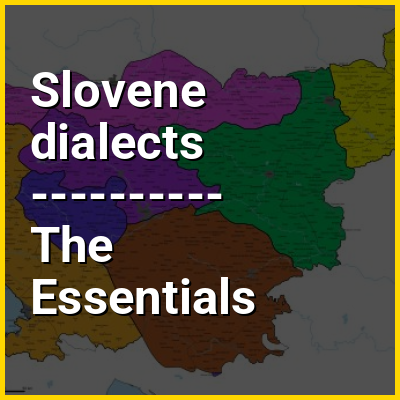
In a purely dialectological sense, Slovene dialects (Slovene: slovenska narečja [sloʋènska narét͡ʃja], Serbo-Croatian: slovenska narječja [slǒʋeːnskaː nǎːrjeːt͡ʃja]) are the regionally diverse varieties that evolved from old Slovene, a South Slavic language of which the standardized modern version is Standard Slovene. This also includes several dialects in Croatia, most notably the so-called Western Goran dialect, which is actually Kostel dialect. In reality, speakers in Croatia self-identify themselves as speaking Croatian, which is a result of a ten centuries old country border passing through the dialects since the Francia. In addition, two dialects situated in Slovene (and the speakers self identify as speaking Slovene) did not evolve from Slovene (left out in the map on the right). The Čičarija dialect is a Chakavian dialect and parts of White Carniola were populated by Serbs during the Turkish invasion and therefore Shtokavian is spoken there.

Spoken Slovene is often considered to have at least 48 dialects (narečja) and 13 subdialects (podnarečja). The exact number of dialects is open to debate, ranging from as many as 50 to merely 7. According to the official chart, published by the Fran Ramovš Institute, there are 48 dialects and 13 subdialects, but that includes all dialects spoken in Slovene. Čičarija dialect is included as a separate dialect and Shtokavian in White Carniola is merged with South White Carniolan. However, the official chart was not updated to include Čabar dialect, which was only recently been discovered to have evolved differently than Kostel dialect, under which it was traditionally listed. Therefore, that division includes 48 dialects and 13 subdialects.
↓ Menu

>>>PUT SHARE BUTTONS HERE<<<
In this Dossier

Slovene dialects in the context of Resian dialect

The Resian dialect or simply Resian (self-designation Standard Rozajanski langäč / Rozojanski langäč, Bila Rozajanski langäč / Rozojanski langäč, Osoanë Rozoanske langäč, Solbica Rozajonski langeč / Rozojonski langeč; Slovene: rezijansko narečje [ɾɛziˈjáːnskɔ naˈɾéːt͡ʃjɛ], rezijanščina; Italian: Dialetto Resiano) is a distinct variety in the South Slavic continuum, generally considered a Slovene dialect spoken in the Resia Valley, Province of Udine, Italy, close to the border with Slovenia.

Together with the Rosen Valley dialect and Ebriach dialect in Carinthia, it is one of the three dialects of Slovene spoken entirely outside the borders of Slovenia. It is unequivocally one of the most distinct and difficult dialects to understand for speakers of central Slovene dialects, especially because most Resians are not familiar with standard Slovene. Its distinguishing characteristic is centralized, breathy vowels. It borders the Slovene Torre Valley dialect to the south and the Soča dialect to the east, both separated by tall mountain ranges. On the other sides, it mostly borders Friulian, but also Bavarian to the north. It belongs to the Littoral dialect group, although it shows few similarities with other Littoral dialects and evolved from the Carinthian dialect base, northern Slovene, as opposed to other Littoral dialects, which evolved either from western or southern Slovene. It is spoken by fewer than a thousand people and is listed as a definitely endangered language according to UNESCO's Atlas of the World's Languages in Danger. Despite this, Resians value their language and it is being passed down to younger generations.

↑ Return to Menu

Slovene dialects in the context of Rosen Valley dialect

The Rosen Valley dialect (Slovene: rožansko narečje, rožanščina) is a Slovene dialect in the Carinthian dialect group. It is spoken in the Rosen Valley (German: Rosental, Slovene: Rož) of Austria, west of a line from Villach to Faak am See and east of a line from Sittersdorf and Lake Klopein to Brückl, excluding the Ebriach dialect area to the southeast. Settlements in the dialect area include Wernberg, Köstenberg, Velden am Wörthersee, Ludmannsdorf, Köttmannsdorf, Viktring, Grafenstein, Tainach, and Rosegg (all north of the Drava River), and Sankt Jakob im Rosental, Feistritz im Rosental, Windisch Bleiberg, Ferlach, Zell, and Gallizien (south of the Drava River).

↑ Return to Menu

Slovene dialects in the context of Ebriach dialect

The Ebriach dialect (Slovene: obirsko narečje, obirščina) is a Slovene dialect in the Carinthian dialect group. It is spoken in Austrian Carinthia around Bad Eisenkappel, in the watershed of the Vellach River (Slovene: Bela) and Ebriach Creek (German: Ebriachbach, Slovene: Obirski potok), and Jezersko.

↑ Return to Menu

Slovene dialects in the context of Soča dialect

The Soča dialect (Slovene: obsoško narečje [ɔpˈsóːʃkɔ naˈɾéːt͡ʃjɛ]) is a Slovene dialect spoken in upper Soča Valley. It is one of the most archaic Slovene dialects, together with the Natisone Valley, Torre Valley, and Rosen Valley dialects. It borders the Karst dialect to the south, Natisone Valley dialect to the southwest, Torre Valley and Resian dialects to the west, Fiulian and Carinthian Bavarian to the northwest, Gail Valley dialect to the north, Upper Carniolan dialect to the east, and Tolmin dialect to the southeast. The dialect belongs to the Littoral dialect group, and it evolved from Soča–Idrija dialect base.

↑ Return to Menu

Slovene dialects in the context of Prekmurje Slovene

Prekmurje Slovene, also known as the Prekmurje dialect or Eastern Slovene (Slovene: prekmurščina, prekmursko narečje; Hungarian: vend nyelv, muravidéki nyelv; Prekmurje Slovene: prekmürski jezik, prekmürščina, prekmörščina, prekmörski jezik, panonska slovenščina), is the language of Prekmurje in Eastern Slovenia, and a variety of the Slovene language. As a part of the Pannonian dialect group, it is spoken in the Prekmurje region of Slovenia and by the Hungarian Slovenes in the Vas County in western Hungary. It is used in private communication, liturgy and publications by authors from Prekmurje as well as in television, radio and newspapers. It is closely related to other Slovene dialects in neighboring Slovene Styria as well as to Kajkavian with which it is mutually intelligible to a considerable degree, and forms a dialect continuum with other South Slavic languages.

Prekmurje Slovene is part of the Pannonian dialect group (Slovene: panonska narečna skupina), which is also known as the eastern Slovene dialect group (vzhodnoslovenska narečna skupina). Prekmurje Slovene shares many common features with the dialects of Haloze, Slovenske Gorice, and Prlekija, with which it is completely mutually intelligible. It is also closely related to the Kajkavian dialects of Croatian, although mutual comprehension is difficult. Prekmurje Slovene, especially its more traditional version spoken by the Hungarian Slovenes, is not readily understood by speakers from central and western Slovenia, whereas speakers from eastern Slovenia (Lower Styria) have much less difficulty understanding it. The early 20th-century philologist Ágoston Pável stated that Prekmurje Slovene is actually a major, independent dialect of Slovene, from which it differs mostly in the aspects of stress, intonation, the softening of consonants and—as a result of the lack of linguistic reform—in the striking dearth of modern vocabulary and that it has preserved many older features from Proto-Slavic.

↑ Return to Menu

Slovene dialects in the context of Carinthian dialect group

The Carinthian dialect group (koroška narečna skupina, koroščina) is a group of closely related dialects of Slovene, a South Slavic language. The Carinthian dialects are spoken by Carinthian Slovenes in Austria, in Slovenian Carinthia, and in the northwestern parts of Slovenian Styria along the upper Drava Valley, in the westernmost areas of Upper Carniola on the border with Italy, and in some villages in the Province of Udine in Italy.

↑ Return to Menu

Slovene dialects in the context of Littoral dialect group

The Littoral dialect group (primorska narečna skupina) is a group of very heterogeneous dialects of Slovene. The Littoral dialects are spoken in most of the Slovenian Littoral (except for the mountainous areas around Tolmin and Cerkno, where Rovte dialects are spoken) and in the western part of Inner Carniola. They are also spoken by Slovenes in the Italian provinces of Trieste and Gorizia, and in the mountainous areas of eastern Friuli (Venetian Slovenia and Resia).

↑ Return to Menu

Slovene dialects in the context of Rovte dialect group

The Rovte dialect group (rovtarska narečna skupina, rovtarščina) is a group of closely related dialects of Slovene. The Rovte dialects are spoken in the mountainous areas of west-central Slovenia, on the border between the Slovenian Littoral, Upper Carniola, and Inner Carniola, in a triangle between the towns of Tolmin, Škofja Loka, and Vrhnika.

↑ Return to Menu

Slovene dialects in the context of Upper Carniolan dialect group

The Upper Carniolan dialect group (gorenjska narečna skupina) is a group of closely related dialects of Slovene. The Upper Carniolan dialects are spoken in most of Upper Carniola and in Ljubljana.

↑ Return to Menu