Singularity (mathematics) in the context of Differentiable function


Singularity (mathematics) in the context of Differentiable function

Singularity (mathematics) Study page number 1 of 1

Play TriviaQuestions Online!

or

Skip to study material about Singularity (mathematics) in the context of "Differentiable function"


⭐ Core Definition: Singularity (mathematics)

In mathematics, a singularity is a point at which a given mathematical object is not defined, or a point where the mathematical object ceases to be well-behaved in some particular way, such as by lacking differentiability or analyticity.

For example, the reciprocal function has a singularity at , where the value of the function is not defined, as involving a division by zero. The absolute value function also has a singularity at , since it is not differentiable there.

↓ Menu
HINT:

In this Dossier

Singularity (mathematics) in the context of Initial singularity

The initial singularity or the Big Bang singularity is a simplified model for the origin of the universe, obtained by extrapolating the Big Bang model of cosmology backward to a state of arbitrarily high density and temperature. While the Big Bang refers to the hot, dense state in the early universe from which the expansion of the universe began, extrapolating general relativity beyond this state leads to a singularity. However, this singularity is considered a breakdown of the current theoretical models, not a physically meaningful description of the universe’s origin.

View the full Wikipedia page for Initial singularity
↑ Return to Menu

Singularity (mathematics) in the context of Tschirnhausen cubic

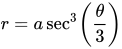
In mathematics, the Tschirnhausen cubic is a cubic plane curve defined by the polar equationor the equivalent algebraic equation

It is a nodal cubic, meaning that it crosses itself at one point, its node. The angle at this crossing point, inside the loop formed by the crossing, is 60°. Because the Tschirnhausen cubic has this singularity, it can be given a parametric equation, and any arc of it can be drawn as a cubic Bézier curve. It is a special case of a sinusoidal spiral, of a pursuit curve, and of a Pythagorean hodograph curve.

View the full Wikipedia page for Tschirnhausen cubic
↑ Return to Menu