Sicilian Vespers in the context of "Charles II of Naples"

Play Trivia Questions online!

or

Skip to study material about Sicilian Vespers in the context of "Charles II of Naples"

Ad spacer

⭐ Core Definition: Sicilian Vespers

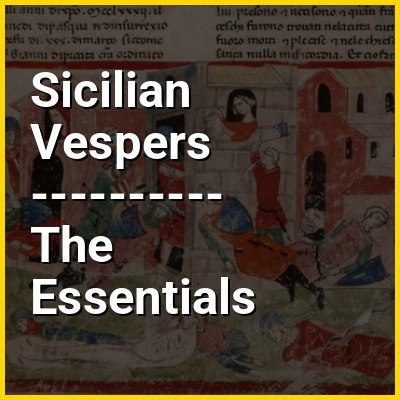
The Sicilian Vespers (Italian: Vespri siciliani; Sicilian: Vespiri siciliani) was a successful rebellion on the island of Sicily that broke out at Easter 1282 against the rule of the French-born king Charles I of Anjou. Since taking control of the Kingdom of Sicily in 1266, the Angevin government had made itself unpopular with its exploitative policies and exclusion of native Sicilians from power.

Sparked by an incident in Palermo, the revolt quickly spread to the majority of Sicily. Within six weeks, approximately 13,000 French men and women were slain or expelled by the rebels, and the government of Charles lost control of the island. Seeking support for the rebellion, the Sicilians offered the throne to Peter III of Aragon, who claimed the crown on behalf of his wife, Constance of Sicily. The Aragonese intervention in the rebellion led to an expansion of the conflict into the War of the Sicilian Vespers.
↓ Menu

>>>PUT SHARE BUTTONS HERE<<<
In this Dossier

Sicilian Vespers in the context of Kingdom of Albania (medieval)

The Kingdom of Albania (Albanian: Mbretëria e Arbërisë, Latin: Regnum Albaniæ) was established by Charles of Anjou in the Albanian territories he conquered from the Byzantine Empire in 1271, with the help of the local Albanian nobility. The Kingdom of Albania was declared in late February 1272. The kingdom extended from the region of Durazzo (Dyrrhachium, modern Durrës) south along the coast to Butrint. A major attempt to advance further in direction of Constantinople failed at the Siege of Berat (1280–1281). A Byzantine counteroffensive soon ensued, which drove the Angevins out of the interior by 1281. The Sicilian Vespers further weakened the position of Charles, and the Kingdom was soon reduced by the Byzantines to a small area around Durazzo. The Angevins held out here, however, until 1368, when the city was captured by Karl Thopia. In 1392, Karl Thopia's son surrendered the city to the Republic of Venice.

↑ Return to Menu

Sicilian Vespers in the context of Kingdom of Sicily

The Kingdom of Sicily (Latin: Regnum Siciliae; Sicilian: Regnu di Sicilia; Italian: Regno di Sicilia) was a state that existed in Sicily and the southern Italian Peninsula as well as, for a time, in Northern Africa, from its founding by Roger II of Sicily in 1130 until 1816. It was a successor state of the County of Sicily, which had been founded in 1071 during the Norman conquest of the southern peninsula. The island was divided into three regions: Val di Mazara, Val Demone and Val di Noto.

After a brief rule by Charles of Anjou, a revolt in 1282 known as the Sicilian Vespers threw off Angevin rule in the island of Sicily. The Angevins managed to maintain control in the mainland part of the kingdom, which became a separate entity also styled Kingdom of Sicily, although it is retroactively referred to as the Kingdom of Naples. The Kingdom of Sicily on the island(also known as Kingdom of Trinacria between 1282 and 1442) on the other hand, remained an independent kingdom ruled by relatives of the House of Barcelona, and was then added permanently to the Crown of Aragon as a result of the Compromise of Caspe of 1412. Following the dynastic union of the crowns of Castile and Aragon in 1479, it was a viceroyalty of the Spanish kingdom. During the War of the Spanish Succession (1700–1714), the island was taken over by the House of Savoy. In 1720, Savoy gave it to Austria in exchange for Sardinia. Later, the island was ruled by a branch of the Bourbons. Following the Napoleonic period, the Kingdom of Sicily was formally merged with the Kingdom of Naples to form the Kingdom of the Two Sicilies, which in 1861 became part of the new unified Kingdom of Italy.

↑ Return to Menu

Sicilian Vespers in the context of Siege of Berat (1280–1281)

The siege of Berat in Albania by the forces of the Angevin Kingdom of Sicily against the Byzantine garrison of the city took place in 1280–1281. Berat was a strategically important fortress, whose possession would allow the Angevins access to the heartlands of the Byzantine Empire. A Byzantine relief force arrived in spring 1281, and managed to ambush and capture the Angevin commander, Hugo de Sully. Thereupon, the Angevin army panicked and fled, suffering heavy losses in killed and wounded as it was attacked by the Byzantines. This defeat ended the threat of a land invasion of the Byzantine Empire, and along with the Sicilian Vespers marked the end of the Western threat to reconquer Byzantium.

↑ Return to Menu

Sicilian Vespers in the context of Kingdom of Trinacria

The Kingdom of Trinacria was established after Sicilian Vespers in 1282, when King Peter III of Aragon ascended the throne, and was consolidated after the War of the Sicilian Vespers in 1302. According to the Peace of Caltabellota, the Kingdom of Sicily was officially divided into two parts, one of which was the island part of Sicily, officially called the Kingdom of Trinacria, but informally called the Kingdom of Sicily.

Since then, Sicily island was ruled as an independent kingdom by relatives of the House of Barcelona, and was then added permanently to the Crown of Aragon as a result of the Compromise of Caspe of 1412. Meanwhile, the continental part of the Kingdom of Sicily, known colloquially as the Kingdom of Naples, remained under the crown of King Charles II of Anjou. The two resulting kingdoms were separated until 1442, when King Alfonso V of Aragon conquered the Kingdom of Naples and unified both Kingdoms.

↑ Return to Menu

Sicilian Vespers in the context of King of Naples

The following is a list of rulers of the Kingdom of Naples, from its first separation from the Kingdom of Sicily to its merger with the same into the Kingdom of the Two Sicilies.

↑ Return to Menu

Sicilian Vespers in the context of War of the Sicilian Vespers

The War of the Sicilian Vespers, also shortened to the War of the Vespers, was a conflict waged by several medieval European kingdoms over control of Sicily from 1282 to 1302. The war, which started with the revolt of the Sicilian Vespers, was fought over competing dynastic claims to the throne of Sicily and grew to involve the Crown of Aragon, Angevin Kingdom of Naples, Kingdom of France, and the papacy.

Initially fought between Sicilian rebels and Charles of Anjou in Sicily and Southern Italy, the war expanded when Peter of Aragon intervened in Sicily to support the rebels and claim the throne. After Aragonese successes, the war grew into the concurrent Aragonese Crusade as the Kingdom of France intervened against Aragon in Iberia. The crusade ended in defeat, but efforts to end the war failed despite several peace treaties. Aragon gave up the crown of Sicily in exchange for papal concessions in 1297, entering into an alliance with Angevin Naples and the papacy against Sicily, but the new alliance's campaign to invade Sicily saw no success. The war ended in 1302 in the Peace of Caltabellotta, by which Sicily became an independent kingdom ruled by the House of Barcelona.

↑ Return to Menu

Sicilian Vespers in the context of Charles II of Anjou

Charles II, also known as Charles the Lame (French: Charles le Boiteux; Italian: Carlo lo Zoppo; 1254 – 5 May 1309), was King of Naples, Count of Provence and Forcalquier (1285–1309), Prince of Achaea (1285–1289), and Count of Anjou and Maine (1285–1290); he also was King of Albania (1285–1294), and claimed the Kingdom of Jerusalem from 1285. He was the son of Charles I of Anjou—one of the most powerful European monarchs in the second half of the 13th century—and Beatrice of Provence. His father granted Charles the Principality of Salerno in the Kingdom of Sicily (or Regno) in 1272 and made him regent in Provence and Forcalquier in 1279.

After the uprising known as the Sicilian Vespers against Charles's father, the island of Sicily became an independent kingdom under the rule of Peter III of Aragon in 1282. A year later, his father made Charles regent in the mainland territories of the Regno (or the Kingdom of Naples). Charles held a general assembly where unpopular taxes were abolished and the liberties of the noblemen and clerics were confirmed. He could not prevent the Aragonese from occupying Calabria and the islands in the Gulf of Naples. The Sicilian admiral Roger of Lauria captured him in a naval battle near Naples in 1284. As he was still in prison when his father died on 7 January 1285, his realms were ruled by regents. The remainder of his rule was spent seeking a resolution to the Sicilian war, diplomatic moves concerning his inheritance, and administrating the new Kingdom of Naples.

↑ Return to Menu

Sicilian Vespers in the context of Veronese Easter

The Veronese Easter (Italian: Pasque Veronesi, or singular Pasqua Veronese; French: Pâques véronaises) was a rebellion during the Italian campaign of 1797, in which inhabitants of Verona and the surrounding areas revolted against the French occupying forces under Antoine Balland, while Napoleon Bonaparte (the French supreme commander in the Italian campaign) was fighting in Austria. The uprising received its name through association with the anti-French uprising of the Sicilian Vespers of the 13th century. Incited by oppressive behaviour by the French (confiscating the assets of Verona's citizens and plotting to overthrow the city's local government), it began on the morning of 17 April 1797, the second day of Easter: the enraged population succeeded in defeating more than a thousand French soldiers in the first hour of fighting, forcing them to take refuge in the town's fortifications, which the mob then captured by force. The revolt ended on 25 April 1797 with the encirclement and capture of the town by 15,000 soldiers, who then forced it to pay a huge fine and hand over various assets, including artwork.

↑ Return to Menu