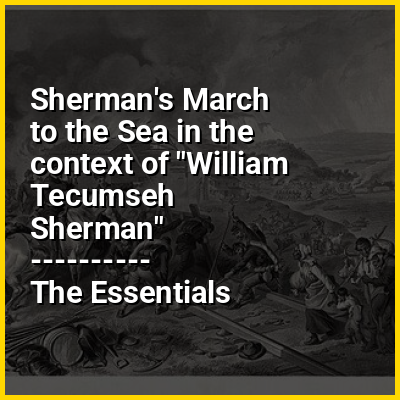
Sherman's March to the Sea (also known as the Savannah campaign or simply Sherman's March) was a military campaign of the American Civil War conducted through Georgia from November 15 until December 21, 1864, by William Tecumseh Sherman, major general of the Union Army. The campaign began on November 15 with Sherman's troops leaving Atlanta, recently taken by Union forces under Sherman, and ended with the capture of the port of Savannah on December 21. Emulating the chevauchée of medieval European warfare, his forces followed a "scorched earth" policy, destroying military targets as well as industry, infrastructure, and civilian property, disrupting the Confederacy's economy and transportation networks.
The operation debilitated the Confederacy and helped lead to its eventual demise. Sherman's decision to operate deep within enemy territory without supply lines was unusual for its time, and his campaign of "hard war" is regarded by some historians as an early example of total war in modern warfare.