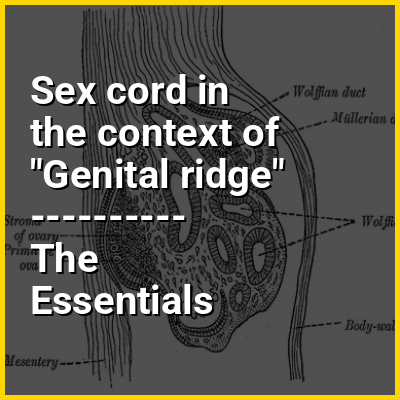
Sex cords are embryonic structures which eventually will give rise (differentiate) to the adult gonads (reproductive organs). They are formed from the genital ridges - which will develop into the gonads - in the first 2 months of gestation (embryonic development) which depending on the sex of the embryo will give rise to male or female sex cords. These epithelial cells (from the genital ridges) penetrate and invade the underlying mesenchyme to form the primitive sex cords. This occurs shortly before and during the arrival of the primordial germ cells (PGCs) to the paired genital ridges. If there is a Y chromosome present, testicular cords will develop via the Sry gene (on the Y chromosome): repressing the female sex cord genes and activating the male. If there is no Y chromosome present the opposite will occur, developing ovarian cords. Prior to giving rise to sex cords, both XX and XY embryos have Müllerian ducts and Wolffian ducts. One of these structures will be repressed to induce the other to further differentiate into the external genitalia.
- ⭐ Core Definition: Sex cord
- Sex cord in the context of SRY
- Sex cord in the context of Granulosa cell
Sex cord in the context of SRY
Sex-determining region Y protein (SRY), or testis-determining factor (TDF), is a DNA-binding protein (also known as gene-regulatory protein/transcription factor) encoded by the SRY gene that is responsible for the initiation of male sex determination in therian mammals (placentals and marsupials). SRY is an intronless sex-determining gene on the Y chromosome. Mutations in this gene lead to a range of disorders of sex development with varying effects on an individual's phenotype and genotype.
SRY is a member of the SOX (SRY-like box) gene family of DNA-binding proteins. When complexed with the steroidogenic factor 1 (SF-1) protein, SRY acts as a transcription factor that causes upregulation of other transcription factors, most importantly SOX9. Its expression causes the development of primary sex cords, which later develop into seminiferous tubules. These cords form in the central part of the yet-undifferentiated gonad, turning it into a testis. The now-induced Leydig cells of the testis then start secreting testosterone, while the Sertoli cells produce anti-Müllerian hormone. Effects of the SRY gene, which normally take place 6–8 weeks after fetus formation, inhibit the growth of female anatomical structure in males. The gene also contributes towards developing the secondary sexual characteristics of males.
View the full Wikipedia page for SRYSex cord in the context of Granulosa cell
A granulosa cell or follicular cell is a somatic cell of the sex cord that is closely associated with the developing female gamete (called an oocyte or egg) in the ovary of mammals.
View the full Wikipedia page for Granulosa cell