Serabit el-Khadim in the context of "Flinders Petrie"

Play Trivia Questions online!

or

Skip to study material about Serabit el-Khadim in the context of "Flinders Petrie"

Ad spacer

⭐ Core Definition: Serabit el-Khadim

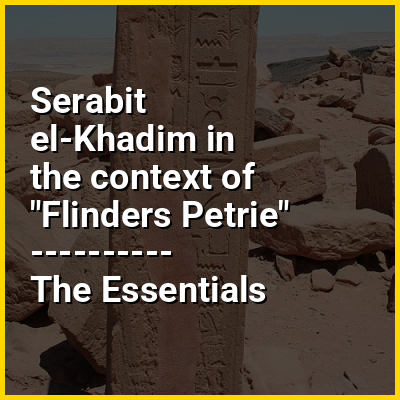
Serabit el-Khadim (Arabic: سرابيط الخادم Arabic pronunciation: [saraːˈbiːtˤ alˈxaːdɪm]; also transliterated Serabit al-Khadim, Serabit el-Khadem) is a locality in the southwest Sinai Peninsula, Egypt, where valuable resources such as turquoise were mined extensively in antiquity, mainly by the ancient Egyptians. Archaeological excavation, initially by Sir Flinders Petrie, revealed ancient mining camps and a long-lived Temple of Hathor, the Egyptian goddess of sensual power, who was favored as a protector in desert regions and known locally as the mistress of turquoise.  

The Sinai Peninsula between Egypt and Western Asia was an important mining area for copper and malachite in ancient Egypt, Serabit el-Khadim being the most important copper mining site in the region. The temple was first established during the Middle Kingdom in the reign of Senusret I (reigned 1971 BC to 1926 BC) and was partly reconstructed in the New Kingdom. The temple is located about 10 kilometers north of Wadi Maghara, another archaeological site, and roughly 43 kilometers east of the modern-day city, Abu Zenima. The function of the temple was to honor the goddess Hathor who acted as a guide to the Egyptian Kings who had undertaken expeditions to utilize these mines, and to glorify the power of the Pharaohs that had overseen these missions.
↓ Menu

>>>PUT SHARE BUTTONS HERE<<<
In this Dossier

Serabit el-Khadim in the context of Serabit el-Khadim proto-Sinaitic inscriptions

The Serabit el-Khadim proto-Sinaitic inscriptions are about 30 early alphabetic inscriptions in proto-Sinaitic script found at or in the vicinity of Serabit el-Khadim on the Sinai Peninsula.

↑ Return to Menu

Serabit el-Khadim in the context of Amenemhat III

Amenemhat III (Ancient Egyptian: Ỉmn-m-hꜣt meaning 'Amun is at the forefront'), also known as Amenemhet III, was a pharaoh of ancient Egypt and the sixth king of the Twelfth Dynasty of the Middle Kingdom. He was elevated to throne as co-regent by his father Senusret III, with whom he shared the throne as the active king for twenty years. During his reign, Egypt attained its cultural and economic zenith of the Middle Kingdom.

The aggressive military and domestic policies of Senusret III, which re-subjugated Nubia and wrested power from the nomarchs, allowed Amenemhat III to inherit a stable and peaceful Egypt. He directed his efforts towards an extensive building program with particular focus on Faiyum. Here he dedicated a temple to Sobek, a chapel to Renenutet, erected two colossal statues of himself in Biahmu, and contributed to excavation of Lake Moeris. He built for himself two pyramids at Dahshur and Hawara, becoming the first pharaoh since Sneferu in the Fourth Dynasty to build more than one. Near to his Hawara pyramid is a pyramid for his daughter Neferuptah. To acquire resources for the building program, Amenemhat III exploited the quarries of Egypt and the Sinai for turquoise and copper. Other exploited sites includes the schist quarries at Wadi Hammamat, amethyst from Wadi el-Hudi, fine limestone from Tura, alabaster from Hatnub, red granite from Aswan, and diorite from Nubia. A large corpus of inscriptions attest to the activities at these sites, particularly at Serabit el-Khadim. There is scant evidence of military expeditions during his reign, though a small one is attested at Kumma in his ninth regnal year. He also sent a handful of expeditions to Punt.

↑ Return to Menu