Senegalia in the context of Pseudosenegalia


Senegalia in the context of Pseudosenegalia

⭐ Core Definition: Senegalia

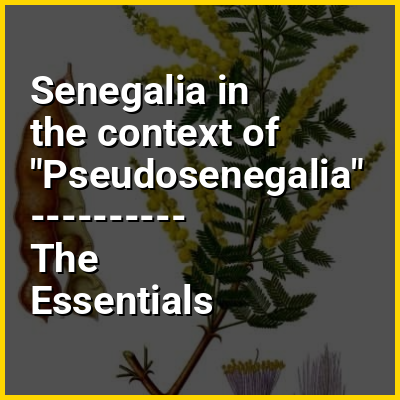
Senegalia (from Senegal and Acacia senegal (L.) Willd.) is a genus of flowering plants in the family Fabaceae. It belongs to the Mimosoid clade. Until 2005, its species were considered members of Acacia.The genus was considered polyphyletic and required further division, with the genera Parasenegalia and Pseudosenegalia accepted soon after.

Senegalia can be distinguished from other acacias by its spicate inflorescences and non-spinescent stipules. Plants in the genus are native to the tropical and subtropical areas of the world, occurring on the Australian, Asian, African and South and North American continents, as well as in Wallacea.

↓ Menu
HINT:

In this Dossier

Senegalia in the context of Senegalia senegal

Senegalia senegal (also known as Acacia senegal) is a small thorny deciduous tree from the genus Senegalia, which is known by several common names, including gum acacia, gum arabic tree, Sudan gum and Sudan gum arabic. In parts of India, it is known as kher, khor, or kumatiya. It is native to semi-desert regions of Sub-Saharan Africa, as well as Oman, Pakistan, and west coastal India. It grows to a height of 5–12 metres (16-40'), with a trunk up to 30 cm (1') in diameter. Sudan is the source of the world's highest quality gum arabic, known locally as hashab gum in contrast to the related, but inferior, gum arabic from Red acacia or talah gum.

View the full Wikipedia page for Senegalia senegal
↑ Return to Menu

Senegalia in the context of Acacia sensu lato

Acacia s.l. (pronounced /əˈkʃə/ or /əˈksiə/), known commonly as mimosa, acacia, thorntree or wattle, is a polyphyletic genus of shrubs and trees belonging to the subfamily Mimosoideae of the family Fabaceae. It was described by the Swedish botanist Carl Linnaeus in 1773 based on the African species Acacia nilotica, now classified as Vachellia nilotica. Many non-Australian species tend to be thorny. Most Australian acacias are not. All species are pod-bearing, with sap and leaves often bearing large amounts of tannins and condensed tannins that historically found use as pharmaceuticals and preservatives.

The genus Acacia constitutes, in its traditional circumspection, the second largest genus in Fabaceae (Astragalus being the largest), with roughly 1,300 species, about 960 of them native to Australia, with the remainder spread around the tropical to warm-temperate regions of both hemispheres, including Europe, Africa, southern Asia, and the Americas (see List of Acacia species). The genus was divided into five separate genera under "Mimosoideae". The genus now called Acacia represents the majority of the Australian species and a few native to Southeast Asia, Réunion, and the Pacific Islands. Most of the species outside Australia, and a small number of Australian species, are classified into Vachellia and Senegalia. The two final genera, Acaciella and Mariosousa, each contain about a dozen species from the Americas (but see "Classification" below for the ongoing debate concerning their taxonomy).

View the full Wikipedia page for Acacia sensu lato
↑ Return to Menu

Senegalia in the context of Acaciella

Acaciella is a Neotropical genus of flowering plants in the legume family, Fabaceae, and its subfamily Mimosoideae. Its centre of diversity is along the Mexican Pacific coast. They are unarmed, have no extrafloral nectaries and the polyads of their pollen are 8-celled. Though its numerous free stamens (sometimes >300) is typical of Acacia s.l., it has several characteristics in common with genus Piptadenia (tribe Mimoseae). Its pollen and free amino acids resemble that of Senegalia. Molecular studies place it sister to a monophyletic clade comprising elements of genus Acacia, and the tribe Ingeae. A nectary ring is present between the stamens and ovary, in common with Acacia subg. Aculeiferum.

View the full Wikipedia page for Acaciella
↑ Return to Menu