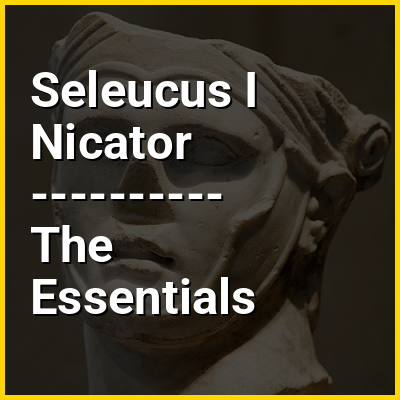
Seleucus I Nicator (/sɪˈluːkəs/; Greek: Σέλευκος Νικάτωρ, Séleukos Nikátōr, "Seleucus the Victorious"; c. 358 BC – 281 BC) was a Macedonian Greek general, officer and successor of Alexander the Great who went on to found the eponymous Seleucid Empire, led by the Seleucid dynasty. Initially a secondary player in the power struggles following Alexander's death, Seleucus rose to become the total ruler of Asia Minor, Syria, Mesopotamia, and the Iranian plateau, assuming the title of basileus (king). The Seleucid Empire was one of the major powers of the Hellenistic world, until it was overcome by the Roman Republic and Parthian Empire in the late second and early first centuries BC.
While serving under Alexander, Seleucus was commander of the Hypaspistai, an elite Macedonian infantry unit. After the death of Alexander in June 323 BC, Seleucus initially supported Perdiccas, the regent of Alexander's empire, and was appointed Commander of the Companions and chiliarch at the Partition of Babylon in 323 BC. However, after the outbreak of the Wars of the Diadochi in 322, Perdiccas' military failures against Ptolemy in Egypt led to the mutiny of his troops in Pelusium. Perdiccas was betrayed and assassinated in a conspiracy by Seleucus, Peithon and Antigenes in Pelusium sometime in either 321 or 320 BC. At the Partition of Triparadisus in 321 BC, Seleucus was appointed Satrap of Babylon under the new regent Antipater. But almost immediately, the wars between the Diadochi resumed and one of the most powerful of the Diadochi, Antigonus, forced Seleucus to flee Babylon. Seleucus was only able to return to Babylon in 312 BC with the support of Ptolemy. From 312 BC, Seleucus ruthlessly expanded his dominions and eventually conquered the Persian and Median lands. Seleucus ruled not only Babylonia, but the entire eastern part of Alexander's empire.