Second Battle of St Albans in the context of "Richard Neville, Earl of Warwick"

Play Trivia Questions online!

or

Skip to study material about Second Battle of St Albans in the context of "Richard Neville, Earl of Warwick"

Ad spacer

⭐ Core Definition: Second Battle of St Albans

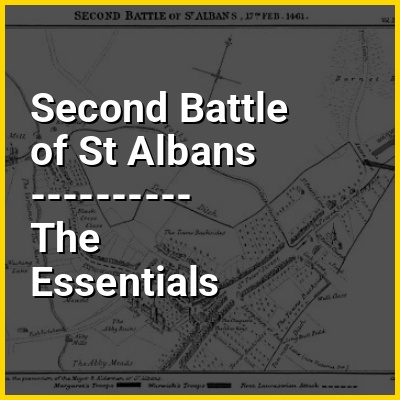
The Second Battle of St Albans was fought on 17 February 1461 during the Wars of the Roses in St Albans, Hertfordshire, England (the First Battle of St Albans had been fought in 1455).

The army of the Yorkist faction, under the Earl of Warwick, attempted to bar the road to London north of the town. The rival Lancastrian army used a wide outflanking manoeuvre to take Warwick by surprise, cut him off from London and drive his army from the field. The victors also released the feeble King Henry VI, who had been Warwick's prisoner, from his captivity, but they ultimately failed to take advantage of their victory.

↓ Menu

>>>PUT SHARE BUTTONS HERE<<<
In this Dossier

Second Battle of St Albans in the context of Wars of the Roses

The Wars of the Roses, known at the time and in following centuries as the Civil Wars, and also the Cousins' War, were a series of armed confrontations, machinations, battles and campaigns fought for control of the English throne from 1455 to 1487. The conflict was fought between supporters of the House of Lancaster (emblem a red rose) and House of York (white rose), two rival cadet branches of the royal House of Plantagenet. The conflict resulted in the end of Lancaster's male line in 1471, leaving the Tudor family to inherit their claim to the throne through the female line. Conflict was largely brought to an end upon the union of the two houses through marriage, creating the Tudor dynasty that would subsequently rule England.

The Wars of the Roses were rooted in English socio-economic troubles caused by the Hundred Years' War (1337–1453) with France, as well as the quasi-military bastard feudalism resulting from the powerful duchies created by King Edward III. The mental instability of King Henry VI of the House of Lancaster revived his cousin Richard, Duke of York's interest in a claim to the throne. Warfare began in 1455 with York's capture of Henry at the First Battle of St Albans, upon which York was appointed Lord Protector by Parliament. Fighting resumed four years later when Yorkists led by Richard Neville, Earl of Warwick, captured Henry again at the Battle of Northampton. After attempting to seize the throne, York was killed at the Battle of Wakefield, and his son Edward inherited his claim per the controversial Act of Accord. The Yorkists lost custody of Henry in 1461 after the Second Battle of St Albans, but defeated the Lancastrians at the Battle of Towton. The Yorkist Edward was formally crowned in June 1461.
↑ Return to Menu

Second Battle of St Albans in the context of Elizabeth Woodville

Elizabeth Woodville (also spelt Wydville, Wydeville, or Widvile; c. 1437 – 8 June 1492), known as Dame Elizabeth Grey during her first marriage, was Queen of England from 1 May 1464 until 3 October 1470 and from 11 April 1471 until 9 April 1483 as the wife of King Edward IV. She was a key figure in the Wars of the Roses, a dynastic civil war between the Lancastrian and the Yorkist factions between 1455 and 1487.

At the time of her birth, Elizabeth's family was of middle rank in the English social hierarchy. Her mother, Jacquetta of Luxembourg, had previously been an aunt-by-marriage to King Henry VI, and was the daughter of Peter I, Count of Saint-Pol. Elizabeth's first marriage was to a minor supporter of the House of Lancaster, John Grey of Groby. He died at the Second Battle of St Albans in 1461, leaving Elizabeth a widowed mother of two young sons.

↑ Return to Menu