Scythian campaign of Darius I in the context of "East Iranian"

Play Trivia Questions online!

or

Skip to study material about Scythian campaign of Darius I in the context of "East Iranian"

Ad spacer

⭐ Core Definition: Scythian campaign of Darius I

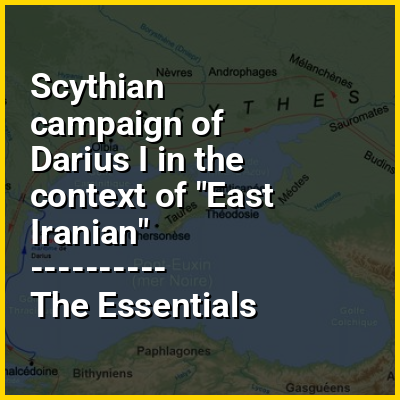
The Scythian campaign of Darius I was a military expedition into parts of European Scythia by Darius I, the king of the Achaemenid Empire, in 513 BC. The Scythians were an East Iranian-speaking people who had invaded Media, revolted against Darius and threatened to disrupt trade between Central Asia and the shores of the Black Sea as they lived between the Danube and Don Rivers and the Black Sea. The campaigns took place in parts of what is now the Balkans, Ukraine, and southern Russia.

The Scythians managed to avoid a direct confrontation with the Persian army due to their mobile lifestyle and lack of any settlement (except Gelonus), while the Persians suffered losses due to the Scythians' scorched earth tactic. However, the Persians conquered much of their cultivated lands and damaged their allies, forcing the Scythians to respect the Persian force. Darius halted the advance to consolidate his gains, and built a defence line.
↓ Menu

>>>PUT SHARE BUTTONS HERE<<<
In this Dossier

Scythian campaign of Darius I in the context of Getae

The Getae or Getai (/ˈɡɛt/ or /ˈt/,; Ancient Greek: Γέται; also Getans) were a large nation who inhabited the regions to either side of the Lower Danube in what is today northern Bulgaria and southern Romania, throughout much of Classical Antiquity. The main source of information about the Getae are Greek and Roman chroniclers, who write that the Getae were closely related to the neighbouring Thracians to the south and Dacians to the north. Cassius Dio writes that the Getae are the same people as the Dacians, Getae being the Greek name for the Dacians. Modern scholars continue to debate the details of these relationships.

The Getae first appear in historical records as fierce opponents of the Persian invasion in 513 BC, as described by the early Greek historian Herodotus. They faded out of historical records during the Roman Empire, when many appear to have become Romans, and others north of the Danube were gradually overwhelmed by other peoples moving from the north and east towards the Roman frontier.

↑ Return to Menu