Scott Joplin in the context of Rag-time


Scott Joplin in the context of Rag-time

Scott Joplin Study page number 1 of 1

Play TriviaQuestions Online!

or

Skip to study material about Scott Joplin in the context of "Rag-time"


⭐ Core Definition: Scott Joplin

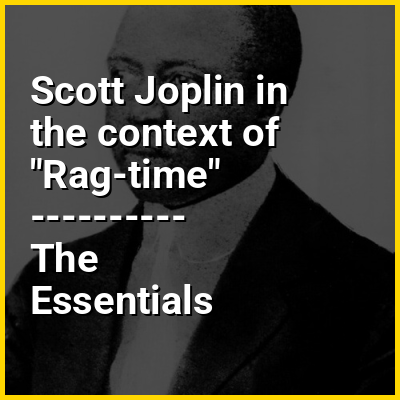
Scott Joplin (November 24, 1868 – April 1, 1917) was an American composer and pianist. Dubbed the "King of Ragtime", he composed more than 40 ragtime pieces, one ragtime ballet (original version of "The Ragtime Dance", 1899/1902), and two operas. One of his first and most popular pieces, the "Maple Leaf Rag", became the genre's first and most influential hit, later being recognized as the quintessential rag. Joplin considered ragtime to be a form of classical music meant to be played in concert halls and largely disdained the performance of ragtime as honky tonk music most common in saloons.

Joplin grew up in a musical family of railway laborers in Texarkana, Texas. During the late 1880s, he traveled the American South as a musician. He went to Chicago for the World's Fair of 1893, which helped make ragtime a national craze by 1897. Joplin moved to Sedalia, Missouri, in 1894 and worked as a piano teacher. He began publishing music in 1895, and his "Maple Leaf Rag" in 1899 brought him fame and a steady income. In 1901, Joplin moved to St. Louis and two years later scored his first opera, A Guest of Honor. It was confiscated—along with his belongings—for non-payment of bills and is now considered lost. In 1907, Joplin moved to New York City to (unsuccessfully) find a producer for a new opera. In 1916, Joplin descended into dementia from neurosyphilis. His 1917 death marks the end of the ragtime era.
↓ Menu
HINT:

In this Dossier

Scott Joplin in the context of Ragtime

Ragtime, also spelled rag-time or rag time, is a musical style that was popular and heavily influenced musical genres such as the Blues, and was seen in the United States from the 1890s to 1910s. Its signature trait is its syncopated or "ragged" rhythm. Ragtime was popularized during the early 20th century by composers such as Scott Joplin, James Scott, and Joseph Lamb. Ragtime pieces (often called "rags") are typically composed for and performed on the piano, though the genre has been adapted for a variety of instruments and styles.

Ragtime music originated within African American communities in the late 19th century and became a distinctly American form of popular music. It is closely related to marches. Ragtime pieces usually contain several distinct themes, often arranged in patterns of repeats and reprises. Scott Joplin, known as the "King of Ragtime", gained fame through compositions like "Maple Leaf Rag" and "The Entertainer". Ragtime influenced early jazz, Harlem stride piano, Piedmont blues, and early 20th century European classical composers such as Erik Satie, Claude Debussy, and Igor Stravinsky. Despite being overshadowed by jazz in the 1920s, ragtime has experienced several revivals, notably in the 1950s and 1970s (the latter renaissance due in large part to the use of "The Entertainer" in the film The Sting). The music was distributed primarily through sheet music and piano rolls, with some compositions adapted for other instruments and ensembles.

View the full Wikipedia page for Ragtime
↑ Return to Menu

Scott Joplin in the context of Tone cluster

A tone cluster is a musical chord comprising at least three adjacent tones in a scale. Prototypical tone clusters are based on the chromatic scale and are separated by semitones. For instance, three adjacent piano keys (such as C, C, and D) struck simultaneously produce a tone cluster. Variants of the tone cluster include chords comprising adjacent tones separated diatonically, pentatonically, or microtonally. On the piano, such clusters often involve the simultaneous striking of neighboring white or black keys.

The early years of the twentieth century saw tone clusters elevated to central roles in pioneering works by ragtime artists Jelly Roll Morton and Scott Joplin. In the 1910s, two classical avant-gardists, composer-pianists Leo Ornstein and Henry Cowell, were recognized as making the first extensive explorations of the tone cluster. During the same period, Charles Ives employed them in several compositions that were not publicly performed until the late 1920s or 1930s, as did Béla Bartók in the latter decade. Since the mid-20th century, they have prominently featured in the work of composers such as Lou Harrison, Giacinto Scelsi, Alfred Schnittke and Karlheinz Stockhausen, and later Eric Whitacre. Tone clusters also play a significant role in the work of free jazz musicians such as Cecil Taylor, Matthew Shipp, and Kevin Kastning.

View the full Wikipedia page for Tone cluster
↑ Return to Menu

Scott Joplin in the context of Stop-time

In tap dancing, jazz, and blues, stop-time is an accompaniment pattern interrupting, or stopping, the normal time and featuring regular accented attacks on the first beat of each or every other measure, alternating with silence or instrumental solos. Stop-time occasionally appears in ragtime music. The characteristics of stop-time are heavy accents, frequent rests, and a stereotyped cadential pattern. Stop-timing may create the impression that the tempo has changed, though it has not, as the soloist continues without accompaniment. Stop-time is common in African-American popular music including R&B, soul music, and led to the development of the break in hip hop.

Stop-time is, according to Samuel A. Floyd Jr., "a musical device in which the forward flow of the music stops, or seems to stop, suspended in a rhythmic unison, while in some cases an improvising instrumentalist or singer continues solo with the forward flow of the meter and tempo. Such stop-time moments are sometimes repeated, creating an illusion of starting and stopping, as, for example, in Scott Joplin's "The Ragtime Dance" and Jelly Roll Morton's "King Porter Stomp"."

View the full Wikipedia page for Stop-time
↑ Return to Menu

Scott Joplin in the context of Maple Leaf Rag

The "Maple Leaf Rag" (copyright registered on September 18, 1899) is an early ragtime musical piece composed for piano by Scott Joplin. It was one of Joplin's early works, becoming the model for ragtime compositions by subsequent composers. It is one of the most famous of all ragtime pieces. Its success led to Joplin being dubbed the "King of Ragtime" by his contemporaries. The piece gave Joplin a steady if unspectacular income for the rest of his life.

Despite ragtime's decline after Joplin's death in 1917, the "Maple Leaf Rag" continued to be recorded by many well-known artists. The ragtime revival of the 1970s brought it back to mainstream public notice once again.

View the full Wikipedia page for Maple Leaf Rag
↑ Return to Menu

Scott Joplin in the context of James Scott (composer)

James Sylvester Scott (February 12, 1885 – August 30, 1938) was an American ragtime composer and pianist. He is regarded as one of the "Big Three" composers of classical ragtime along with Scott Joplin and Joseph Lamb.

View the full Wikipedia page for James Scott (composer)
↑ Return to Menu

Scott Joplin in the context of Joseph Lamb (composer)

Joseph Francis Lamb (December 6, 1887 – September 3, 1960) was an American composer of ragtime music. Lamb, of Irish descent, was the only non-African American of the "Big Three" composers of classical ragtime, the other two being Scott Joplin and James Scott. The ragtime of Joseph Lamb ranges from standard popular fare to complex and highly engaging. His use of long phrases was influenced by classical works he had learned from his sister and others while growing up, but his sense of structure was potentially derived from his study of Joplin's piano rags. By the time he added some polish to his later works in the 1950s, Lamb had mastered the classic rag genre in a way that almost no other composer was able to approach at that time, and continued to play it passably as well, as evidenced by at least two separate recordings done in his home, as well as a few recorded interviews.

View the full Wikipedia page for Joseph Lamb (composer)
↑ Return to Menu

Scott Joplin in the context of The Entertainer (rag)

"The Entertainer" is a 1902 classic piano rag written by Scott Joplin.

It was sold first as sheet music by John Stark & Son of Saint Louis, Missouri, and in the 1910s as piano rolls that would play on player pianos. The first recording was by blues and ragtime musicians "the Blue Boys" in 1928, played on mandolin and guitar.

View the full Wikipedia page for The Entertainer (rag)
↑ Return to Menu

Scott Joplin in the context of The Sting

The Sting is a 1973 American caper film. Set in 1936, it involves a complicated plot by two professional grifters (Paul Newman and Robert Redford) to con a mob boss (Robert Shaw). The film was directed by George Roy Hill, who had directed Newman and Redford in Butch Cassidy and the Sundance Kid (1969). The screenplay, by David S. Ward, was inspired by real-life cons perpetrated by brothers Fred and Charley Gondorff and documented by David Maurer in his 1940 book The Big Con: The Story of the Confidence Man.

The film plays out in sections introduced by old-fashioned title cards, drawn by artist Jaroslav "Jerry" Gebr in a style reminiscent of the Saturday Evening Post. It is noted for its use of ragtime, particularly the melody "The Entertainer" by Scott Joplin, which was adapted (along with other Joplin pieces) for the film by Marvin Hamlisch, producing a Billboard-topping soundtrack and a top-10 single. The film's success created a resurgence of interest in Joplin's work.

View the full Wikipedia page for The Sting
↑ Return to Menu