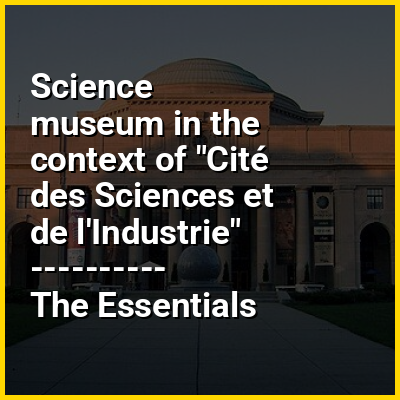
Science museum in the context of "Cité des Sciences et de l'Industrie"

Play Trivia Questions online!

or

Skip to study material about Science museum in the context of "Cité des Sciences et de l'Industrie"


⭐ Core Definition: Science museum

A science museum is a museum devoted primarily to science. Older science museums tended to concentrate on static displays of objects related to natural history, paleontology, geology, industry and industrial machinery, etc. Modern trends in museology have broadened the range of subject matter and introduced many interactive exhibits. Modern science museums, increasingly referred to as "science centres" or "discovery centres", also feature technology.

While the mission statements of science centres and modern museums may vary, they are commonly places that make science accessible and encourage the excitement of discovery.

↓ Menu

👉 Science museum in the context of Cité des Sciences et de l'Industrie

48°53′44″N 2°23′17″E / 48.89556°N 2.38806°E / 48.89556; 2.38806

The Cité des Sciences et de l'Industrie (French pronunciation: [site de sjɑ̃s e lɛ̃dystʁi], "City of Science and Industry", abbreviated la CSI) or simply CSI is a large science museum in Europe. Located in the Parc de la Villette in Paris, France, it is one of the three dozen French Cultural Centers of Science, Technology and Industry (CCSTI), promoting science and science culture.

↓ Explore More Topics
In this Dossier

Science museum in the context of Science Museum of Virginia

The Science Museum of Virginia is a science museum located in Richmond, Virginia. Established in 1970, it is an agency of the Commonwealth of Virginia. It is housed in the former Broad Street Station, built in 1917.

↑ Return to Menu

Science museum in the context of CosmoCaixa Barcelona

CosmoCaixa Barcelona (Catalan pronunciation: [ˌkɔzmuˈkaʃə βəɾsəˈlonə]) is a science museum located in Barcelona, Catalonia, Spain. It features a variety of permanent and temporary exhibitions devoted to the environment, nature, science, and space. The museum is sponsored by "La Caixa" banking foundation.

Formerly known as the Science Museum of Barcelona, it closed for renovations in 1998 and reopened in 2004 under its current name. It has interactive exhibitions such as touch and play for small children, planetarium, bookstore, gift shop, library, teaching center and café. Entry to the museum is free for children under the age of sixteen. Adults can visit the museum with a regular ticket.

↑ Return to Menu

Science museum in the context of Foucault pendulum

The Foucault pendulum or Foucault's pendulum is a simple device named after French physicist Léon Foucault, conceived as an experiment to demonstrate the Earth's rotation. If a long and heavy pendulum suspended from the high roof above a circular area is monitored over an extended period of time, its plane of oscillation appears to change spontaneously as the Earth makes its 24-hourly rotation. This effect is greatest at the poles and diminishes with lower latitude until it no longer exists at Earth's equator.

The pendulum was introduced in 1851 and was the first experiment to give simple, direct evidence of the Earth's rotation. Foucault followed up in 1852 with a gyroscope experiment to further demonstrate the Earth's rotation. Foucault pendulums have become popular in science museums and universities.

↑ Return to Menu

Science museum in the context of Heritage interpretation

Heritage interpretation refers to all the ways in which information is communicated to visitors to an educational, natural or recreational site, such as a museum, park or science centre. More specifically it is the communication of information about, or the explanation of, the nature, origin, and purpose of historical, natural, or cultural resources, objects, sites and phenomena using personal or non-personal methods. Some international authorities in museology prefer the term mediation for the same concept, following usage in other European languages.

Heritage interpretation may be performed at dedicated interpretation centres or at museums, historic sites, parks, art galleries, nature centres, zoos, aquaria, botanical gardens, nature reserves and a host of other heritage sites. Its modalities can be extremely varied and may include guided walks, talks, drama, staffed stations, displays, signs, labels, artwork, brochures, interactives, audio-guides and audio-visual media. The process of developing a structured approach to interpreting these stories, messages and information is called interpretive planning. The thematic approach to heritage interpretation advocated by University of Idaho professor Sam Ham, the National Association for Interpretation, the US National Park Service, and others, is considered best practice.

↑ Return to Menu

Science museum in the context of Old Town Albuquerque

Old Town is the historic original town site of Albuquerque, New Mexico, for the provincial kingdom of Santa Fe de Nuevo México, established in 1706 by New Mexico governor Francisco Cuervo y Valdés. It is listed on the New Mexico State Register of Cultural Properties as the Old Albuquerque Historic District, and is protected by a special historic zoning designation by the city. However, prior to its establishment as a city in the Santa Fe de Nuevo México province, many indigenous tribes lived there including Diné, Pueblo, Apache, Tiwa, and others. The present-day district contains about ten blocks of historic adobe buildings surrounding Old Town Plaza. On the plaza's north side stands San Felipe de Neri Church, a Spanish colonial church constructed in 1793.

Old Town is a popular tourist destination with a large number of restaurants, shops, and galleries, and is also home to the Albuquerque Museum of Art and History. The New Mexico Museum of Natural History and Science and the Explora science center are located a short distance to the northeast. Old Town is known for its luminaria displays during the holiday season, particularly on Christmas Eve.

↑ Return to Menu

Science museum in the context of Teylers Museum

Teylers Museum (Dutch pronunciation: [ˈtɛilərs myˈzeːjʏm]) is an art, natural history, and science museum in Haarlem, Netherlands. Established in 1778, Teylers Museum was founded as a centre for contemporary art and science. The historic centre of the museum is the neoclassical Oval Room (1784), which was built behind the house of Pieter Teyler van der Hulst (1702–1778), the so-called Fundatiehuis (Foundation House). Pieter Teyler was a wealthy cloth merchant and banker of Scottish descent, who bequeathed his fortune for the advancement of religion, art, and science. He was a Mennonite and follower of the Scottish Enlightenment.

↑ Return to Menu