Science fiction film in the context of "Fantasy film"

Play Trivia Questions online!

or

Skip to study material about Science fiction film in the context of "Fantasy film"

Ad spacer

⭐ Core Definition: Science fiction film

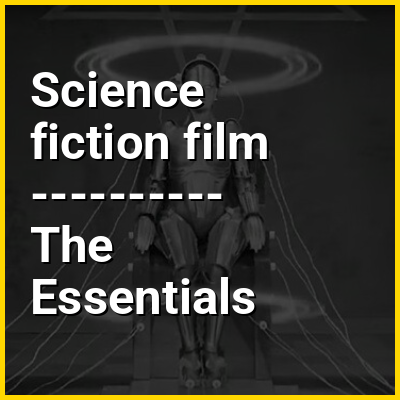
Science fiction (or sci-fi) is a film genre that uses speculative, science-based depictions of phenomena that are not fully accepted by mainstream science, such as extraterrestrial lifeforms, spacecraft, robots, cyborgs, mutants, interstellar travel, time travel, or other technologies. Science fiction films have often been used to focus on political or social issues, and to explore philosophical issues like the human condition.

The genre has existed since the early years of silent cinema, when Georges Méliès' A Trip to the Moon (1902) employed trick photography effects. The next major example (first in feature-length in the genre) was the film Metropolis (1927). From the 1930s to the 1950s, the genre consisted mainly of low-budget B movies. After Stanley Kubrick's landmark 2001: A Space Odyssey (1968), the science fiction film genre was taken more seriously. In the late 1970s, big-budget science fiction films filled with special effects became popular with audiences after the success of Star Wars (1977) and paved the way for the blockbuster hits of subsequent decades.
↓ Menu

>>>PUT SHARE BUTTONS HERE<<<
In this Dossier

Science fiction film in the context of War of the Worlds (2005 film)

War of the Worlds is a 2005 American science fiction action-thriller film directed by Steven Spielberg and written by Josh Friedman and David Koepp, based on H. G. Wells' 1898 novel, The War of the Worlds. Tom Cruise stars in the main role alongside Dakota Fanning, Miranda Otto, and Tim Robbins, with narration by Morgan Freeman. It follows an American dock worker who must look after his estranged children as he struggles to protect and reunite them with their mother when extraterrestrials invade Earth and devastate cities with giant war machines.

Produced by Paramount Pictures, DreamWorks Pictures, Amblin Entertainment, and Cruise/Wagner Productions, the film was shot in 73 days, using five different sound stages as well as locations in California, Connecticut, New Jersey, New York, and Virginia. It was surrounded by a secrecy campaign so few details would be leaked before its release. Tie-in promotions were made with several companies, including Hitachi.

↑ Return to Menu

Science fiction film in the context of A Trip to the Moon

A Trip to the Moon (French: Le Voyage dans la Lune [lə vwajaʒ dɑ̃ la lyn], transl. "The Journey to the Moon") is a 1902 French science-fiction adventure trick film written, directed and produced by Georges Méliès. Inspired by the Jules Verne novel From the Earth to the Moon (1865) and its sequel Around the Moon (1870), the film follows a group of astronomers who travel to the Moon in a cannon-propelled capsule, explore the Moon's surface, escape from an underground group of Selenites (lunar inhabitants), and return to Earth with a captive Selenite. Méliès leads an ensemble cast of French theatrical performers as the main character Professor Barbenfouillis.

Although the film disappeared into obscurity (after Méliès's retirement from the film industry) it was rediscovered around 1930, when Méliès's importance to the history of cinema was beginning to be recognised by film devotees. An original hand-colored print was discovered in 1993, and restored in 2011.

↑ Return to Menu

Science fiction film in the context of Pixels (2015 film)

Pixels (marketed as Pixels: The Movie) is a 2015 science fiction action comedy film directed by Chris Columbus from a screenplay by Tim Herlihy and Tim Dowling, based on a story by Herlihy. Loosely adapted from the 2010 short film Pixels by Patrick Jean (who serves as an executive producer on the film), the film stars Adam Sandler, Kevin James, Michelle Monaghan, Peter Dinklage, Josh Gad and Brian Cox. In the film, an alien force misinterprets video feeds of classic arcade games as a declaration of war, resulting in them attacking Earth with technological recreations of icons from the games. The President of the United States promptly assembles a team of former arcade champions to lead the planet's defense.

Development on the film began in 2010, when Sandler obtained the rights to Jean's short film via his Happy Madison Productions company and began developing the script with Herlihy. In 2013, Columbus entered talks to direct the film, drawn to the nostalgic homage to 1980s arcade games like Pac-Man, Donkey Kong and Space Invaders, all of which were licensed for use in the film. Filming took place in Toronto for three months, which involved extensive night shoots and practical sets. Post-production, led by Digital Domain and Sony Pictures Imageworks, focused on creating voxelized 3D versions of arcade characters to integrate into the live-action scenes.

↑ Return to Menu

Science fiction film in the context of Tokusatsu

Tokusatsu (特撮とくさつ; lit.'special filming') is a Japanese term for live-action films or television programs that make heavy use of practical special effects. Credited to special effects director Eiji Tsuburaya, tokusatsu mainly refers to science fiction, superhero, fantasy, or horror media featuring such technology but is also occasionally dubbed a genre itself. Its contemporary use originated in the Japanese mass media around 1958 to explain special effects in an easy-to-understand manner and was popularized during the "first monster boom" (1966–1968). Prior to the monster boom, it was known in Japan as tokushu gijutsu (特殊技術; lit.'special technology') or shortened tokugi (特技; lit.'special technique').

Subgenres of tokusatsu include kaiju such as the Godzilla and Gamera series; superhero such as the Kamen Rider and Metal Hero series; Kyodai Hero like Ultraman and Denkou Choujin Gridman; and mecha like Giant Robo and Super Robot Red Baron. Some tokusatsu television programs combine several of these subgenres, for example, the Super Sentai series.

↑ Return to Menu

Science fiction film in the context of Star Wars (film)

Star Wars (also known as Star Wars: Episode IV – A New Hope) is a 1977 American epic space opera film written and directed by George Lucas, produced by Lucasfilm Ltd. and released by Twentieth Century-Fox. It is the first film in the Star Wars franchise and the fourth chronological chapter of the "Skywalker Saga". Set in a fictional galaxy under the rule of the tyrannical Galactic Empire, the film follows a resistance movement, called the Rebel Alliance, that aims to destroy the Empire's ultimate weapon, the Death Star. When the rebel leader Princess Leia is captured by the Galactic Empire, Luke Skywalker acquires stolen architectural plans for the Death Star and sets out to rescue her while learning the ways of a metaphysical power known as "the Force" from the Jedi Master Obi-Wan Kenobi. The cast includes Mark Hamill, Harrison Ford, Carrie Fisher, Peter Cushing, Alec Guinness, Anthony Daniels, Kenny Baker, Peter Mayhew, David Prowse, and James Earl Jones.

Lucas had the idea for a science fiction film in the vein of Flash Gordon around the time he completed his first film, THX 1138 (1971), and he began working on a treatment after the release of American Graffiti (1973). After numerous rewrites, principal photography began in March of 1976 in locations including Tunisia and Elstree Studios in Hertfordshire, England. Lucas formed the visual effects company Industrial Light & Magic to help create the film's visual effects. Star Wars suffered production difficulties: the cast and crew believed the film would be a failure, and it went $3 million over budget due to delays.

↑ Return to Menu

Science fiction film in the context of Close Encounters of the Third Kind

Close Encounters of the Third Kind is a 1977 American science fiction drama film written and directed by Steven Spielberg, starring Richard Dreyfuss, Melinda Dillon, Teri Garr, Bob Balaban, Cary Guffey, and François Truffaut. The film depicts the story of Roy Neary, an everyday blue-collar worker in Indiana, whose life changes after an encounter with an unidentified flying object (UFO), and Jillian Guiler, a single mother whose three-year-old son Barry is abducted during the same UFO manifestation.

Close Encounters was a long-cherished project for Spielberg. In late 1973, he developed a deal with Columbia Pictures for a science-fiction film. Though Spielberg received sole credit for the script, he was assisted by Paul Schrader, John Hill, David Giler, Hal Barwood, Matthew Robbins, and Jerry Belson, all of whom contributed to the screenplay in varying degrees. The title is derived from Ufologist J. Allen Hynek's classification of close encounters with extraterrestrials, in which the third kind denotes human observations of extraterrestrials or "animate beings". Douglas Trumbull served as the visual effects supervisor, while Carlo Rambaldi designed the aliens.

↑ Return to Menu

Science fiction film in the context of E.T. the Extra-Terrestrial

E.T. the Extra-Terrestrial (or simply E.T.) is a 1982 American science fiction film produced and directed by Steven Spielberg and written by Melissa Mathison. It tells the story of Elliott, a boy who befriends an extraterrestrial that he names E.T. who has been stranded on Earth. Along with his friends and family, Elliott must find a way to help E.T. find his way home. The film stars Dee Wallace, Henry Thomas, Peter Coyote, Robert MacNaughton, and Drew Barrymore.

The film's concept was based on an imaginary friend that Spielberg created after his parents' divorce. In 1980, Spielberg met Mathison and developed a new story from the unrealized project Night Skies. In less than two months, Mathison wrote the first draft of the script, titled E.T. and Me, which went through two rewrites. The project was rejected by Columbia Pictures, who doubted its commercial potential. Universal Pictures eventually purchased the script for $1 million. Filming took place from September to December 1981 on a budget of $10.5 million. Unlike most films, E.T. was shot in rough chronological order to facilitate convincing emotional performances from the young cast. The animatronics for the film were designed by Carlo Rambaldi.

↑ Return to Menu

Science fiction film in the context of Georges Méliès

Marie-Georges-Jean Méliès (/mlˈjɛs/ mayl-YES, French: [maʁi ʒɔʁʒ ʒɑ̃ meljɛs]; 8 December 1861 – 21 January 1938) was a French filmmaker, actor, magician, and toymaker. He led many technical and narrative developments in the early days of cinema, primarily in the fantasy and science fiction genres. Méliès rose to prominence creating "trick films" and became well known for his innovative use of special effects, popularizing such techniques as substitution splices, multiple exposures, time-lapse photography, dissolves, and hand-painted colour. He was also one of the first filmmakers to use storyboards in his work. His most important films include A Trip to the Moon (1902) and The Impossible Voyage (1904).

↑ Return to Menu

Science fiction film in the context of Panic in Year Zero!

Panic in Year Zero! is a 1962 American black-and-white survival science fiction film from American International Pictures. It was produced by Arnold Houghland and Lou Rusoff, directed by Ray Milland, who also stars with Jean Hagen, Frankie Avalon, Mary Mitchel, and Joan Freeman. The original music score was composed by Les Baxter. The screenplay was written by John Morton and Jay Simms. The film was released by AIP in 1962 as a double feature with Tales of Terror.

↑ Return to Menu