Santa Croce in Gerusalemme in the context of "Rione"

Play Trivia Questions online!

or

Skip to study material about Santa Croce in Gerusalemme in the context of "Rione"


⭐ Core Definition: Santa Croce in Gerusalemme

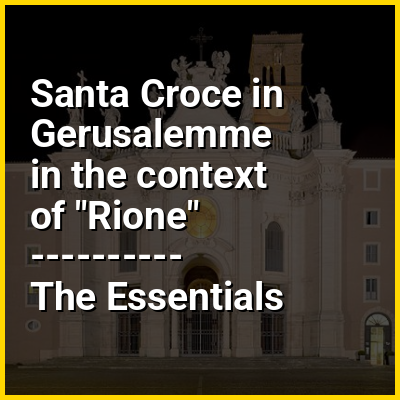
The Basilica of the Holy Cross in Jerusalem or Basilica di Santa Croce in Gerusalemme (Latin: Basilica Sanctae Crucis in Hierusalem) is a Catholic minor basilica and titular church in the rione of Esquilino, Rome, Italy. It is one of the Seven Pilgrim Churches of Rome.

According to Christian tradition, the basilica was consecrated circa 325 to house the relics of the Passion of Jesus Christ brought to Rome from the Holy Land by Empress Helena, mother of Roman Emperor Constantine I. The basilica's floor was supposed to be covered with a handfull of soil from Jerusalem, thus acquiring the title in Hierusalem; it is not dedicated to the Holy Cross of Jerusalem, but is considered in a sense to be in Jerusalem (much in the way that an embassy is considered extraterritorial). Between 1561 and 2011 it was the conventual church of an adjacent and now dissolved abbey of Cistercian monks whose aesthetic simplicity greatly influenced the basilica's interior. The church is now run directly by the Diocese of Rome. The current cardinal priest of the church is Juan José Omella.
↓ Menu

In this Dossier

Santa Croce in Gerusalemme in the context of Pope Marcellus II

Pope Marcellus II (Italian: Marcello II; 6 May 1501 – 1 May 1555), born Marcello Cervini degli Spannocchi, was head of the Catholic Church and ruler of the Papal States from 10 April 1555 to his death, 22 days later.

Marcellus succeeded Pope Julius III. Before his accession as pope he had been Cardinal-Priest of Santa Croce in Gerusalemme. He is the most recent pope to choose to retain his birth name as his regnal name upon his accession, and the most recent pope to date with the regnal name "Marcellus".

↑ Return to Menu

Santa Croce in Gerusalemme in the context of Aula Regia

An aula regia (lat. for "royal hall"), also referred to as a palas hall, is a name given to the great hall in an imperial (or governor's) palace in the Ancient Roman architecture and in the derived medieval audience halls of emperors, kings or bishops as part of their palaces (for example the German Kaiserpfalz – Imperial palace). In the Middle Ages the term was also used as a synonym for the Pfalz (palace) itself.

Architecturally, the medieval aulas followed the model of the ancient Roman audience halls in the imperial and governor's palaces such as the Aula regia in the Flavian Palace on the Palatine Hill in Rome, completed in 92 AD or the Aula Palatina in Trier, Germany, completed in 311 under Constantine the Great. This emperors's mother Helena lived in Rome in the Sessorium Palace; She had its smaller, hall-shaped aula converted into the church of Santa Croce in Gerusalemme for the relics she had brought with her from Jerusalem, while of the palace's larger civil basilica, built in the style of a three-aisled columned basilica, only the apse remains as a free-standing ruin.

↑ Return to Menu