Samburu people in the context of "Maasai people"

Play Trivia Questions online!

or

Skip to study material about Samburu people in the context of "Maasai people"


⭐ Core Definition: Samburu people

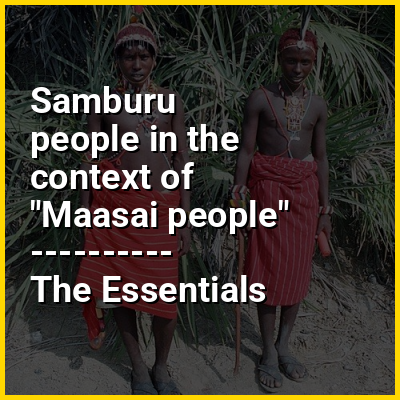
The Samburu are a Nilotic people of north-central Kenya. Traditionally, they are semi-nomadic pastoralists who primarily herd cattle but also keep sheep, goats and camels. They refer to themselves as Lokop or Loikop, a term with varied interpretations among the Samburu. Some believe it means "owners of the land" ("lo" meaning ownership and "nkop" meaning land) while others have different interpretations.

The Samburu speak the Samburu dialect of the Maa language, a Nilotic language which is also spoken by 22 other sub tribes of the Maa community commonly known as the Maasai. Some suggest that the Samburu are a distinct tribe separate from the Maasai, but this is not accepted by most Samburu as many refer to themselves and the Maasai collectively as Maa and celebrate their general shared culture and achievements.
↓ Menu

In this Dossier

Samburu people in the context of Maasai language

Maasai (previously spelled Masai) or Maa (English: /ˈmɑːs/ MAH-sye; autonym: ɔl Maa) is an Eastern Nilotic language spoken in Southern Kenya and Northern Tanzania by the Maasai people, numbering about 1.5 million. It is closely related to the other Maa varieties: Samburu (or Sampur), the language of the Samburu people of central Kenya, Chamus, spoken south and southeast of Lake Baringo (sometimes regarded as a dialect of Samburu); and Parakuyu of Tanzania. The Maasai, Samburu, il-Chamus and Parakuyu peoples are historically related and all refer to their language as ɔl Maa. Properly speaking, "Maa" refers to the language and the culture and "Maasai" refers to the people "who speak Maa".

↑ Return to Menu

Samburu people in the context of Samburu language

Samburu is a Maa language dialect spoken by Samburu pastoralists in northern Kenya. The Samburu number about 128,000 (or 147,000 including the Camus/Chamus). The Samburu dialect is closely related to the Camus dialect (88% to 94% lexical similarity) and to the South Maasai dialects (77% to 89% lexical similarity). The word "Samburu" itself may derive from the Maa word saamburr for a leather bag the Samburu use.

↑ Return to Menu

Samburu people in the context of Chamus language

The Ilchamus (sometimes spelled Iltiamus, also known as Njemps), are a Maa-speaking people living south and southeast of Lake Baringo, Kenya. They numbered approximately 32,949 people in 2019 and are closely related to the Samburu living more to the north-east in the Rift Valley Province. They are one of the smallest ethnic groups in Kenya.

In their oral traditions, the Ilchamus economy underwent a succession of elaborations: from foraging and fishing to a sophisticated system of irrigation, and then this was mixed with pastoralism under the influence of Samburu immigrants and neighbouring Maasai. These changes involved a series of embellishments in their culture and social organization. However, this evolving system did not survive the challenges of the capitalist economy in post-colonial Kenya, leading to a more polarized society with diminishing prospects for the majority of Ilchamus.

↑ Return to Menu