Salona in the context of "Julius Nepos"

Play Trivia Questions online!

or

Skip to study material about Salona in the context of "Julius Nepos"

Ad spacer

⭐ Core Definition: Salona

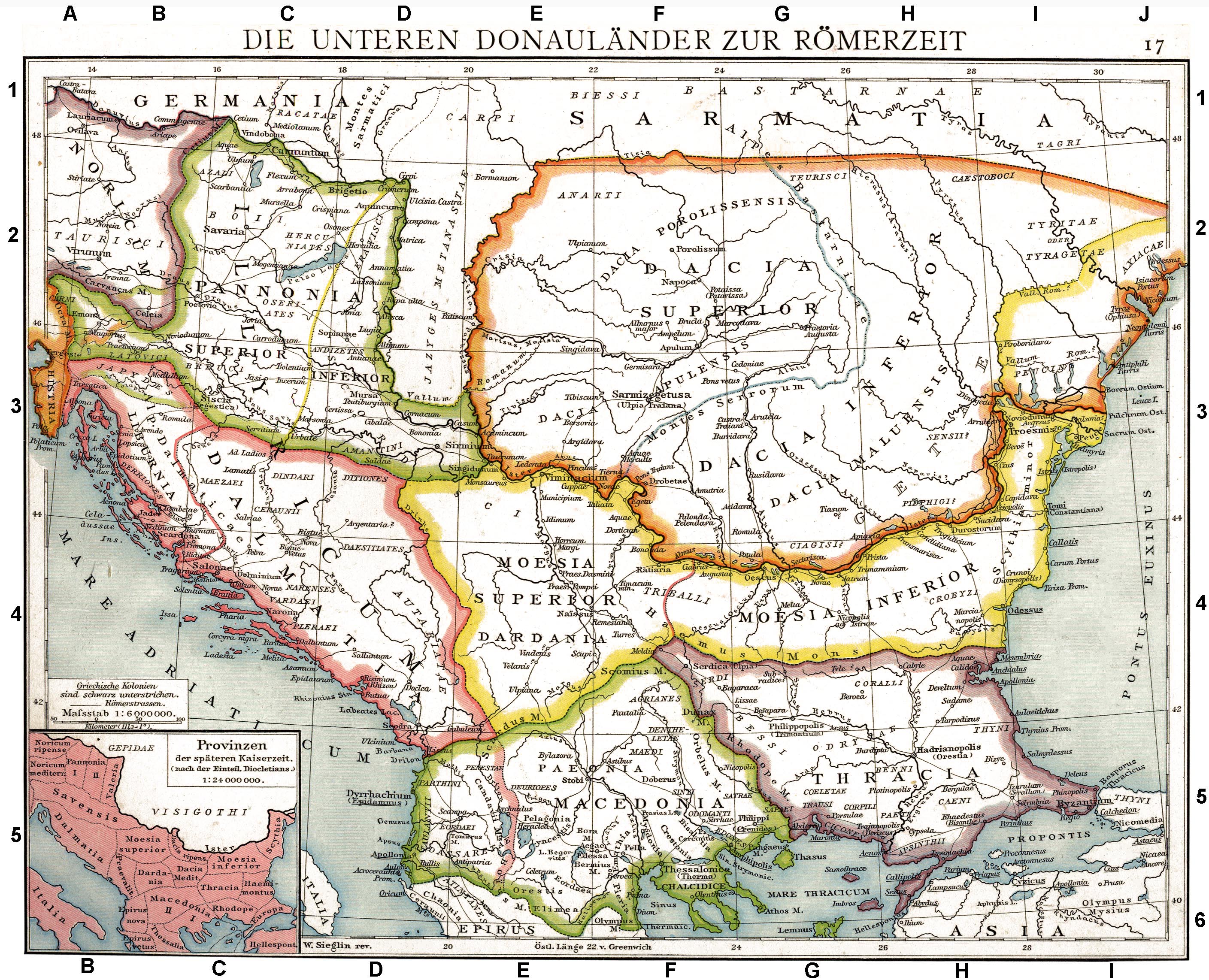
Salona (Ancient Greek: Σάλωνα, Latin: Salo) was an ancient city and the capital of the Roman province of Dalmatia and near to Split, in Croatia. It was one of the largest cities of the late Roman empire with 60,000 inhabitants. It was the last residence of the final western Roman Emperor Julius Nepos and acted as the de facto capital of the Western Roman Empire during the years 476-480.

Salona was founded in the 3rd century BC and was mostly destroyed in the invasions of the Avars and Slavs in the seventh century AD.

↓ Menu

>>>PUT SHARE BUTTONS HERE<<<
In this Dossier

Salona in the context of Split, Croatia

Split (/splɪt/; Croatian: [splît] , see other names) is the second-largest city of Croatia after the capital Zagreb. It is the largest city in Dalmatia, largest city on the Croatian coast, and the seat of the Split-Dalmatia County. The Split metropolitan area is home to about 330,000 people. It lies on the eastern shore of the Adriatic Sea and is spread over a central peninsula and its surroundings. An intraregional transport hub and popular tourist destination, the city is linked to the Adriatic islands and the Apennine Peninsula. More than 1 million tourists visit it each year.

The city was founded as the Greek colony of Aspálathos (Ancient Greek: Ἀσπάλαθος) in the 3rd or 2nd century BCE on the coast of the Illyrian Dalmatae, and in 305 CE, it became the site of the Palace of the Roman emperor Diocletian. It became a prominent settlement around 650 when it succeeded the ancient capital of the Roman province of Dalmatia, Salona. After the sack of Salona by the Avars and Slavs, the fortified Palace of Diocletian was settled by Roman refugees. Split became a Byzantine city. Later it drifted into the sphere of the Republic of Venice and the Kingdom of Croatia. For much of the High and Late Middle Ages, Split enjoyed autonomy as a free city of the Dalmatian city-states, caught in the middle of a struggle between Venice and Croatia for control over the Dalmatian cities.

↑ Return to Menu

Salona in the context of Illyricum (Roman province)

Illyricum /ɪˈlɪrɪkəm/ was a Roman province created by Augustus in 27 BC to secure the northeastern Adriatic frontier. It combined Upper Illyricum (Dalmatia) and Lower Illyricum (Pannonia) under a governor resident at Salona, administering coastal and Danubian territories across what are now Albania, Bosnia and Herzegovina, Croatia, Hungary, Kosovo, Montenegro, Serbia, and Slovenia. The province incorporated the rugged Dinaric Alps, the eastern Adriatic islands, and the fertile Pannonian Plain, bringing Roman civil and military institutions to long-established Illyrian, Celtic, and Hellenized communities.

The term Illyrians was used to describe the inhabitants of the area as far back as the late 6th century BC by Hecataeus of Miletus.

↑ Return to Menu

Salona in the context of Solin

Solin is a town and a suburb of Split, in Split-Dalmatia county, Croatia. It is situated right northeast of Split, on the Adriatic Sea and the river Jadro.

Solin developed on the location of ancient city of Salona, which was the capital of the Roman province of Dalmatia and the birthplace of Emperor Diocletian. After the arrival of Avars and Croats in the 7th-century, the town was destroyed, and its refugees moved to the settlement in and around Diocletian's palace, "Spalatum" (Split), turning it into a fortified town. In the Early Middle Ages, Solin was part of Croatian territory and played an important role in the Medieval Croatian state, being one of the political centres.

↑ Return to Menu

Salona in the context of Bijaći

Bijaći was a medieval Croatian village, some 5 kilometres (3.1 mi) northeast of Trogir. The village developed around the church of St. Martha on the site of a former 1st century villa rustica at Stombrate locality, about half way between Tragurium and Salona, in the hinterland of the Roman veterans' coastal settlement of Siculi [hr]. Renovated in late antiquity, part of the villa became an early Christian church, which evolved between the 5th and 7th centuries.

Following the arrival of the Croats, it is believed that the complex of the villa was transformed into the center of a Croatian ducal estate, which stretched to the coast, incorporating the Divulje area and the church of St. Vital. During this period, the early church was repaired and rededicated to St. Martha; arguably, the church was a court church of the early Croatian dukes.

↑ Return to Menu

Salona in the context of Bosna (river)

The Bosna (Serbian Cyrillic: Босна, pronounced [bɔ̂sna]) is the third longest river in Bosnia and Herzegovina, and is considered one of the country's three major internal rivers, along with the Neretva and the Vrbas. The other three major rivers of Bosnia and Herzegovina are the Una, to the northwest; the Sava, to the north, and the Drina, to the east. This river is the namesake of Bosnia. The river Bosna flows for 282 kilometers (175 mi).

The river is possibly mentioned for the first time during the 1st century AD by Roman historian Marcus Velleius Paterculus under the name Bathinus flumen. Another basic source that is associated with the hydronym Bathinus is the Salonitan inscription of the governor of Dalmatia, Publius Cornelius Dolabella, where it is said that the Bathinum river divides the Breuci from the Osseriates. Another name could also have been Basante.

↑ Return to Menu

Salona in the context of Diocletian's Palace

Diocletian's Palace (Croatian: Dioklecijanova palača, pronounced [diokletsijǎːnova pǎlatʃa]; Latin: Palatium Diocletiani) is an ancient Roman palace and fortress complex in Split, Croatia. It was built at the end of the third century AD by the Roman Emperor Diocletian as his retirement residence. About half of the complex was for Diocletian's personal use, with the rest housing the military garrison. The complex was built on a peninsula six kilometres (3.7 mi) southwest from Salona, the former capital of Dalmatia, one of the largest cities of the late empire with 60,000 people and the birthplace of Diocletian.

Today the palace forms about half of the old town of Split, with 3,000 inhabitants and numerous shops, boutiques, cafes, bars, and restaurants. In 1979, it was listed by UNESCO as a World Heritage Site.

↑ Return to Menu

Salona in the context of Roman–Dalmatae Wars

The Roman–Dalmatian wars were a series of conflicts between the Dalmatae (Delmatae) and the Romans. After the fall of the Ardiaei in southern Illyria, the Dalmatae were to pose the greatest resistance against the Romans in their conquest of Illyria.

The first confrontation in 156 BC – 155 BC finished with the destruction of the Dalmatian capital Delminium by the consul Scipio Nasica. The second war was fought in 118 BC, after the fall of the kingdom of Gentius in the south, apparently ending in a Roman victory as the consul L. Caecilius Metellus celebrated a triumph in 117 BC and assumed his surname "Delmaticus". The third conflict occurred between 78 BC – 76 BC and finished with the capture of the Dalmatian stronghold, Salona (port Solin near modern city Split) by the proconsul C. Cosconius.

↑ Return to Menu

Salona in the context of Split Archaeological Museum

The Split Archaeological Museum is the oldest museum in Croatia, established in 1820 by a decree of the Dalmatian government in Zadar. Some 150,000 artifacts cover prehistoric times, the period of Greek colonization of the Adriatic, Roman Provincial and Early Christian era to the early Middle Ages and the period of Croatian popular rulers. There is a collection of stone inscriptions from Salona and the collections of Graeco-Hellenistic ceramic objects, Roman glass, ancient clay lamps, bone, and metal articles, gems and coins.

The museum is housed at Zrinsko-Frankopanska 25 in Split. There is also a branch building in Solin (Salona and Tusculum ) and two regional centres at Vid near Metković (Narona Collection), and on the island of Vis.

↑ Return to Menu