SS Kaiser Wilhelm II in the context of "Transatlantic crossing"

Play Trivia Questions online!

or

Skip to study material about SS Kaiser Wilhelm II in the context of "Transatlantic crossing"


⭐ Core Definition: SS Kaiser Wilhelm II

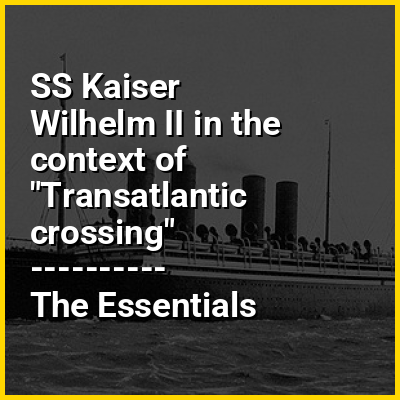
SS Kaiser Wilhelm II was a Norddeutscher Lloyd (NDL) Kaiser-class ocean liner. She was launched in 1902 in Stettin, Germany. In the First World War she was laid up in New York from 1914 until 1917, when the US Government seized her and renamed her USS Agamemnon. In 1919 she was decommissioned from the Navy and laid up. In 1927 she was transferred to the United States Army, who renamed her USAT Monticello. She was scrapped in 1940.

When launched, Kaiser Wilhelm II was the largest ship registered in Germany. The weight of her hull and machinery was surpassed only by the British White Star Liners RMS Cedric and Celtic. She served NDL's transatlantic route between Bremen and New York. She won the Blue Riband in 1904. Her passengers included the composers Gustav Mahler in 1910 and Jean Sibelius in 1914.
↓ Menu

In this Dossier

SS Kaiser Wilhelm II in the context of SS Kaiser Wilhelm der Grosse

Kaiser Wilhelm der Grosse ("Emperor William the Great") was a German transatlantic ocean liner in service from 1897 to 1914, when she was scuttled in battle. She was the largest ship in the world for a time, and held the Blue Riband for the fastest passenger liner crossing of the Atlantic Ocean, until Cunard Line’s RMS Lusitania entered service in 1907. The vessel’s career was relatively uneventful, despite a refit in 1913.

The liner was built in Stettin for Norddeutscher Lloyd, and entered service in 1897. She was the first liner to be a Four funnel liner and is considered to be the first "super liner." The first of four sister ships built between 1903 and 1907 for Norddeutscher Lloyd (the others being Kronprinz Wilhelm, Kaiser Wilhelm II and Kronprinzessin Cecilie), she marked the beginning of a change in the way maritime supremacy was demonstrated in Europe at the beginning of the 20th century.

↑ Return to Menu