SN 2005ap in the context of Type II supernova


SN 2005ap in the context of Type II supernova

SN 2005ap Study page number 1 of 1

Play TriviaQuestions Online!

or

Skip to study material about SN 2005ap in the context of "Type II supernova"


⭐ Core Definition: SN 2005ap

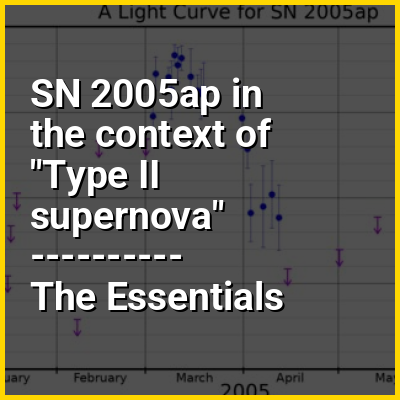
SN 2005ap was an extremely energetic Type Ic supernova in the galaxy SDSS J130115.12+274327.5. With a peak absolute magnitude of around −22.7, it is the second-brightest superluminous supernova yet recorded, twice as bright as the previous record holder, SN 2006gy, though SN 2005ap was eventually surpassed by ASASSN-15lh. It was initially classified as Type II-L, but later revised to Type Ic. It was discovered on 3 March 2005, on unfiltered optical images taken with the 0.45 m ROTSE-IIIb (Robotic Optical Transient Search Experiment) telescope, which is located at the McDonald Observatory in West Texas, by Robert Quimby, as part of the Texas Supernova Search that also discovered SN 2006gy. Although it was discovered before SN 2006gy, it was not recognized as being brighter until October 2007. As it occurred 4.7 billion light years from Earth, it was not visible to the naked eye.

Although SN 2005ap was twice as bright at its peak than SN 2006gy, it was not as energetic overall, as the former brightened and dimmed in a typical period of a few days whereas the latter remained very bright for many months. SN 2005ap was about 300 times brighter than normal for a Type II supernova. It has been speculated that this hypernova involved the formation of a quark star. Quimby has suggested that the hypernova is of a new type distinct from the standard Type II supernova, and his research group have identified five other supernovae similar to SN 2005ap and SCP 06F6, all of which were extremely bright and lacking in hydrogen.
↓ Menu
HINT:

In this Dossier

SN 2005ap in the context of SN 2006gy

SN 2006gy was an extremely energetic supernova, also referred to as a hypernova, that was discovered on September 18, 2006. It was first observed by Robert Quimby and P. Mondol, and then studied by several teams of astronomers using facilities that included the Chandra, Lick, and Keck Observatories. In May 2007, NASA and several of the astronomers announced the first detailed analyses of the supernova, describing it as the "brightest stellar explosion ever recorded". In October 2007, Quimby announced that SN 2005ap had broken SN 2006gy's record as the brightest-ever recorded supernova, and several subsequent discoveries are brighter still. Time magazine listed the discovery of SN 2006gy as third in its Top 10 Scientific Discoveries for 2007.

View the full Wikipedia page for SN 2006gy
↑ Return to Menu

SN 2005ap in the context of Robert Quimby

Robert M. Quimby (born September 9, 1976) is an American astronomer who received his Ph.D. in astronomy from the University of Texas at Austin. Prior to pursuing a career in astronomy, Robert Quimby was a member of the ska band Reel Big Fish, serving as a second trombonist.

As a lead member of the Texas Supernova Search (TSS), Quimby and his team used the relatively small 18-inch ROTSE-IIIb robotic telescope on McDonald Observatory's Mount Fowlkes, along with a program he designed to track supernovae. In 2005, Quimby discovered SN 2005ap, at this writing the brightest explosion ever recorded. Quimby measured the burst at 100 billion times the luminosity of the Sun, at a distance of 4.7 billion light-years. As a comparison, this supernova occurred about 160 million years before the formation of the Earth. Quimby continues his research at the California Institute of Technology in Pasadena, California.

View the full Wikipedia page for Robert Quimby
↑ Return to Menu