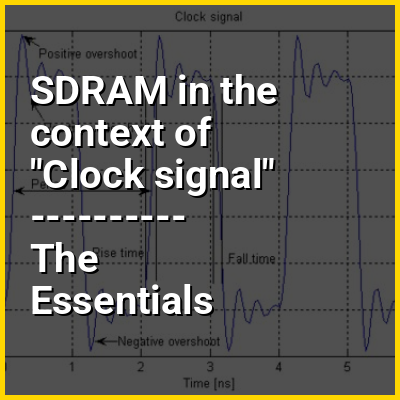
Synchronous dynamic random-access memory (synchronous dynamic RAM or SDRAM) is any DRAM where the operation of its external pin interface is coordinated by an externally supplied clock signal.
DRAM integrated circuits (ICs) produced from the early 1970s to the early 1990s used an asynchronous interface, in which input control signals have a direct effect on internal functions delayed only by the trip across its semiconductor pathways. SDRAM has a synchronous interface, whereby changes on control inputs are recognised after a rising edge of its clock input. In SDRAM families standardized by JEDEC, the clock signal controls the stepping of an internal finite-state machine that responds to incoming commands. These commands can be pipelined to improve performance, with previously started operations completing while new commands are received. The memory is divided into several equally sized but independent sections called banks, allowing the device to operate on a memory access command in each bank simultaneously and speed up access in an interleaved fashion. This allows SDRAMs to achieve greater concurrency and higher data transfer rates than asynchronous DRAMs could.