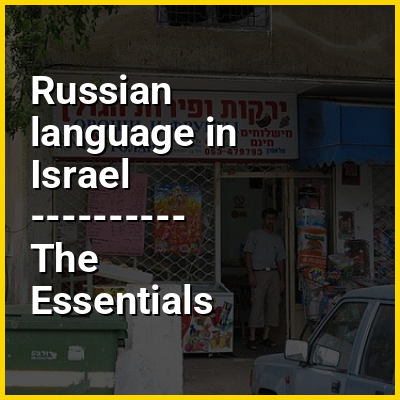
The Russian language is spoken natively by a considerable proportion of the population of Israel, mostly by immigrants who came from the former Soviet Union from 1989 onwards. It is a major foreign language in the country, and is used in many aspects of life. Russian is the third most common native language in Israel after Modern Hebrew and Arabic. Government institutions and businesses often also provide information and services in Russian, and has effectively become semi-official in some areas with high concentration of Russian-speaking immigrants. The Russian-speaking population of Israel is the world's third-largest population of Russian native-speakers living outside the former Soviet Union territories after Germany and the United States, and the highest as a proportion of the population. As of 2013, 1,231,003 residents of the Post-Soviet states have immigrated to Israel since the fall of the Soviet Union. As of 2017, there are up to 1.5 million Russian-speaking Israelis out of total population of 8,700,000 (17.25%).
- ⭐ Core Definition: Russian language in Israel
- Russian language in Israel in the context of Russian language
- Russian language in Israel in the context of Russian-language
Russian language in Israel in the context of Russian language
Russian is an East Slavic language belonging to the Balto-Slavic branch of the Indo-European language family. It is one of the four extant East Slavic languages, and is the native language of the Russians. It was the de facto and de jure official language of the former Soviet Union. Russian has remained an official language of the Russian Federation, Belarus, Kazakhstan, Kyrgyzstan, and Tajikistan, and is still commonly used as a lingua franca in Ukraine, Moldova, the Caucasus, Central Asia, and to a lesser extent in the Baltic states and Israel.
Russian has over 253 million total speakers worldwide. It is the most spoken native language in Europe, the most spoken Slavic language, and the most geographically widespread language of Eurasia. It is the world's seventh-most spoken language by number of native speakers, and the world's ninth-most spoken language by total number of speakers. Russian is one of two official languages aboard the International Space Station, one of the six official languages of the United Nations, as well as the fourth most widely used language on the Internet.
View the full Wikipedia page for Russian languageRussian language in Israel in the context of Russian-language
Russian is an East Slavic language belonging to the Balto-Slavic branch of the Indo-European language family. It is one of the four extant East Slavic languages, and is the native language of the Russians. It was the de facto and de jure official language of the former Soviet Union. Russian has remained an official language of the Russian Federation, Belarus, Kazakhstan, Kyrgyzstan, and Tajikistan, and is still commonly used as a lingua franca in Ukraine, Moldova, the Caucasus, Central Asia, and to a lesser extent in the Baltic states and Israel.
Russian has over 253 million total speakers worldwide. It is the most spoken native language in Europe, the most spoken Slavic language, and the most geographically widespread language of Eurasia. It is the world's seventh-most spoken language by number of native speakers, and the world's ninth-most spoken language by total number of speakers. Russian is one of two official languages aboard the International Space Station, one of the six official languages of the United Nations, as well as the seventh most widely used language on the Internet.
View the full Wikipedia page for Russian-language