Russian annexation of Crimea in the context of "Capture of the Crimean Parliament"

Play Trivia Questions online!

or

Skip to study material about Russian annexation of Crimea in the context of "Capture of the Crimean Parliament"

Ad spacer

⭐ Core Definition: Russian annexation of Crimea

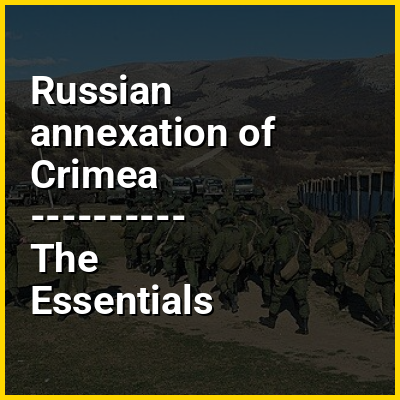
In February and March 2014, Russia invaded the Crimean Peninsula, part of Ukraine, and then annexed it. This took place in the relative power vacuum immediately following the Revolution of Dignity. It marked the beginning of the Russo-Ukrainian war.

The events in Kyiv that ousted Ukrainian president Viktor Yanukovych on 22 February 2014 sparked both pro-Russian and anti-separatism demonstrations in Crimea. At the same time, Russian president Vladimir Putin told his security chiefs to begin work on "returning Crimea to Russia". On 27 February, Russian special forces without insignia seized strategic sites across Crimea. Russia at first denied involvement, but Putin later admitted that they were Russian troops. As the armed men occupied Crimea's parliament, it dismissed the Crimean government, installed the pro-Russian Aksyonov government, and announced a referendum on Crimea's status. The referendum was held under Russian occupation and, according to the Russian-installed authorities, the result was overwhelmingly in favor of joining Russia. The next day, 17 March 2014, Crimea's authorities declared independence and requested to join Russia. Russia formally incorporated Crimea on 18 March 2014 as the Republic of Crimea and federal city of Sevastopol. Following the annexation, Russia militarized the peninsula and warned against any outside intervention.
↓ Menu

>>>PUT SHARE BUTTONS HERE<<<
In this Dossier

Russian annexation of Crimea in the context of Russian occupation of Crimea

On 27 February 2014, unmarked Russian soldiers were deployed to the Crimean Peninsula in order to wrest control of it from Ukraine, starting the Russo-Ukrainian War. This military occupation, which the Ukrainian government considers to have begun on 20 February laid the foundation for the Russian annexation of Crimea on 18 March 2014. Under Russia, the Ukrainian Autonomous Republic of Crimea was replaced by the Republic of Crimea, though the legitimacy of the latter is scarcely recognized internationally.

The occupation began during Ukraine's Revolution of Dignity, which ousted pro-Russian president Viktor Yanukovych. Russian special forces without insignia took control of Crimea's government buildings, surrounded Ukrainian military bases, and blockaded the peninsula. A pro-Russian government was installed and a referendum on Crimea's status was held under occupation. According to the Russian-installed authorities, the result was in favour of joining Russia. It annexed Crimea on 18 March 2014, re-organizing it as a Russian republic and turning Sevastopol into a Russian federal city.

↑ Return to Menu

Russian annexation of Crimea in the context of Timeline of the 2014 Crimean crisis

The Russian annexation of Crimea took place in the aftermath of the 2014 Ukrainian Revolution of Dignity. On 22–23 February, Russian President Vladimir Putin convened an all-night meeting with security services chiefs to discuss pullout of deposed President, Viktor Yanukovych, and at the end of that meeting Putin remarked that "we must start working on returning Crimea to Russia.". Russia sent in soldiers on February 27, 2014. Crimea held a referendum. According to official Russian and Crimean sources 95% voted to reunite with Russia. The legitimacy of the referendum has been questioned by the international community on both legal and procedural grounds.

↑ Return to Menu

Russian annexation of Crimea in the context of Plausible deniability

Plausible deniability is a social tactic that allows people to deny knowledge, participation, or an active role in carrying out an activity, relaying a loaded message, etc. The deniability exists due to a lack of culpable evidence, or more commonly, from multiple plausible intrepretations of the present evidence. Plausible deniablity is prime shield of defense against accountability, and forms the basis of covert attacks that make up human social behavior.

In a chain of command, senior officials can deny knowledge or responsibility for actions committed by or on behalf of members of their organizational hierarchy. They may do so because of a lack of evidence that can confirm their participation, even if they were personally involved in or at least willfully ignorant of the actions. If illegal or otherwise disreputable and unpopular activities become public, high-ranking officials may deny any awareness of such acts to insulate themselves and shift the blame onto the agents who carried out the acts, as they are confident that their doubters will be unable to prove otherwise. The lack of evidence to the contrary ostensibly makes the denial plausible (credible), but sometimes, it makes any accusations only unactionable.

↑ Return to Menu

Russian annexation of Crimea in the context of Mejlis of the Crimean Tatar People

The Mejlis of the Crimean Tatar People (Crimean Tatar: Qırımtatar Milliy Meclisi) is the single highest executive-representative body of the Crimean Tatars in the period between sessions of the Qurultay of the Crimean Tatar People. The Mejlis is a member institution of the Platform of European Memory and Conscience.

The Mejlis was outlawed by Russia in 2016 for "the use of propaganda of aggression and hatred towards Russia, inciting ethnic nationalism and extremism in society" and listed as an extremist organization two years after the 2014 Russian annexation of Crimea. In April 2017, the International Court of Justice delivered its order on the request for the indication of provisional measures, according to which Russia must lift the ban; Russia has since ignored and refused to comply with the Court's decision.

↑ Return to Menu