Route from the Varangians to the Greeks in the context of Kunya River


Route from the Varangians to the Greeks in the context of Kunya River

⭐ Core Definition: Route from the Varangians to the Greeks

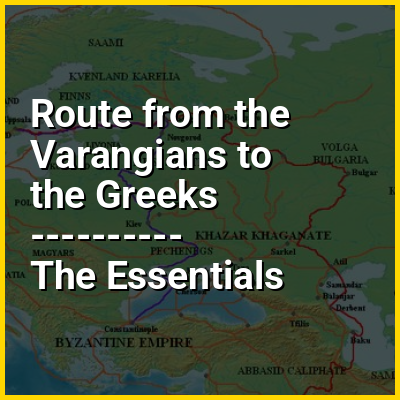
The trade route from the Varangians to the Greeks was a medieval trade route that connected Scandinavia, Kievan Rus' and the Eastern Roman Empire. The route allowed merchants along its length to establish a direct prosperous trade with the Empire, and prompted some of them to settle in the territories of present-day Belarus, Russia and Ukraine. The majority of the route comprised a long-distance waterway, including the Baltic Sea, several rivers flowing into the Baltic Sea, and rivers of the Dnieper river system, with portages on the drainage divides. An alternative route was along the Dniester river with stops on the western shore of Black Sea. These more specific sub-routes are sometimes referred to as the Dnieper trade route and Dniester trade route, respectively.

The route began in Scandinavian trading centers such as Birka, Hedeby, and Gotland, the eastern route crossed the Baltic Sea, entered the Gulf of Finland, and followed the Neva River into Lake Ladoga. Then it followed the Volkhov River upstream past the towns of Staraya Ladoga and Novgorod (where it met the Volga trade route and which became a major trade centre), crossed Lake Ilmen, and continued up the Lovat River, the Kunya River and possibly the Serezha River [ru]. From there, a portage led to the Toropa River [ru] and downstream to the Western Dvina River. From the Western Dvina, the ships went upstream along the Kasplya River and were portaged again to the Katynka River (near Katyn), a tributary of the Dnieper. It seems probable that once the route was established, the goods were unloaded onto land transport to cross the portage and reloaded onto other waiting ships on the Dnieper. Along the Dnieper, the route crossed several major rapids and passed through Kiev. After entering the Black Sea, it followed its west coast to Constantinople.
↓ Menu
HINT:

In this Dossier

Route from the Varangians to the Greeks in the context of Rus' people

The Rus', also known as Russes, were a people in early medieval Eastern Europe. The scholarly consensus holds that they were originally Norsemen, mainly originating from present-day Sweden, who settled and ruled along the river-routes between the Baltic and the Black Seas from around the 8th to 11th centuries AD.

The two original centres of the Rus' were Ladoga (Aldeigja), founded in the mid-8th century, and Rurikovo Gorodische (Holmr), founded in the mid-9th century. The two settlements were situated at opposite ends of the Volkhov River, between Lake Ilmen and Lake Ladoga, and the Norsemen likely called this territory Gardar. From there, the name of the Rus' was transferred to the Middle Dnieper, and the Rus' then moved eastward to where the Finnic tribes lived and southward to where the Slavs lived.

View the full Wikipedia page for Rus' people
↑ Return to Menu

Route from the Varangians to the Greeks in the context of Foreign trade of medieval Novgorod

The city of Novgorod was a major trade hub from the beginning of its history as part of Kievan Rus' through the years of the Novgorod Republic in the 12th–15th centuries. Novgorod benefitted from its location at the crossroads of several major trading routes, including the route from Scandinavia to the Byzantine Empire and the Volga route connecting Rus' to the Middle East. Novgorod had trade contact with inhabitants of the Baltic seaboard and was described as a "trade city" by Scandinavian merchants. Trade was eventually dominated by German cities united in the Hanseatic League, which had its easternmost office in Novgorod. Despite the thriving trade, Novgorod had numerous conflicts with the League. Moreover, its powerful commercial position also made it a prized target for Rus' princes of various competing branches, who sought to control Novgorod by attempted conquest, hindering its economy, or manipulating its politics.

The main exports of Novgorod were furs, honey, wax, leather and fish, while silver, cloth, wine, salt and herring were imported. Trade involved Novgorodians of different social status, including professional merchants, landowners, peasants and moneylenders. The center of trade in Novgorod was the Torg (Russian: торг, now archaic term for “marketplace”), located across the Volkhov from the Kremlin. The city's population grew from c. 10,000–15,000 in the early 11th century to c. 25,000 by the early 13th; a large city by that time's standards.

View the full Wikipedia page for Foreign trade of medieval Novgorod
↑ Return to Menu