Rolls-Royce Phantom V in the context of Coachbuilder


Rolls-Royce Phantom V in the context of Coachbuilder

Rolls-Royce Phantom V Study page number 1 of 1

Play TriviaQuestions Online!

or

Skip to study material about Rolls-Royce Phantom V in the context of "Coachbuilder"


⭐ Core Definition: Rolls-Royce Phantom V

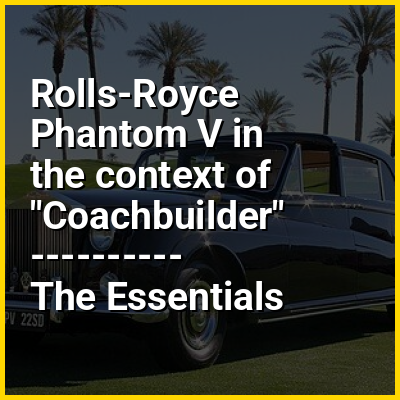
The Rolls-Royce Phantom V is a large four-door limousine produced by Rolls-Royce Limited from 1959 to 1968. Based on the Silver Cloud II, it shares a V8 engine and Rolls-Royce Hydramatic automatic gearbox (manufactured under license from General Motors by Rolls-Royce) with that model. Rolls-Royce built the cars' chassis and drivetrains, with bodies mainly made to standard designs by coachbuilders Park Ward, Mulliner Park Ward and James Young, former vendors absorbed by Rolls-Royce. Other coachbuilders, including Hooper, Henri Chapron and Woodall Nicholson, built one or two bodies each on Phantom V chassis.

The engine is a 6,230 cc 90-degree V8 with twin SU carburettors, coupled to a 4-speed automatic transmission. The car has massive drum brakes and a wheelbase of 3,683 mm. Power assisted steering was standard.
↓ Menu
HINT:

In this Dossier

Rolls-Royce Phantom V in the context of Luxury car

Although the concept of luxury cars has evolved over time, from the beginning of the 20th century to 2025. The definition of a luxury car is a passenger automobile built in limited series, with high-quality and cutting-edge materials, and therefore very expensive and intended for an elite clientele, very wealthy to afford it.

In short, a luxury car is an automobile not accessible for the masses. This classification excludes state vehicles: those of presidents, autocrats, dictators, etc. As such, they have technical specifications that go beyond the concept of a luxury car.

View the full Wikipedia page for Luxury car
↑ Return to Menu

Rolls-Royce Phantom V in the context of Luxury vehicle

A luxury car is a passenger automobile providing superior comfort levels, features, and equipment. More expensive materials and surface finishes are used, and buyers expect a correspondingly high build quality.

The term is relative and unavoidably subjective, reflecting both objective qualities of a car and the projected and perceived image of the vehicle's marque. Luxury brands rank above premium brands, though there is no clear distinction between the two.

View the full Wikipedia page for Luxury vehicle
↑ Return to Menu